


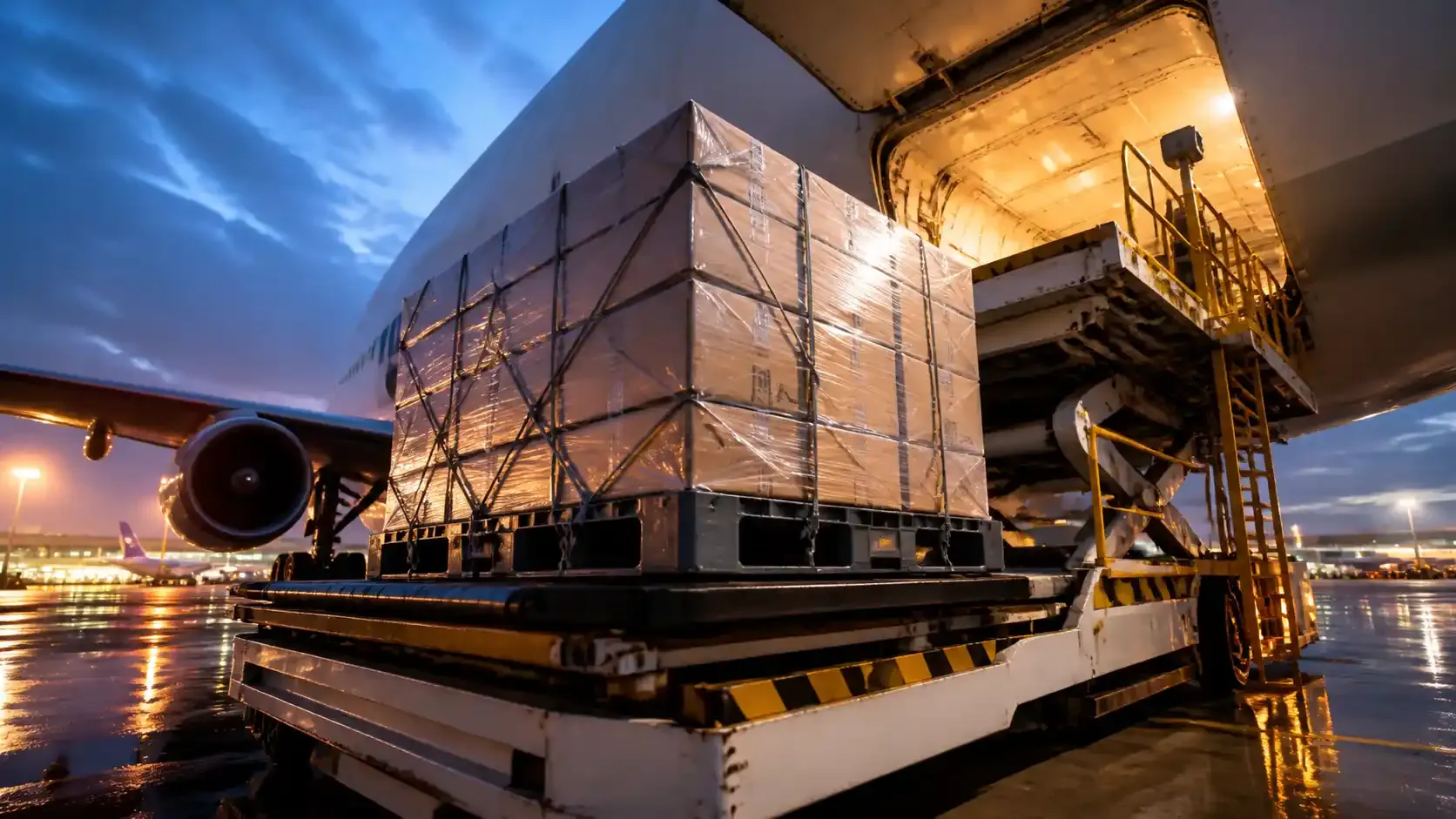
Rising air freight costs have made shipment weight a boardroom issue, not just a warehouse concern. Exporters often optimize carton dimensions, product packaging, and cargo consolidation, yet the pallet underneath the goods is still treated as a fixed cost of doing business. That assumption can be expensive. In air cargo, every kilogram assigned to packaging is a kilogram that may increase chargeable weight, reduce payload flexibility, or push a shipment closer to surcharge thresholds. Lightweight molded pallets address this overlooked cost driver by reducing non-revenue tare weight while supporting standardized handling, export preparation, and more efficient storage of empty pallets.
Why Pallet Weight Matters More in Air Freight
Air freight pricing is commonly influenced by chargeable weight, which compares actual weight with volumetric weight and applies the higher figure. For dense shipments such as electronics, machinery components, industrial parts, packaged consumer goods, or tightly stacked cartons, actual weight can become the controlling factor. In those cases, the pallet is not just a handling platform; it becomes part of the billable shipment mass.
This is why lightweight molded pallets are receiving closer attention from export logistics teams. A traditional pallet may look inexpensive at the purchasing stage, but its tare weight travels through the entire freight calculation. Across dozens or hundreds of pallet positions, extra pallet weight can translate into higher freight charges, lower usable payload, and less flexibility when carriers apply weight limits.
The issue is not only the cost of one pallet. It is the repeated cost of moving pallet weight through each international shipment. When air freight rates are elevated, reducing unnecessary pallet mass becomes one of the most direct ways to improve shipment economics without changing the product itself.
What Makes Lightweight Molded Pallets Different
Lightweight molded pallets are manufactured as a one-piece molded structure rather than assembled from multiple boards, blocks, and fasteners. In molded wood pallet production, recycled wood fibers or wood processing residues can be compressed under high temperature and pressure to form a stable logistics platform. This approach creates consistent dimensions and a predictable structure for material handling.
For buyers comparing pallet options, the main practical difference is that a molded wood pallet is engineered as a unified platform. It avoids many of the weight variations associated with traditional assembled wooden pallets, where moisture content, board thickness, component selection, and fasteners can all affect the final tare weight.
One-piece molded construction for dimensional consistency
Lower tare weight potential compared with heavier conventional pallet structures
No nails or separate joints in the molded body
Stable shape for palletized cargo handling
Nestable design for compact empty pallet storage
Export-oriented usability for international logistics workflows
These advantages make lightweight molded pallets especially relevant where the pallet is part of a repeated, high-volume export process rather than a one-time packaging afterthought.
Traditional Wooden Pallets Versus Molded Pallets in Air Cargo
The difference between traditional pallets and lightweight molded pallets becomes clearer when the full logistics workflow is considered. A heavier pallet may be acceptable in low-cost ground transport, but air cargo changes the calculation because the financial penalty of unnecessary weight is much higher.
| Evaluation Point | Traditional Wooden Pallets | Lightweight Molded Pallets |
|---|---|---|
| Structure | Assembled from boards, blocks, and fasteners | One-piece molded construction |
| Weight consistency | Can vary by material and assembly | More consistent from molded production |
| Empty storage | Typically occupies more space | Nestable when empty |
| Export preparation | May require additional treatment depending on destination rules | Commonly considered suitable for simplified export workflows |
| Handling compatibility | Depends on pallet quality and dimensions | Consistent geometry supports standardized handling |
| Air freight relevance | Higher tare weight may increase chargeable shipment mass | Lower tare weight can help reduce non-value shipping weight |
This comparison does not mean every shipment should automatically switch pallets. It means logistics teams should evaluate pallet weight as part of the freight cost structure, especially when shipments are dense, high-value, or routed by air.
The Cost Logic Behind Tare Weight Reduction
The business case for lightweight molded pallets is straightforward: air freight rewards weight discipline. If a shipment is billed by actual weight, reducing the pallet’s tare weight can directly reduce chargeable weight. If a shipment is near a carrier’s weight threshold, a lighter pallet may provide more room for product before reaching the limit.
Industry research has also highlighted the broader importance of lighter transport packaging. Studies on presswood and molded pallet alternatives frequently point to weight reduction as a practical advantage over conventional hardwood pallets. Separately, air cargo studies show that consolidation decisions, unit load limits, and freight rate structures can significantly influence the final cost of shipment planning.
Reduce non-value weight carried in every air shipment.
Improve payload allocation by shifting more of the allowed weight toward saleable goods.
Support better planning when shipments involve strict airline or forwarder weight limits.
A pallet does not generate revenue, but it consumes weight capacity. Lightweight molded pallets help reduce that imbalance.
Nestable Design Saves Space Before and After Loading
Weight is only one part of air freight efficiency. Space also matters, especially when empty pallets must be stored, repositioned, or prepared for repeated outbound shipments. Many molded pallet designs are nestable, meaning empty pallets can stack into one another rather than forming tall, bulky stacks.
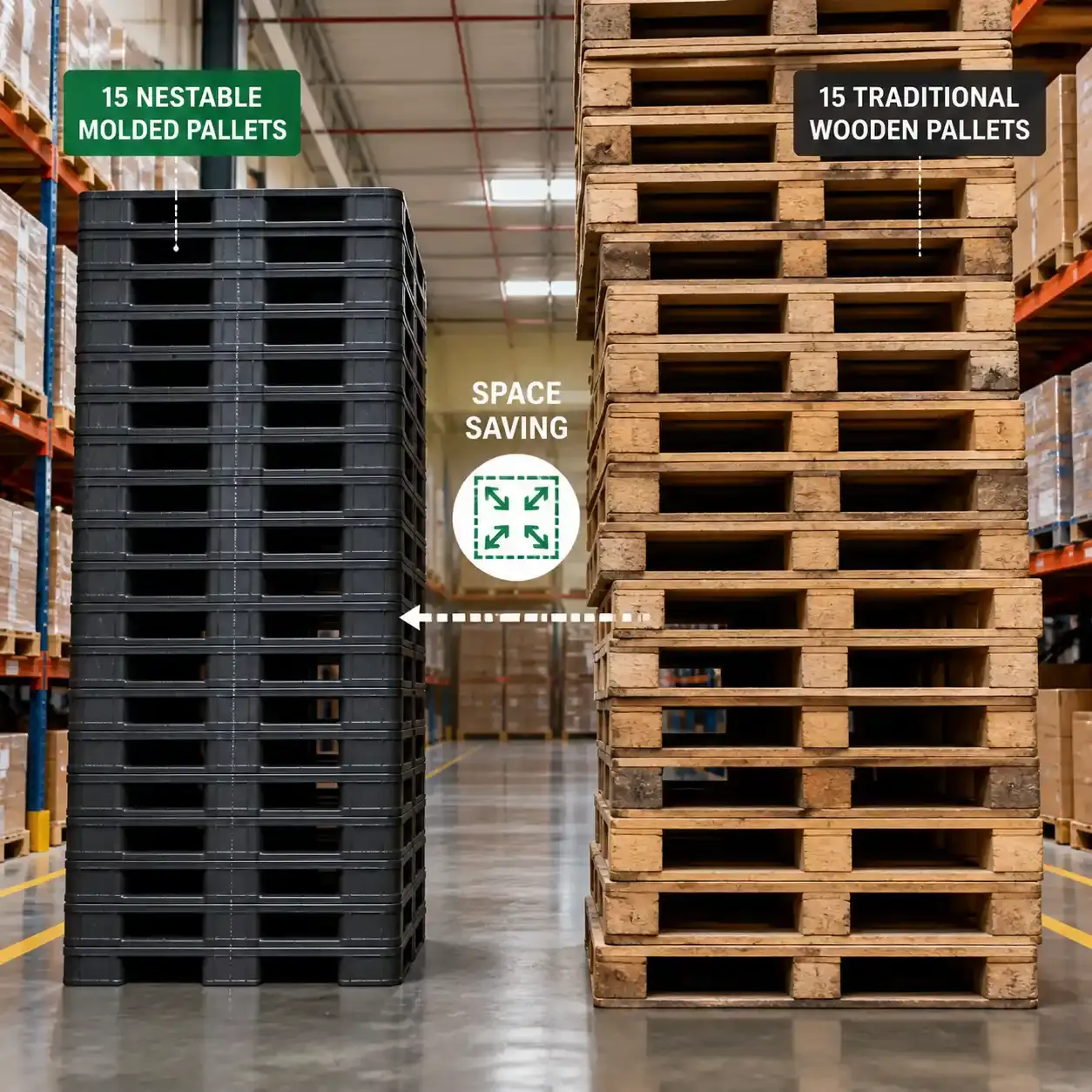
In warehouses and distribution centers, this can reduce the storage footprint for unused pallets. In return logistics, it can also improve the efficiency of moving empty pallets back through the supply chain. In export staging areas, the ability to store more empty pallets in less space helps keep loading zones cleaner and easier to manage.
The value of nesting is particularly visible in facilities that handle fast-moving cartonized goods. When pallets are prepared in batches, staged near loading docks, or transferred between warehouse zones, compact empty pallet storage supports smoother floor operations. Combined with lower tare weight, the nestable format strengthens the case for using lightweight molded pallets in air cargo programs where both kilograms and cubic space are tightly controlled.
Export Readiness and Compliance Planning
International logistics often brings additional requirements for wood packaging materials. Conventional solid wood pallets may need heat treatment, fumigation, or documentary checks depending on the destination and applicable phytosanitary rules. Delays at this stage can disrupt shipment schedules and create extra administrative work for exporters.
Molded wood pallets are made from processed wood materials and are commonly used in export logistics because this manufacturing approach can simplify treatment-related procedures in many shipping scenarios. Buyers still need to confirm the requirements of their destination market, carrier, and customs broker, but processed wood pallet solutions are often evaluated as a practical way to reduce compliance complexity.
For companies that export regularly, this can matter as much as pallet weight. A pallet choice that supports smoother customs preparation, predictable documentation, and consistent physical handling can reduce friction across the full shipment cycle. This is especially useful for businesses shipping through multiple air routes or serving customers in different regions.
Compatibility With Modern Warehouse Handling
Air freight shipments often move through several handling environments before reaching the final consignee: factory warehouse, forwarder facility, airport terminal, cargo build-up area, destination terminal, and local distribution point. Each transfer increases the importance of pallet consistency.
Lightweight molded pallets are produced with standardized molds, giving them consistent dimensions and geometry. This supports compatibility with forklifts, pallet stackers, conveyors, and automated handling environments. In modern logistics centers, predictable pallet dimensions help reduce interruptions caused by irregular pallet shape, damaged deck boards, or inconsistent entry points.
This is where palletization becomes more than a loading method. It becomes a controlled unitization strategy. When the pallet platform is stable and consistent, cartons can be arranged more reliably, handling teams can move goods faster, and automated systems can operate with fewer pallet-related disruptions.
When Lightweight Molded Pallets Deliver the Most Value
Lightweight molded pallets are most attractive when air freight costs are high and shipment weight is closely managed. They are also a strong fit for operations where empty pallet storage, export preparation, and standardized handling all affect total logistics cost.
Dense cargo billed mainly by actual weight
High-frequency export shipments using multiple pallet positions
Cartonized goods moving through warehouse and air cargo terminals
Export programs requiring predictable pallet dimensions
Facilities with limited empty pallet storage space
Supply chains that prefer nestable pallets for return or repositioning efficiency
Lightweight molded pallets may not be the only solution for every cargo type. Heavy industrial products, specialized racking requirements, and unique load profiles should be assessed carefully. Still, for many air cargo exporters, the pallet is one of the easiest components to review because it can reduce shipment weight without altering the goods being sold.
A Practical Checklist for Logistics Teams
Before switching to lightweight molded pallets, procurement and logistics teams should evaluate the decision with a complete cost view. The purchase price of the pallet is only one part of the calculation. Air freight impact, storage space, compliance preparation, handling reliability, and cargo protection all influence the real result.
Current pallet weight and its share of total shipment weight
Air freight billing method on key routes
Actual weight versus volumetric weight for typical cargo
Number of pallet positions per shipment
Empty pallet storage requirements
Export documentation and phytosanitary procedures
Compatibility with forklifts, conveyors, and pallet stackers
Cargo stability during warehouse transfers and long-distance transport
Whether wooden pallets are still the most cost-effective option for specific load conditions
This type of evaluation helps companies avoid focusing only on unit pallet price. In air freight, the lower-cost pallet at purchase may become the more expensive pallet once freight charges, storage, and export handling are included.
Why This Decision Is Becoming More Strategic
Air cargo is often used for urgent, high-value, seasonal, or time-sensitive shipments. In these lanes, cost pressure is intense, but delivery reliability remains critical. Lightweight molded pallets give exporters a practical way to remove unnecessary mass from the shipment while keeping the goods on a standardized logistics platform.
The shift is also part of a broader movement toward engineered packaging. Rather than relying only on conventional materials, logistics teams are selecting pallets based on measurable supply chain outcomes: tare weight, storage density, export readiness, equipment compatibility, and handling consistency.
For exporters facing persistent air freight surcharges, lightweight molded pallets are not just a packaging alternative. They are a cost-control lever. When every kilogram counts, reducing pallet weight can help companies protect margins, use air freight capacity more efficiently, and build a more disciplined international shipping process.
FAQs
How do lightweight molded pallets help reduce air freight costs?
They reduce the tare weight included in the shipment. When air freight is billed by actual weight, lowering pallet weight can reduce chargeable weight and help control freight surcharges.
Are lightweight molded pallets suitable for export shipments?
Molded wood pallets are made from processed wood materials and are commonly used in international logistics. Exporters should still confirm route-specific requirements with their freight forwarder or customs broker.
What is the main advantage of a nestable pallet design?
Nestable pallets stack into one another when empty, reducing storage space and improving efficiency when empty pallets are staged, returned, or repositioned.
Do lightweight molded pallets work with automated logistics systems?
Their standardized molded dimensions can support compatibility with conveyors, pallet stackers, and other warehouse handling equipment, depending on the specific pallet design and system requirements.
Should every air shipment use lightweight molded pallets?
Not necessarily. They are most valuable for dense, weight-sensitive, export-oriented cargo. Heavy-duty loads or special handling conditions should be evaluated case by case.


