


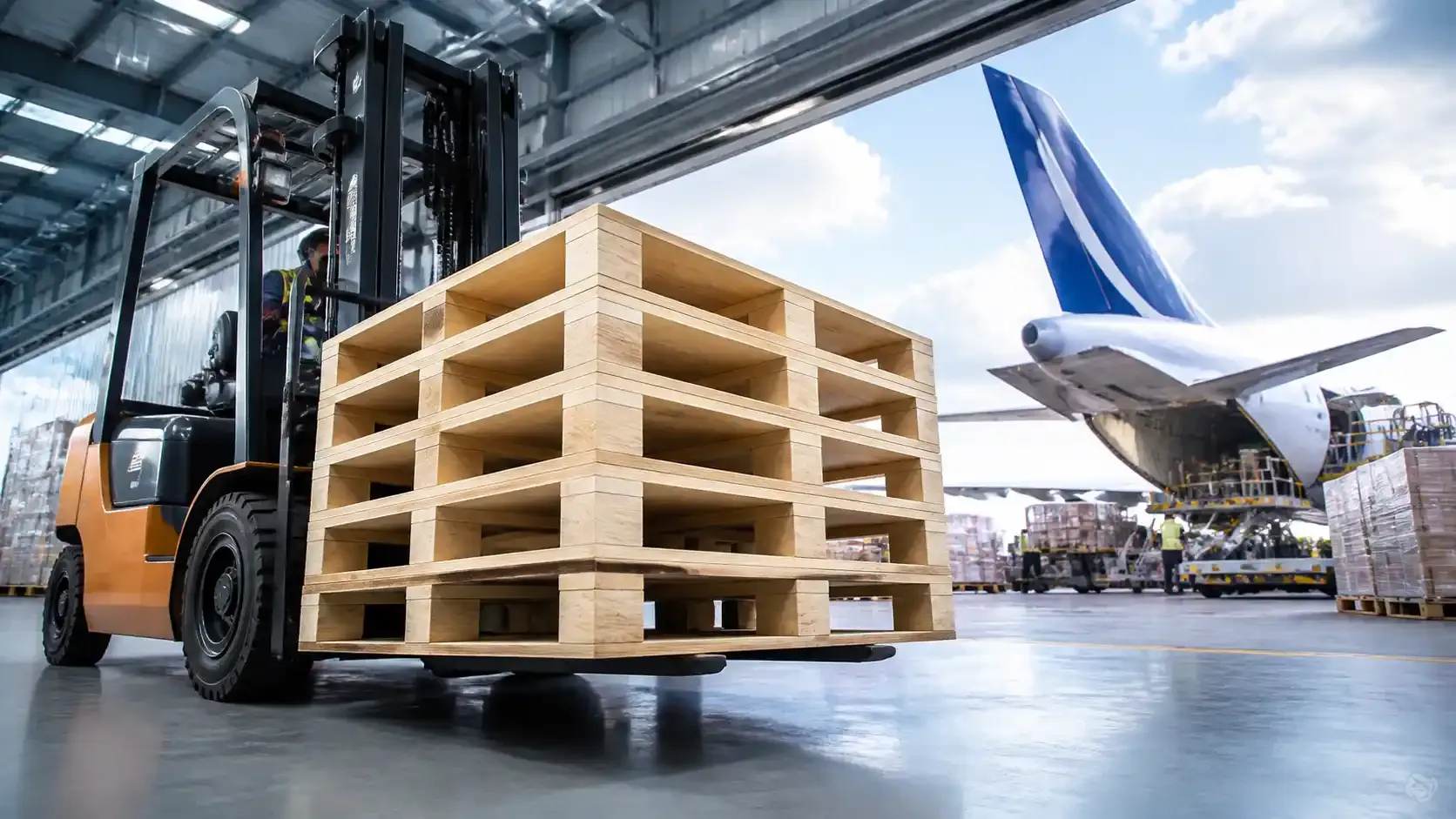
Freight prices may rise and fall, but pallet self-weight remains one of the few cost factors logistics buyers can control directly. For exporters moving goods by air, sea, or road, a lightweight plywood pallet can reduce non-revenue weight before the shipment even leaves the warehouse. Compared with traditional timber alternatives, plywood wooden pallets can reduce weight by approximately forty percent, with common equivalent pallet weights in the 12–20 kg range. That difference does not require a new carrier, route, or packing system; it starts with choosing a lighter, export-ready load platform.
Why Pallet Weight Becomes a Freight Cost Problem
In logistics, every kilogram attached to the pallet is weight that cannot be used for sellable product. This matters most in air freight, where chargeable weight can directly affect the invoice. It also matters in container shipping, where payload ceilings, loading plans, and gross weight declarations shape how efficiently cargo moves. Even in road transport, reducing unnecessary pallet weight can support easier handling and more efficient vehicle loading.
A lightweight plywood pallet addresses this issue at the packaging level. Instead of treating the pallet as a fixed expense, buyers can evaluate it as part of total landed cost. If a shipper moves hundreds or thousands of palletized loads over time, a moderate weight reduction per pallet can become a meaningful operational advantage.
What Makes Plywood Pallets Different From Solid Timber
A Shipping Plywood Pallet is engineered from processed plywood rather than assembled from conventional solid lumber. Its cross-laminated veneer construction helps create balanced strength, more consistent dimensions, and fewer natural irregularities such as knots or uneven grain behavior.
For export buyers, the practical value is clear. Plywood pallets combine light weight with a smooth, splinter-free deck that helps protect cartons, shrink wrap, protective films, and other packaging materials during handling. Their consistent dimensions also support reliable stacking in containers and warehouses, which is especially important for standardized export workflows and facilities using conveyors, palletizers, or forklift-based loading systems.
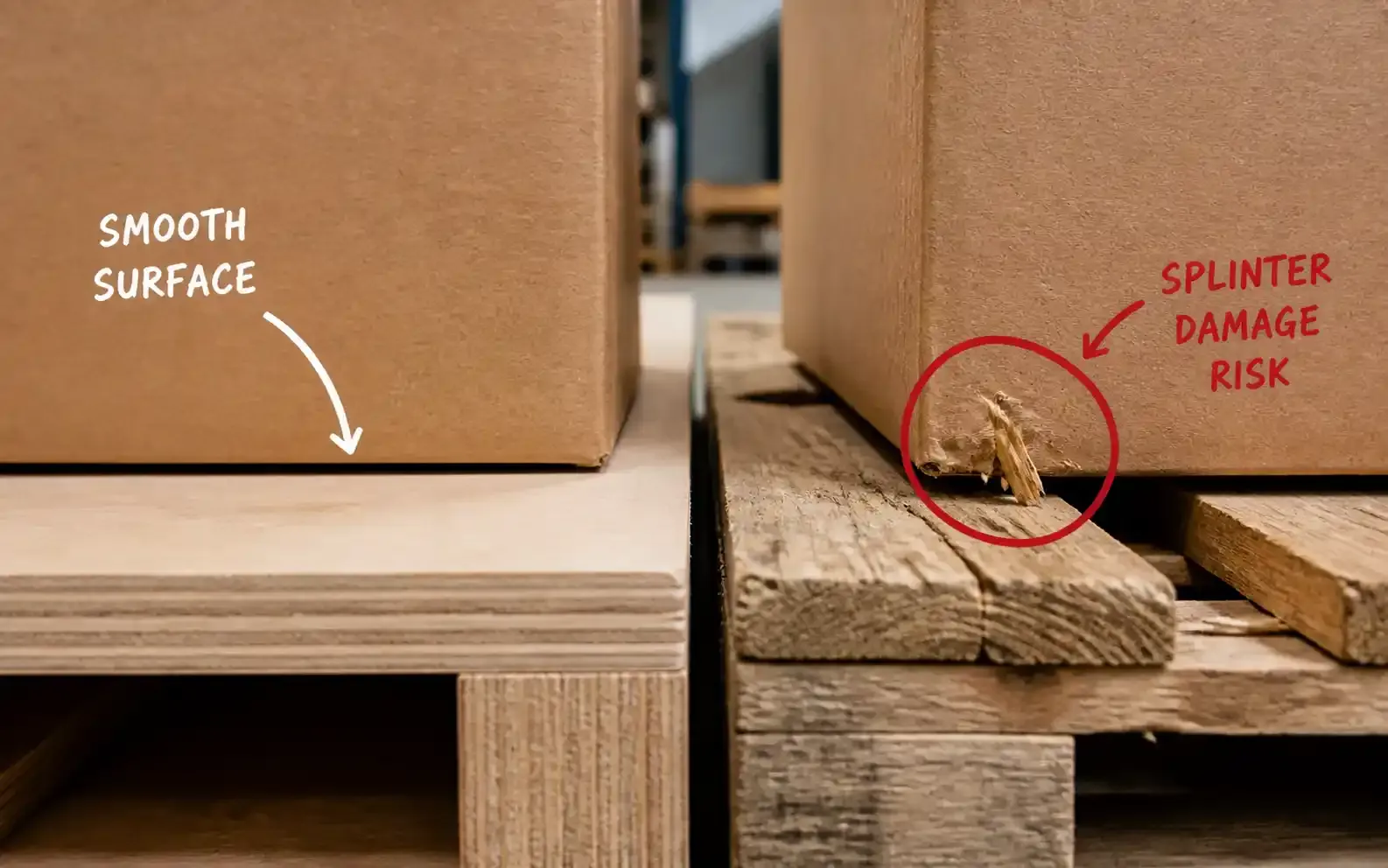
This smoother surface does more than improve appearance. It reduces the chance of snagging films, scratching carton bases, or introducing splinters into packaged goods areas. For exporters shipping consumer products, electronics, or boxed industrial components, these small handling details can improve packaging integrity and reduce rework during loading and unloading.
Export Readiness Without Fumigation Delays
Export packaging is not only about strength. It also has to pass through customs and phytosanitary controls without creating avoidable delays. Shipping plywood pallets are manufactured using heat-treated plywood and are described as ISPM 15 compliant for international export without requiring chemical fumigation.
That feature can simplify planning for companies that ship across borders regularly. Instead of coordinating additional fumigation steps for solid wood packaging, buyers can move export-ready pallets into the loading process with fewer treatment-related interruptions. For time-sensitive shipments, this can be just as valuable as the weight reduction itself.
Turning Weight Reduction Into Practical Savings
The most effective way to evaluate a lightweight plywood pallet is to look beyond the purchase price and consider the full logistics chain. A heavier pallet may appear economical at first, but it can increase chargeable weight, reduce payload flexibility, and make manual handling more difficult. A lighter engineered pallet shifts more of the shipment’s weight allowance toward actual cargo.
A simple procurement review can follow four steps:
| Review Step | What Buyers Should Check | Why It Matters |
|---|---|---|
| Current pallet weight | Compare existing timber pallet weight with plywood alternatives | Identifies avoidable dead weight |
| Transport mode | Separate air, ocean, road, and warehouse requirements | Shows where weight reduction has the strongest effect |
| Load requirement | Match pallet design to cargo weight and handling conditions | Prevents under-specification |
| Export workflow | Confirm ISPM 15 readiness and documentation needs | Reduces treatment and customs delays |
This approach keeps the decision grounded in real operations. The goal is not simply to buy the lightest pallet, but to select a pallet that reduces unnecessary weight while still supporting cargo protection, stacking, and handling performance.
Matching Pallet Type to Shipment Risk
Not every shipment needs the same pallet structure. Standard plywood pallets are suitable for many general export and international freight applications where light weight, clean surfaces, and dimensional consistency are priorities. When cargo is heavier or handling conditions are more demanding, Heavy Duty Plywood Pallets may be evaluated for applications requiring higher strength and durability.
For one-way export shipments where empty pallet storage and return logistics are key concerns, compressed or presswood designs can also be considered. A Compressed Pallet offers a nestable structure, fastener-free surface, and export-friendly handling characteristics, making it a practical alternative in certain high-volume logistics scenarios.
Engineering Features That Support Reliability
The strength of a lightweight plywood pallet comes from engineered construction rather than excess material. Plywood wooden pallets are described with multi-layer veneer architecture, commonly ranging from seven to fifteen layers. Alternating grain directions help distribute loads more evenly and reduce the inconsistency often found in solid wood.
Other construction details also matter. Kiln-dried veneer improves dimensional stability. Water-resistant bonding systems help maintain integrity in humid or marine environments. Reinforced entry points can extend service life where forklifts repeatedly engage the pallet. These details are important because weight reduction only creates value when the pallet still performs safely under real logistics conditions.
Buyer Checklist for Export Pallet Selection
Before replacing traditional timber pallets, procurement teams should review the shipment profile carefully. A lightweight plywood pallet is often attractive when freight weight is sensitive, cargo packaging needs a smooth deck, and international export compliance is a priority.
Key questions include:
Is the shipment billed mainly by weight, volume, or container space?
Does the cargo require a smooth, splinter-free surface?
Will the pallet enter automated warehouse or conveyor systems?
Is ISPM 15 compliance required for the destination market?
Should the pallet be designed for one-way export or repeated use?
Would reinforced corners or a heavy-duty structure better match the cargo?
These questions help buyers avoid a common mistake: choosing pallet type only by unit cost. For export logistics, pallet performance affects freight cost, cargo protection, loading efficiency, and customs readiness at the same time.
When a Lighter Pallet Becomes a Strategic Advantage
A pallet may look like a small part of the shipping bill, but its weight travels through every stage of the supply chain. It is lifted in the warehouse, counted in freight calculations, loaded into containers, moved across ports, and handled again at destination. Reducing that self-weight can improve efficiency without requiring major changes to the shipping network.
For exporters facing rising freight rates, the lightweight plywood pallet has become a practical cost-control tool. Its value comes from a combination of lower self-weight, export-ready compliance, smooth cargo-contact surfaces, and consistent manufacturing. In a market where logistics margins are under pressure, replacing unnecessary pallet weight with more usable cargo capacity is a straightforward way to improve total shipping economics.
FAQs
Are lightweight plywood pallets suitable for export shipping?
Yes. Shipping plywood pallets are described as ISPM 15 compliant for international export and do not require chemical fumigation, making them suitable for cross-border logistics workflows.
How much lighter can plywood wooden pallets be?
Plywood wooden pallets can reduce weight by approximately forty percent compared with traditional timber pallets, with equivalent pallets commonly weighing around 12–20 kg depending on design.
Do lighter plywood pallets still protect cargo?
Yes. Their smooth, splinter-free plywood deck helps reduce damage risks to cartons, shrink wrap, protective films, and packaged goods during handling and transit.
When should buyers choose heavy-duty plywood pallets?
Heavy-duty plywood pallets are better suited when cargo requires higher load-bearing capacity, stronger structural performance, or more demanding industrial handling conditions.
Are compressed pallets a substitute for plywood pallets?
They can be an alternative in certain logistics scenarios. Compressed pallets are especially useful when nestable storage, reduced return transport space, and a fastener-free surface are important.


