

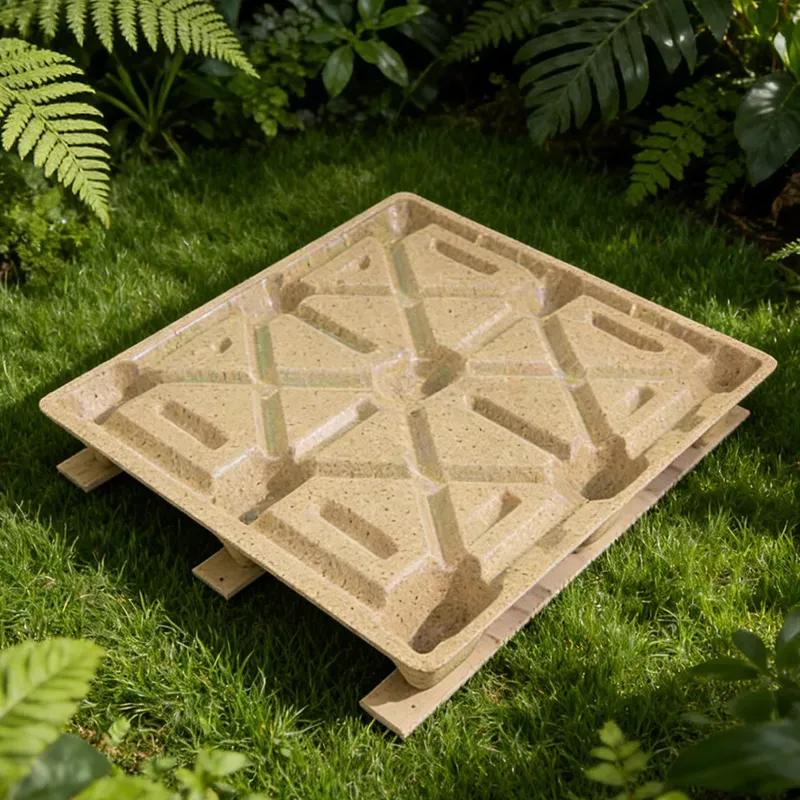
For decades, the global supply chain has relied almost exclusively on traditional wooden pallets to move goods from factories to warehouses to store shelves. But the logistics industry is undergoing a fundamental shift. Rising freight costs, tightening environmental regulations, and growing consumer demand for sustainable packaging have created space for a smarter alternative – the molded pallet.
A molded pallet is a shipping platform manufactured by combining reclaimed wood fibers with a resin binder under intense heat and pressure. The result is a one-piece, engineered product that delivers the same load-bearing function as traditional pallets while offering superior durability, space efficiency, and environmental benefits. Pressed molded pallets, also known as presswood pallets, are gaining rapid adoption across industries ranging from food and beverage to pharmaceuticals and automotive logistics.
This article explores why leading pallets manufacturers are shifting production toward molded pallets, how pressed molded pallets outperform traditional wood in every key metric, and why the molded pallet represents the future of sustainable, cost-effective logistics.
What Is a Molded Pallet? Understanding the Engineering Behind It
A molded pallet is fundamentally different from a traditional sawn-timber pallet. Rather than cutting and nailing together pieces of solid wood, pallets manufacturers use a high-pressure molding process that transforms wood waste – including sawdust, wood shavings, and agricultural residues – into a dense, homogeneous pallet structure.
The production process involves several key stages. Raw materials are first crushed and dried to remove excess moisture. They are then mixed with a resin binder and laid into a precision mold. The mold is subjected to extreme heat and pressure – typically 1250 to 1600 tons of pressing force – which fuses the materials into a solid, one-piece platform. The resulting molded pallet is dense, water-resistant, and completely free of nails, staples, or other metal fasteners.

Pressed molded pallets are classified as processed wood material under international phytosanitary standards. This classification brings a significant advantage: molded pallets are permanently exempt from ISPM 15 heat treatment or fumigation requirements. For exporters, this eliminates a major compliance cost and administrative burden, as no treatment certificates or IPPC stamps are needed for cross-border shipments.
Why Pallets Manufacturers Are Shifting to Molded Pallets
Leading pallets manufacturers have observed a clear trend: demand for molded pallets is growing faster than any other pallet type. There are several reasons for this shift.
Durability is a primary factor. Traditional wooden pallets have a breakage rate of twenty to thirty percent, while molded pallets have a breakage rate below five percent. This means that for every one hundred traditional pallets, twenty to thirty will require repair or replacement. In contrast, pressed molded pallets can withstand hundreds of cycles without structural degradation. This longevity directly reduces replacement costs and supply chain disruptions.
Consistency is another advantage. Traditional wood pallets vary in dimensions, moisture content, and strength due to natural wood variability. A molded pallet, however, is manufactured to precise tolerances, typically within plus or minus one millimeter. This uniformity is critical for automated warehousing systems, where even small deviations can cause jams, misreads, and downtime. Pallets manufacturers increasingly design molded pallets specifically for automation, ensuring seamless integration with conveyors, AGVs, and robotic handling equipment.
Space efficiency also favors the molded pallet. Pressed molded pallets are nestable – they stack inside one another when empty, reducing storage height by up to seventy percent. A stack of fifty molded pallets measures approximately 2.2 meters, compared to seven meters for the same number of traditional wood pallets. This nestability translates to lower warehouse overhead, higher storage density, and significantly cheaper return logistics for empty pallets.
Cost Comparison: Molded Pallet vs. Traditional Wood Pallet
While the upfront cost of a molded pallet may be slightly higher than a traditional wooden pallet – typically ranging from seven to eighteen dollars per unit – the total cost of ownership tells a different story.
First, replacement costs are dramatically lower. With a breakage rate below five percent, a molded pallet fleet requires far fewer replacements over the same period. For a mid-sized operation using ten thousand pallets annually, switching to molded pallets can reduce replacement spending from approximately twenty-five thousand dollars to five thousand dollars or less per year.
Second, freight savings are substantial. Pressed molded pallets are up to thirty percent lighter than hardwood pallets of comparable size. This weight reduction lowers shipping costs for both outbound goods and empty returns. Additionally, the nestable design allows more than three times as many molded pallets to fit in a standard shipping container compared to traditional wood pallets, further reducing per-unit transport expenses.
Third, compliance costs disappear entirely. Traditional wood pallets require ISPM 15 treatment, which can cost five to fifty dollars per pallet and involves customs delays of three days or more. A molded pallet, being processed wood, is exempt. This eliminates fumigation fees, certificate management, and the risk of customs holds.
Fourth, product damage is minimized. Traditional wood pallets have protruding nails that can puncture packaging. Pressed molded pallets have no nails or staples, reducing packaging damage rates by approximately eighteen percent. For businesses shipping bagged goods, drums, or sensitive products, this reduction alone can offset the initial cost difference.
When all these factors are combined, pallets manufacturers report that the ROI payback period for transitioning to molded pallets is typically under eighteen months. Some logistics companies have saved over two hundred eighty thousand dollars annually after switching.
Environmental Sustainability: The Green Advantage of Pressed Molded Pallets
Sustainability is no longer a niche concern – it is a business imperative. The molded pallet delivers exceptional environmental performance across its entire lifecycle.
Production of pressed molded pallets uses recycled wood waste that would otherwise end up in landfills or be burned. Leading pallets manufacturers achieve up to eighty-two percent recycled content in their molded pallet products. This reduces demand for virgin timber and supports circular economy principles.
Energy consumption in manufacturing is lower than for traditional wooden pallets, which require kiln drying and sawmilling. The molding process also produces minimal waste, as off-spec products can be ground up and reintroduced into the raw material stream.
At end of life, a molded pallet is fully recyclable. It can be chipped and reprocessed into new molded pallets or other wood-fiber products. This is a stark contrast to traditional wood pallets, which often end up in landfills or require energy-intensive incineration.
Under emerging carbon pricing mechanisms, molded pallets carry a significantly lower carbon footprint and associated tax exposure – estimated at approximately seventy cents per unit compared to two dollars fifty for traditional wood. For companies reporting under frameworks like the Carbon Disclosure Project or the EU's Corporate Sustainability Reporting Directive, the molded pallet offers a tangible pathway to improving environmental scores.
Applications Across Industries
Pressed molded pallets are versatile enough to serve a wide range of industries. In the food and beverage sector, their hygienic, nail-free design makes them ideal for transporting bagged goods, canned products, and bottled beverages. In pharmaceuticals, the absence of chemical treatments and consistent dimensions meet clean-room requirements. Automotive manufacturers use heavy-duty molded pallets for engine components and body panels. E-commerce and retail logistics benefit from the lightweight, nestable design that reduces shipping costs and warehouse space.
Even for one-way export shipments – where pallets are not returned – the molded pallet offers an increasingly attractive value proposition. Its ISPM 15 exemption eliminates the single biggest export compliance headache, while its lower weight and nestability reduce freight costs significantly compared to traditional wood.
How to Choose the Right Pallets Manufacturer for Molded Pallets
Selecting a reliable pallets manufacturer is critical to realizing the full benefits of molded pallets. Look for manufacturers with ISO certification, indicating quality management systems. Ask about customization options – the best pallets manufacturers offer tailored sizes, load ratings, and entry configurations (two-way or four-way) to match your specific requirements.
Evaluate the manufacturer's recycling and take-back programs. Many leading pallets manufacturers operate closed-loop systems, collecting used molded pallets for reprocessing into new products. This can reduce your disposal costs and strengthen your sustainability narrative.
Check for load capacity documentation. Reputable pallets manufacturers provide test reports showing static, dynamic, and racking load capacities. Typical molded pallets offer static loads up to six thousand kilograms, dynamic loads of fifteen hundred to twenty-five hundred kilograms, and racking loads of up to one thousand kilograms. For heavy-duty applications, some pressed molded pallets can handle even higher loads.
Finally, consider lead times and minimum order quantities. Some pallets manufacturers specialize in high-volume production, while others focus on low-volume, custom designs. Match your operational scale to their capabilities.
Conclusion: The Molded Pallet Is the Future
The molded pallet is not a niche product or a temporary trend. It is a proven, engineered solution that outperforms traditional wood pallets in durability, space efficiency, cost, compliance, and environmental impact. Leading pallets manufacturers are investing heavily in molded pallet production capacity, recognizing that the logistics industry is moving decisively toward this smarter platform.
Pressed molded pallets eliminate the hidden costs that plague traditional wood – breakage, fumigation, product damage, storage inefficiency, and carbon taxation. They deliver consistent performance in automated warehouses, reduce freight expenses, and support circular economy goals.
The question is no longer whether molded pallets work – they do. The question is whether your supply chain can afford to stick with outdated wooden pallets when a superior alternative is already available. The technology is mature, the savings are substantial, and pallets manufacturers are ready to guide your transition. Now is the time to make the smarter choice.


