

Automated warehousing is no longer a futuristic concept. From ASRS and AGVs to robotic pick-and-place systems, modern distribution centers rely on precision equipment that demands precision inputs. The humble pallet – once a simple wooden platform – has become a critical interface between human-operated logistics and fully automated material handling.
This shift has forced pallet manufacturers to fundamentally rethink how they design and optimize load capacity. Traditional wooden pallets, with their variable dimensions, protruding nails, and inconsistent structural performance, simply cannot keep pace with the tolerances required by automated systems. Enter the molded pallet – an engineered platform that combines consistent geometry, high strength-to-weight ratio, and predictable load-bearing performance.
This article examines how pallet manufacturers are optimizing molded pallet load capacity specifically for automated warehousing environments. We will explore the three critical load ratings that matter most in automation, the design innovations that enhance structural integrity, the testing standards that validate performance, and the real-world results that leading pallet manufacturers are achieving.
Why Automated Warehousing Demands a Different Approach to Load Capacity
Automated warehousing systems place unique stresses on pallets that traditional storage methods do not. In a conventional warehouse, pallets are moved by human-operated forklifts, stacked in static piles, and retrieved with relatively gentle handling. In an automated environment, the picture is entirely different.
AGVs and shuttle systems subject pallets to rapid acceleration and deceleration forces. Robotic arms grip pallets at precise points, requiring consistent edge strength. Conveyor systems roll pallets over long distances, demanding smooth underside surfaces and dimensional stability. High-bay racking systems store pallets at heights exceeding 40 meters, where even slight deflection can cause catastrophic failure-.
Pallet manufacturers have recognized that optimizing a molded pallet for automated warehousing requires addressing all three load capacity types simultaneously. Static load capacity determines how much weight a molded pallet can support while resting on a flat surface – critical for stacked storage. Dynamic load capacity governs performance during forklift or AGV transport. Racking load capacity – perhaps the most demanding specification – defines the weight a molded pallet can hold while suspended on rack beams with no support underneath-.
The Three Load Ratings That Pallet Manufacturers Are Optimizing
Leading pallet manufacturers focus their engineering efforts on three distinct load capacity metrics, each of which affects automated warehousing performance differently.
Static load capacity represents the foundation. Molded pallets typically achieve static load ratings of up to 6,000 kg (13,200 lbs), making them suitable for the heaviest warehouse storage application. Some reinforced designs push this even further – double-deck molded pallets can reach static loads exceeding 13,000 kg21. For pallet manufacturers serving automated warehouses, high static capacity ensures that stacked pallets remain stable and safe even at maximum storage density.
Dynamic load capacity is where the molded pallet truly differentiates itself from traditional alternatives. Molded pallets generally support between 1,500 kg and 2,500 kg (3,300–5,500 lbs) in dynamic loads, depending on size and material composition. More advanced designs achieve 2,500 lb dynamic load capacity while weighing just 45-55 lbs per unit – approximately 30% lighter than hardwood alternatives--. This weight reduction translates directly to longer AGV battery life, faster sortation speeds, and lower energy costs per task-.
Racking load capacity presents the greatest engineering challenge. Most molded pallets have a racking load capacity of up to 1,000 kg (2,200 lbs), though this varies based on design and reinforcement. Pallet manufacturers have responded with innovative solutions – reinforced rib designs, thicker molding, and structural features like bottom deck boards that increase strength across rack beams. Some suppliers now offer molded pressed pallet configurations with automated racking loads of 1,000 kg or more.
Design Innovations That Maximize Molded Pallet Load Capacity
Pallet manufacturers employ several engineering strategies to optimize molded pallet load capacity for automated systems.
Material composition is the first variable. Molded pallets are manufactured from wood fiber bonded with resins such as UF, MUF, or MDI23. The choice of resin directly affects strength, durability, and moisture resistance. High-pressure compression molding – typically applied at 1,000 tons of pressure – creates uniform density and structural stability that significantly enhances load-bearing capacity compared to traditional wooden pallets.
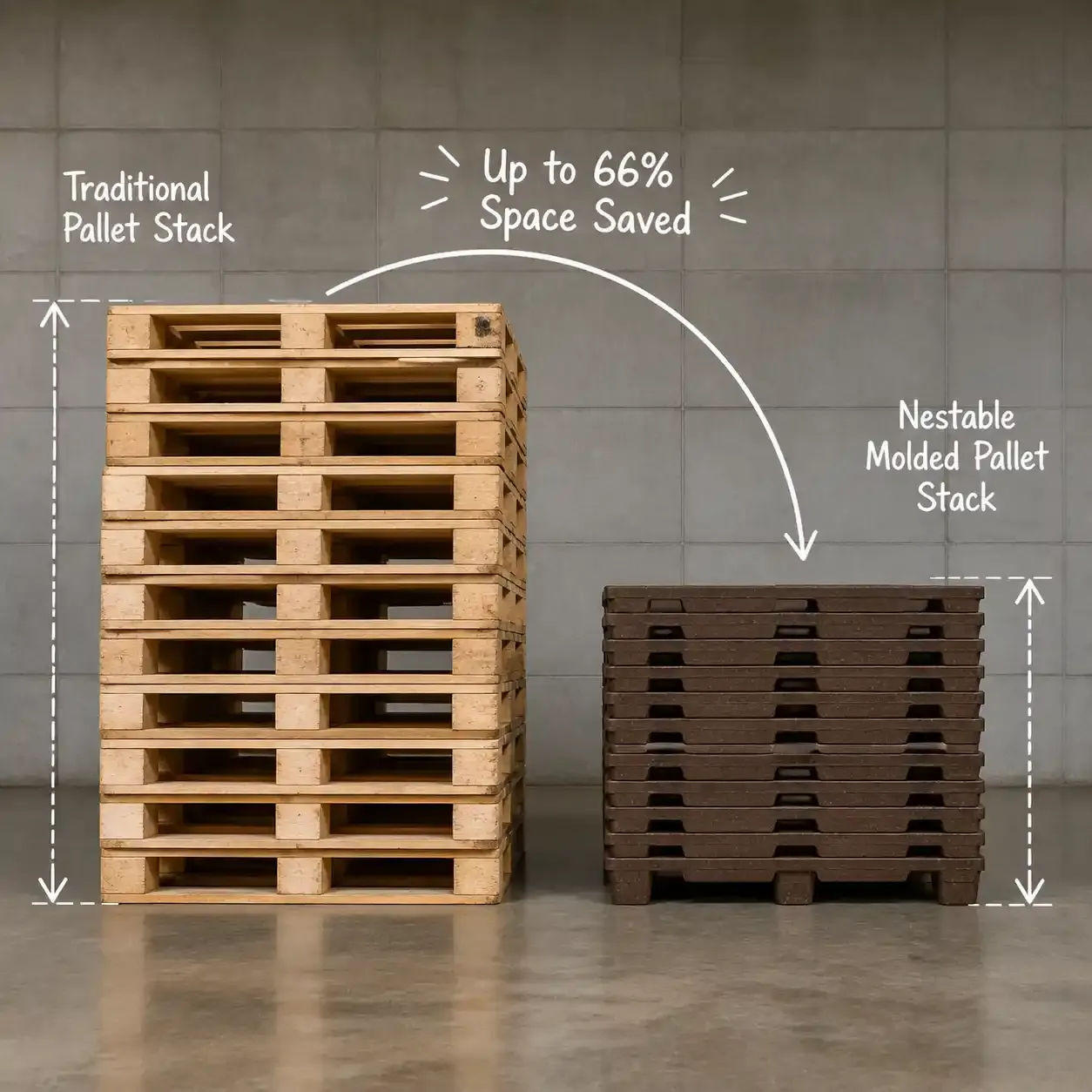
Structural design is equally critical. Pallet manufacturers have developed several configurations tailored to automated warehousing needs. Nestable pallets save space but may have slightly lower load capacities. Reinforced rib designs provide extra strength for racking applications. Thicker molding increases overall durability and weight tolerance-. Double-deck molded pallets, with two solid load-bearing surfaces, offer superior strength and stability for heavy-duty operations and racking systems.
Some pallet manufacturers have introduced dedicated rackable versions of their molded pallet products. These designs incorporate three bottom deck boards beneath the molded structure, increasing strength across rack beams and improving performance in conveyorized systems-. The reinforcement positions the molded pallet as suitable for rack-supported warehouse storage, conveyor-driven production lines, and high-volume bulk handling environments-22.
Dimensional precision is a third optimization area. Unlike variable-sized wooden platforms, molded pallets maintain consistent footprints – typically the GMA standard of 48 by 40 inches – with ±1 mm dimensional tolerance. This robotics-ready exactness allows seamless integration into automation, reducing alignment errors by 91%-3-.
Testing and Certification: How Pallet Manufacturers Validate Performance
Optimizing molded pallet load capacity is meaningless without rigorous testing to validate performance claims. Pallet manufacturers rely on established standards and independent testing to demonstrate that their products meet the demands of automated warehousing.
ASTM D1185 provides the framework for evaluating pallet performance in materials handling and shipping-. These test methods measure the relative resistance of pallets to deformations, damages, and structural failures that affect the functionality of the unit load-. Testing includes bending stiffness evaluations with specific yield strength and deflection limits-.
Some pallet manufacturers go beyond standard testing. Independent research has shown that pressed wood pallets can outperform both new and repaired traditional wood pallets in strength and stiffness metrics. Testing conducted with university research centers has found that molded platforms demonstrate higher durability and approximately twice the stiffness in comparative testing-
ISO 8611 certification provides additional validation for automated warehousing applications, particularly for stacking capacity and dimensional tolerance-1. Pallet manufacturers that achieve these certifications give warehouse operators confidence that their molded pallet will perform reliably in high-density, automated storage environments.
Real-World Results from Leading Pallet Manufacturers
The optimization efforts of pallet manufacturers are delivering measurable results in actual automated warehousing operations.
Major logistics providers have documented significant improvements after switching to molded pallets. DHL reported that implementing presswood pallets reduced annual energy costs by $217,000 at one facility-3. Amazon’s smart warehouses achieved 89% fewer misplacements, $4.2 million in annual labor cost savings, and 65% higher storage density after adopting presswood pallets-1. Walmart reported that molded pallet adoption reduced holiday season errors by 210,000 cases-1.
The durability advantages are equally compelling. Molded wood pallets withstand 1,200 or more automation cycles compared to 400-600 for standard wood platforms-3. Their compressed layered construction resists forklift impact damage with an 83% reduction, moisture warping with 92% less than wood, and UV degradation 50% slower than plastics-. Walmart’s automated Texas distribution center reported 78% fewer pallet-related jams after switching to presswood pallets-3.
Pallet manufacturers also emphasize the total cost of ownership advantages. AutoStore systems achieve full payback 11 months sooner with molded pallets, and the combination of durability with automation compatibility delivers 17% lower total cost of ownership-. Procter & Gamble’s automated Ohio plant reduced pallet-related downtime by 62% using presswood pallets-
The Role of Pallet Manufacturers in Future-Proofing Automation
As warehouse automation continues to grow, pallet manufacturers are positioning the molded pallet as the foundation for next-generation systems. With 84% of Fortune 500 logistics teams now specifying presswood pallets for automation projects, the trend is unmistakable-.
Pallet manufacturers are designing molded pallets to support emerging technologies including AI-powered inventory drones, 3D shuttle storage systems, and blockchain-tracked shipments-. The precision-engineered design of the molded pallet provides the technical foundation these systems require – consistent dimensions, predictable load behavior, and seamless integration with automated handling equipment.
For warehouse operators evaluating their pallet strategy, the message from pallet manufacturers is clear. The molded pallet is not just an alternative to traditional wood – it is an essential enabler of automated warehousing efficiency. By optimizing load capacity through material science, structural design, and rigorous testing, pallet manufacturers have transformed the molded pallet from a simple shipping platform into a precision logistics tool.
Conclusion: The Optimized Molded Pallet Is Here
Pallet manufacturers have made remarkable progress in optimizing molded pallet load capacity for automated warehousing systems. Through careful attention to material composition, structural design, dimensional precision, and rigorous testing, they have created a platform that meets the exacting demands of modern logistics.
The molded pallet delivers static loads up to 6,000 kg, dynamic loads of 1,500-2,500 kg, and racking loads of 1,000 kg or more – all while weighing 30% less than hardwood alternatives and maintaining ±1 mm dimensional tolerance. These specifications translate directly to measurable operational improvements: faster robotic handling, lower energy costs, fewer jams, and higher storage density.
For warehouse operators transitioning to automation, or those seeking to optimize existing automated systems, the engineered molded pallet represents a strategic investment. The technology is proven, the results are documented, and pallet manufacturers are ready to provide solutions tailored to specific operational requirements.
The question is no longer whether molded pallets belong in automated warehouses. They already do – and pallet manufacturers are continuing to push the boundaries of what these engineered platforms can achieve.


