

Exporting heavy machinery parts is one of the most demanding logistics operations in global trade. A single engine block, industrial pump, or precision CNC component can weigh several tons and carry a price tag of hundreds of thousands of dollars. When something goes wrong during shipping—a pallet collapses, cargo shifts, or customs holds a container—the financial consequences are devastating.
For decades, exporters had little choice but to rely on traditional wooden pallets. But these nailed-together platforms were never designed for the extreme point loads, ocean moisture, and regulatory scrutiny that accompany heavy machinery exports. Today, a superior alternative has emerged. The molded pallet is engineered specifically for the challenges of heavy-duty international shipping. Leading pallet manufacturers have refined the technology to deliver exceptional strength, compliance, and cost efficiency.
This article presents five compelling reasons why the molded pallet has become the preferred export pallet for heavy machinery parts, backed by real-world performance data and industry case studies.

Reason One: Superior Load-Bearing Capacity for Extreme Point Loads
Heavy machinery parts rarely distribute their weight evenly across a pallet surface. A metal base plate, a protruding flange, or an uneven casting can concentrate thousands of pounds of force onto a single square inch. Traditional wooden pallets, with their nailed-together deck boards, simply cannot withstand these extreme point loads. The result is cracked boards, collapsed pallets, and damaged equipment.
The molded pallet solves this problem through engineering. Manufactured under high temperature and extreme pressure—often using 1600-ton hydraulic presses—the molded pallet features a one-piece, homogenous construction with no nails, staples, or weak joints. This dense, fiber-reinforced structure distributes point loads across the entire pallet surface, eliminating the stress concentrations that cause traditional pallets to fail.
The performance difference is dramatic. While a standard wooden pallet typically has a dynamic load capacity of approximately 2,000 to 3,000 pounds, a heavy-duty molded pallet can handle up to 5,500 pounds with zero flexing. Some advanced molded pallet configurations achieve dynamic load capacities of 8,000 kilograms—more than three times higher than traditional wood pallets. Static load capacities can exceed 15,000 pounds, making the molded pallet suitable for even the heaviest machinery components.
For exporters shipping equipment weighing 1,000 kilograms or more, a traditional wooden pallet with an 800-kilogram capacity is at high risk of breaking. The molded pallet, with its typical load capacity exceeding 2,000 kilograms, ensures heavy goods are fully supported throughout the journey. This prevents transportation accidents and the costly damages that follow.
Reason Two: Permanent ISPM 15 Exemption – No Fumigation, No Delays
For exporters of heavy machinery, customs delays are a nightmare. Every day a container sits at port incurs demurrage fees that can exceed $1,000 per day. Traditional wooden pallets require ISPM 15 heat treatment or chemical fumigation before they can cross international borders. These treatments add costs, create administrative burdens, and introduce the risk of faded or missing stamps that can trigger customs holds.
The molded pallet eliminates this entire compliance headache. Because it is manufactured under temperatures exceeding 220 degrees Celsius—far above the ISPM 15 threshold of 56 degrees Celsius—the molded pallet is globally recognized as processed wood. This classification makes it permanently exempt from fumigation, heat treatment, and IPPC stamping requirements.
The operational benefits are immediate. Pressed wood pallet shipments achieve clearance rates above 99 percent with average processing times of just minutes, compared to days for traditional wood pallets. The inspection rate for molded pallets is a fraction of that for solid wood. For exporters shipping to the European Union, United States, Australia, Japan, and other major markets, the molded pallet eliminates the single biggest source of customs uncertainty.
A leading pallet manufacturer reports that their molded pallets are accepted at customs worldwide with only a material declaration—no additional documentation required. This is not a temporary exemption but a permanent classification based on the manufacturing process itself. For heavy machinery exporters, this means predictable transit times, lower demurrage risk, and fewer shipping delays.
Reason Three: Lightweight Construction and Nestable Design Slash Freight Costs
Shipping heavy machinery is expensive. Every kilogram counts, and every cubic meter of container space represents revenue. The molded pallet delivers significant advantages on both fronts.
First, the molded pallet is substantially lighter than traditional alternatives. A typical molded pallet weighs approximately 18 kilograms, compared to 25 kilograms for a comparable wooden pallet. This 30 percent weight reduction translates directly to lower freight costs. For a shipment of 10,000 pallets, the weight savings alone can reduce fuel consumption by over 1,200 kilograms. For air freight, the savings per kilogram are even more pronounced.
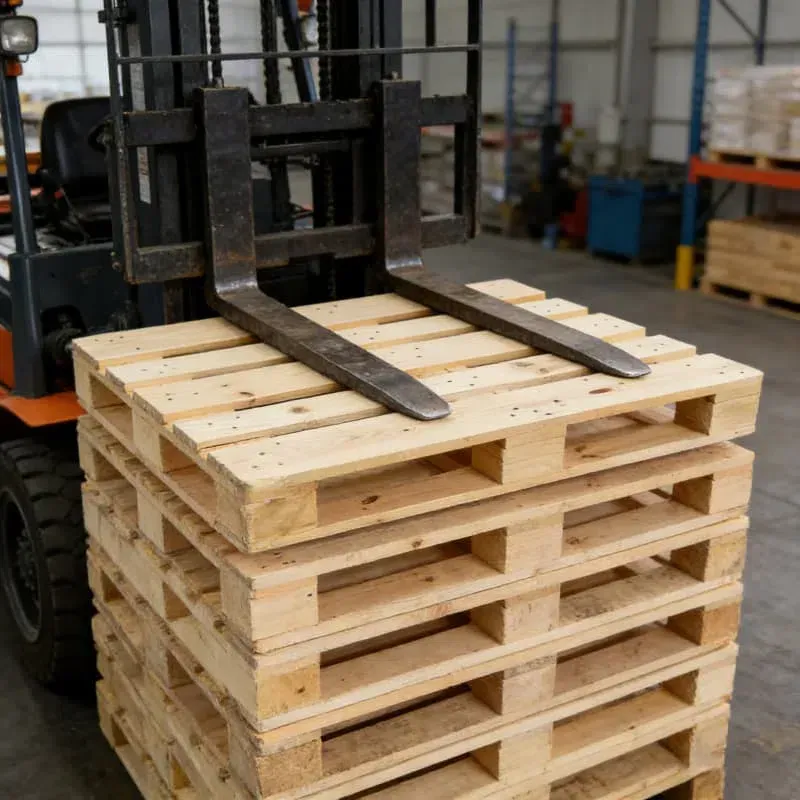
Second, the molded pallet is nestable. Empty molded pallets stack inside one another, dramatically reducing storage height. A stack of 65 molded pallets measures approximately 2.4 meters high, compared to over 7 meters for the same number of traditional wooden pallets. This nestability delivers two major benefits. In warehouse storage, it frees up valuable floor space for active inventory. In return logistics, it allows more than three times as many empty pallets to fit in a shipping container.
The freight density advantage is remarkable. A standard 40-foot container can hold approximately 1,650 molded pallets, compared to just 450 traditional wooden pallets. This 3.6-fold increase in transport density slashes per-unit shipping costs by nearly 60 percent. For exporters shipping large volumes of heavy machinery parts, this translates to millions of dollars in annual savings.
Some molded pallet configurations achieve up to 75 percent space savings in storage and transport, further amplifying the cost benefits. The combination of lighter weight and higher density makes the molded pallet the most freight-efficient option for heavy machinery exports.
Reason Four: Exceptional Durability and Moisture Resistance for Ocean Transit
Heavy machinery parts often travel for weeks across oceans, exposed to temperature swings, high humidity, and salt-laden air. Traditional wooden pallets absorb moisture during these voyages, leading to swelling, warping, mold growth, and structural weakening. When a pallet weakens mid-transit, the results can be catastrophic for expensive equipment.
The molded pallet is engineered to withstand these harsh conditions. Its high-density, resin-bonded structure provides superior water resistance. Premium molded pallets use MDI adhesive, which forms a highly resilient polyurethane molecular chain that repels moisture far better than traditional urea-formaldehyde binders. The result is a pallet that maintains its structural integrity even after prolonged exposure to ocean humidity.
The durability extends beyond moisture resistance. The molded pallet resists deformation under heavy loads, maintains its shape across hundreds of cycles, and does not splinter or warp over time. Performance data shows that molded pallets have a deformation rate of just 0.3 percent under heavy loads, compared to 12 percent for traditional wood pallets. This dimensional stability is critical for heavy machinery, where even slight pallet flexing can shift equipment and cause damage.
Leading pallet manufacturers have designed molded pallets to operate reliably in temperatures ranging from -40 degrees Celsius to 150 degrees Celsius, with IP69K waterproof certification. This temperature resilience ensures that the molded pallet performs consistently whether shipping through Arctic routes or tropical climates.
Reason Five: Proven Cost Savings – Real Results from Industry Leaders
The theoretical advantages of the molded pallet are compelling, but the real proof comes from actual implementation results. Leading pallet manufacturers have documented substantial cost savings across multiple industries.
One of the most striking examples comes from a major heavy equipment manufacturer. After switching to molded pallets for their export shipments, the company reduced damage claims by 92 percent, saving approximately $780,000 annually. Customs delays were reduced to zero incidents. Loading speed increased by 40 percent, from 12 minutes per pallet to 7 minutes, while return shipping costs dropped by 63 percent through the nestable design.
A global shipping company reported that their switch to molded pallet systems reduced Asia-Europe heavy equipment losses by 210 tons in a single quarter. Another exporter shipping 800 pallets to Germany avoided six days of fumigation delays that would have risked tens of thousands of dollars in penalties.
For companies spending more than $100,000 annually on pallets, the business case is particularly strong. The combination of lower replacement costs, reduced freight expenses, eliminated fumigation fees, and minimized product damage creates a total cost of ownership that is substantially lower than traditional wood pallets. Leading pallet manufacturers report ROI payback periods of under 18 months for customers transitioning to molded pallet systems.
Conclusion: The Molded Pallet Is the Export-Ready Solution
The molded pallet has evolved from a niche alternative to the preferred export pallet for heavy machinery parts. Its superior load-bearing capacity handles the extreme point loads that destroy traditional pallets. Its permanent ISPM 15 exemption eliminates fumigation costs and customs delays. Its lightweight, nestable design slashes freight costs and storage space requirements. Its moisture resistance and durability ensure reliable performance through the toughest ocean transits. And its proven cost savings are delivering measurable results for industry leaders.
Leading pallet manufacturers continue to innovate, pushing the boundaries of what molded pallets can achieve. The technology is mature, the data is clear, and the benefits are substantial. For exporters who want to protect their valuable machinery, simplify their compliance, and reduce their logistics costs, the molded pallet is not just an option—it is the answer.
The question is no longer whether molded pallets work for heavy machinery exports. They do. The question is how many more shipments will you risk on outdated wooden pallets before making the switch.


