

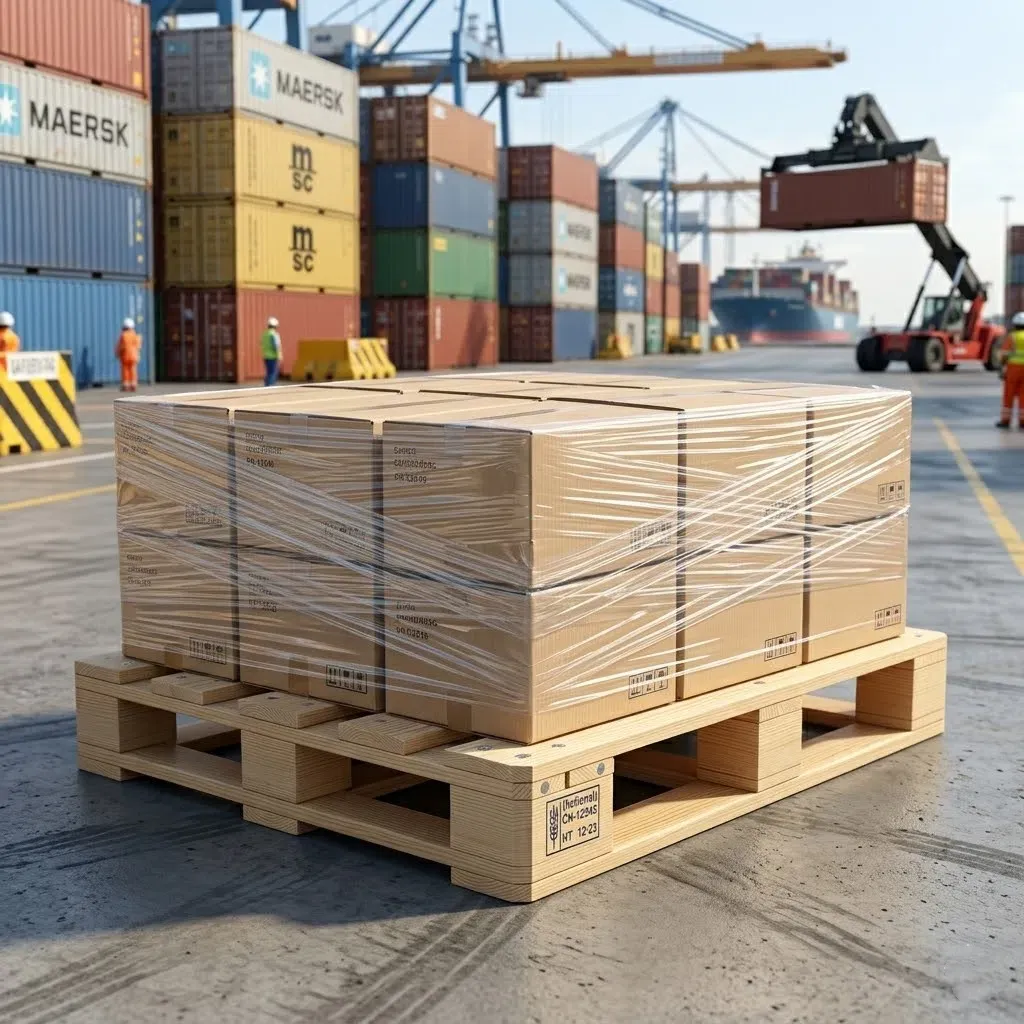
Navigating global supply chains requires balancing strict international regulations, rising freight costs, and demanding delivery schedules. For cross-border trade, traditional wooden pallets have increasingly become a operational bottleneck. Between mandatory heat treatment certifications, potential pest quarantine delays, and excessive tare weight, solid timber shipping platforms can rapidly turn into an expensive trade liability.
To resolve these logistical challenges, forward-thinking trade enterprise and global supply chain managers are shifting toward a modern packaging innovation: the molded pallet. Widely recognized as an engineered wood pressed molded pallet, this solution allows exporters to streamline customs compliance, optimize warehouse utilization, and significantly lower overall shipping expenses.
Automatic ISPM 15 Compliance: Bypassing Customs Bottlenecks
The most critical barrier in global logistics is ISPM 15 (International Standards for Phytosanitary Measures No. 15). Raw timber pallets must undergo rigorous Heat Treatment (HT) or Methyl Bromide (MB) fumigation to eradicate invasive biological pests, complete with official IPPC stamps and extensive paper verification.
A modern molded pallet eliminates this administrative burden completely.
During the manufacturing process, top-tier pallets manufacturers combine dried wood fibers, timber processing residues, and specialized thermosetting synthetic resins. This mixture is subjected to extreme hydraulic pressure (often exceeding 1,000 tons) and temperatures above 200°C (392°F).
Complete Pest Eradication: High-temperature thermo-forming automatically destroys all biological pests, insects, larvae, and wood-boring organisms deep within the fiber structure.
Inherent Exempt Status: International customs authorities categorize the wood pressed molded pallet as processed wood (similar to plywood, OSB, and particleboard), placing it outside standard raw-wood quarantine regulations.
Zero Documentation Risk: Customs clearance no longer depends on fumigation certificates, treatment logs, or visible IPPC stamps. This eliminates expensive port delays caused by missing paperwork or worn-out stamp marks.
Freight Cost Efficiency: Superior Nestability and Lower Tare Weight
Air cargo tariffs, sea freight container rates, and long-haul trucking costs require maximum volumetric and weight efficiency. Traditional framed pallets are bulky, rigid, and heavy, wasting valuable space in storage racks and transport containers.
The unique geometry of an engineered molded pallet addresses both spatial and weight limitations with precision:
Exceptional Nesting Ratio (4:1 Space Savings)
Thanks to tapered support legs and hollowed bases, these platforms nest seamlessly into one another. While a standard warehouse stack holds only 15 to 20 traditional wooden pallets, the exact same vertical space can store 60 to 80 presswood units. This 75% volume reduction slashes inbound transit overhead and reclaims critical floor space in busy packing facilities.
Reduced Tare Weight for Freight Savings
Weighing up to 50% less than hardwood alternatives of identical load capacity, adopting a lightweight export pallet provides immediate freight savings. For air freight consignments and weight-restricted ocean containers, reducing tare weight directly lowers total billable tonnage.
Structural Integrity: Monocoque Design Meets Automated Logistics
Solid timber pallets frequently suffer from organic defects such as knots, structural cracks, and fluctuating moisture levels, leading to sudden breakage or warping under multi-ton loads.
Professional pallets manufacturers build presswood platforms using high-precision metal compression molds, replacing natural material unpredictability with engineered consistency:
Seamless Monocoque Structure: Formed in a single continuous pressing cycle, this design eliminates nails, metal staples, and sharp joint edges. This protects stretch-wrapped cargo and corrugated boxes from punctures and tears.
Consistent Dimensional Accuracy: Because every molded pallet matches exact millimeter tolerances, it operates smoothly with modern automated guided vehicles (AGVs), conveyor systems, and robotic palletizers without jamming.
Water & Moisture Resistance: High-density resin bonding combined with extreme pressure compression maintains moisture content below 8%, drastically reducing mold growth risks during extended ocean journeys through tropical climate zones.
Sustainability and ESG Alignment for International Brands
Modern multinational corporations are under immense pressure to reduce carbon footprints across their indirect Scope 3 supply chains. The wood pressed molded pallet aligns directly with circular economy principles and environmental, social, and governance (ESG) targets.
Upcycled Material Utilization: Instead of harvesting fresh forest timber, these platforms are manufactured using industrial wood waste, forestry trimmings, and post-consumer timber fibers, reducing deforestation pressure.
100% Closed-Loop Recyclability: At the end of its operational life cycle, a damaged export pallet can be re-crushed, blended with fresh resin, and molded directly into a brand-new pallet.
Chemical-Free Operational Safety: Devoid of chemical fumigation residues (such as Methyl Bromide) and sharp metal fasteners, these units provide a safer handling environment for warehouse personnel.
Technical Comparison Matrix: Evaluating Export Packaging Options
To select the most efficient unit load device for international shipping, supply chain planners must weigh regulatory compliance against cost and durability.
| Performance Metric | Solid Hardwood Pallet | Plastic Export Pallet | Wood Molded Pallet |
|---|---|---|---|
| ISPM 15 Compliance | Requires HT / MB Fumigation | Fully Exempt | Fully Exempt (Process-Built) |
| Space Efficiency (Nesting) | No (Stackable Only) | Partial (Model Dependent) | Yes (4:1 High-Density Nesting) |
| Fasteners & Sharp Edges | Nails, Staples, Splinters | None | None (Smooth Monocoque) |
| Tare Weight Impact | Heavy (High Shipping Cost) | Moderate to Light | Lightweight (High Payload) |
| Environmental Footprint | High Raw Timber Usage | Petroleum Plastic Derivative | Upcycled Fiber & Recyclable |
Upgrading Your Cross-Border Packaging Strategy
In an era where cross-border trade demands maximum efficiency, switching to a high-density wood pressed molded pallet eliminates ISPM 15 compliance risks while cutting overall transportation and storage costs.
By partnering with experienced pallets manufacturers, your logistics team can source the exact export pallet specifications required to secure cargo, pass customs without delay, and support sustainable supply chain initiatives worldwide. Choosing a reliable molded pallet is no longer just a packaging upgrade—it is a strategic advantage for global exporters.


