

For exporters who ship goods internationally, the humble pallet carries a hidden tax that few procurement managers fully appreciate. Every time a traditional wooden pallet crosses a border, it must comply with ISPM 15 – the International Standards for Phytosanitary Measures No. 15 – which requires either heat treatment or chemical fumigation to eliminate pests and pathogens. This compliance step adds real costs, real delays, and real risks to every shipment.
The molded pressed pallet changes everything. Manufactured under extreme heat and pressure, this export-ready solution is permanently exempt from ISPM 15 fumigation requirements. No treatment certificates. No IPPC stamps. No customs holds over a pallet. For businesses shipping to the EU, USA, Australia, Canada, Japan, South Korea, and most major importing countries, the molded pallet offers a direct path to eliminating fumigation costs entirely.
This article examines why the molded pressed pallet has become the preferred choice for export-oriented businesses, how it eliminates ISPM 15 compliance costs, and what the total savings look like when you make the switch.
The Real Cost of ISPM 15 Compliance for Traditional Wood Pallets
ISPM 15 is not optional. Over 180 countries require wood packaging material to be either heat-treated to a minimum core temperature of 56°C for 30 continuous minutes or fumigated with methyl bromide. For traditional wooden pallets, this means every single export shipment incurs compliance costs.
The numbers are significant. Fumigation costs typically range from $10 to $50 per pallet, with some sources citing approximately $5 per pallet for basic treatment. For a business shipping 1,000 pallets annually, that is $5,000 to $50,000 in fumigation fees alone – before counting any delays. Global logistics faces an estimated $3.6 billion annually in fumigation costs for wooden pallets.
But the direct fees are only part of the story. Fumigation creates delays – an average of three days, which can stretch to eight days during peak seasons. Each day of detention at a major port can cost over $1,000 in demurrage fees. Fumigation certificates face verification delays in approximately 23% of cases, creating customs roulette for exporters. A single failed inspection can detain cargo for days, incurring fees of $500 or more per day.
For exporters shipping 5,000 pallets per year at $5 per pallet for fumigation, the annual cost reaches $25,000. When you factor in the risk of customs delays, rejected shipments, and the administrative burden of managing treatment certificates, the true cost of ISPM 15 compliance for traditional wooden pallets is substantially higher than the line item on an invoice.
Why the Molded Pressed Pallet Is Permanently ISPM 15 Exempt
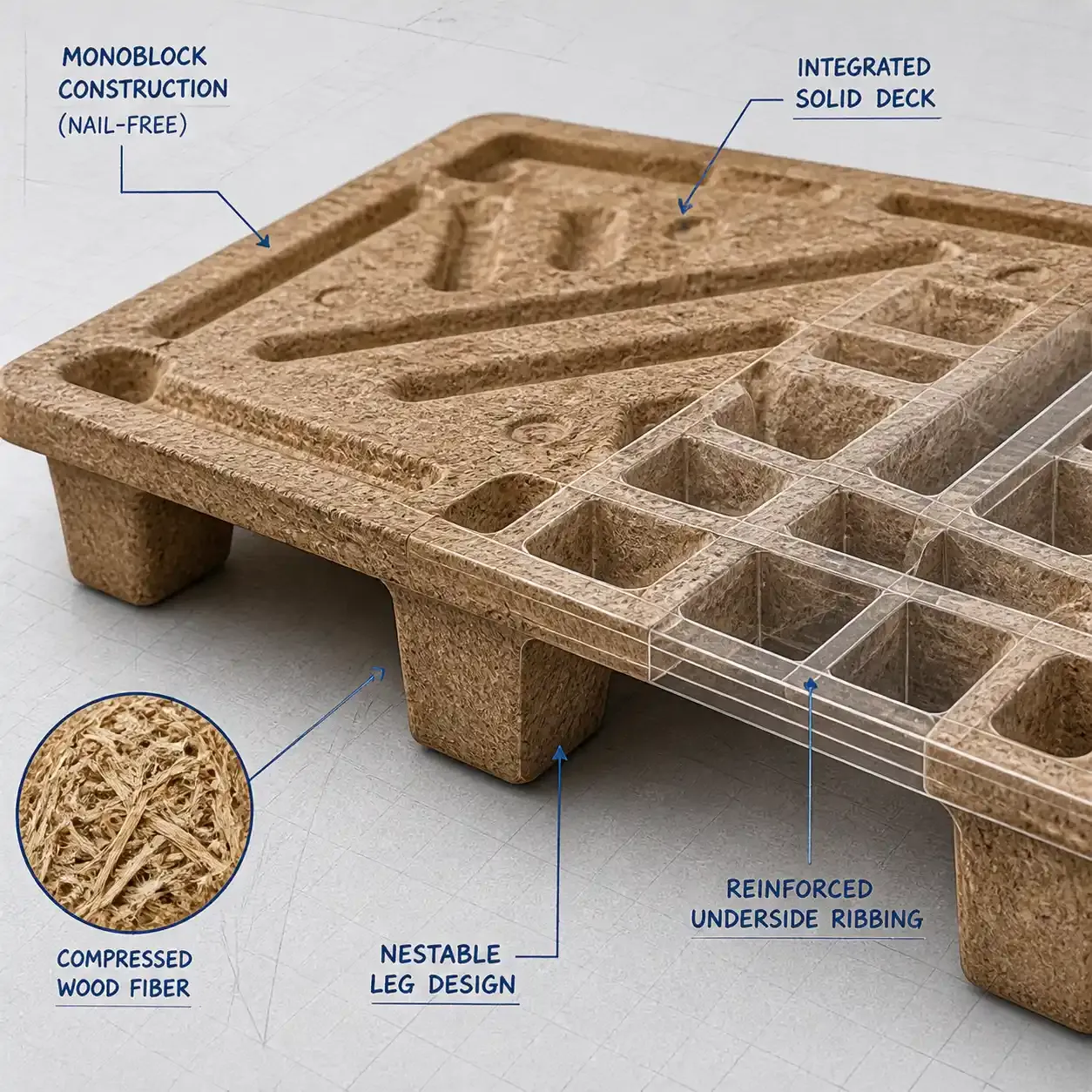
The molded pressed pallet – also known as a molded pallet, wooden molded pallet, or presswood pallet – is fundamentally different from traditional sawn-timber pallets. It is manufactured from recycled wood fibers bonded under extreme heat and pressure. During production, the molded pressed pallet undergoes temperatures of 180°C to 220°C – far exceeding the ISPM 15 threshold of 56°C. This process destroys all biological organisms and pests permanently.
Under international phytosanitary standards, the molded pressed pallet is classified as “Processed Wood Material” – not raw wood. ISPM 15 explicitly exempts wood packaging made entirely of processed wood materials such as particle board, plywood, or materials created using glue, heat, or pressure. Because the molded pallet falls into this exempt category, it requires no fumigation, no heat treatment, no IPPC stamp, and no treatment certificate.
Leading pallet manufacturers confirm that molded pressed pallets are accepted at customs worldwide with only a Material Declaration – no additional documentation required. This is not a temporary exemption or a certification that can expire. It is a permanent classification based on the manufacturing process itself.
For exporters, this means the molded pallet eliminates the single biggest compliance headache in international shipping. No more scheduling fumigation. No more waiting for certificates. No more risk of customs holds over a pallet.
Quantifying the Savings: What You Eliminate by Switching
Switching to a molded pressed pallet eliminates multiple cost layers that traditional wooden pallets carry.
Direct fumigation fees disappear entirely. A business shipping 1,000 pallets annually at $25 per pallet for fumigation saves $25,000 per year. At $5 per pallet, the saving is still $5,000 annually. Over five years, fumigation fees alone for 5,000 pallets can reach $31,250.
Customs delay costs are eliminated. Pressed wood pallet shipments achieve a 99.7% customs clearance rate with an average processing time of just five minutes, compared to 72 hours for traditional wood pallets. The inspection rate for pressed wood pallets is 0.3%, versus 22% for wood. This prevents the $2,500-per-day detention fees common at major ports.
Administrative overhead vanishes. No treatment certificates to manage. No IPPC stamps to verify. No fumigation records to retain. No risk of faded or missing stamps causing customs detention during sea voyages.
Product damage costs decline. Traditional wooden pallets are assembled with nails that can protrude as wood shrinks and twists. A molded pressed pallet has no nails or staples, eliminating packaging damage risk entirely. Switching to a smooth-surface pallet reduces packaging damage rates by approximately 18%.
One seafood exporter eliminated $38,400 per year in fumigation costs and achieved a 99.7% on-time delivery rate – up from 82% – after switching to pressed wood pallets. A furniture exporter shipping 800 pallets to Germany avoided six days of fumigation delays that would have risked €50,000 in penalties. An e-commerce company shipping 1,000 pallets internationally eliminated $25,000 in annual fumigation expenses.
Beyond Fumigation: Additional Export Advantages of the Molded Pallet
The molded pressed pallet delivers benefits that extend far beyond eliminating fumigation costs.
Nestable design saves freight space. Fifty molded pallets stack to approximately 2.2 meters, compared to 7 meters for the same number of traditional wooden pallets. A standard 40-foot container can hold approximately 1,650 molded pallets, compared to just 450 traditional wooden pallets – a 3.6-fold increase in freight density. This translates to dramatically lower per-unit shipping costs.
Lightweight construction reduces freight weight. A molded pallet typically weighs 15 to 20 kg, compared to 25 kg for a traditional wooden pallet. For air freight, this saves approximately $0.12 per kg. For sea freight, the cumulative weight reduction across a container lowers total shipping costs.
Dimensional stability ensures automation compatibility. The molded pressed pallet maintains ±1 mm precision tolerance, enabling stable stacking and seamless integration with automated conveyor systems. Traditional wood pallets warp, swell, and shrink with humidity changes – causing jams and downtime in automated warehouses.
Environmental sustainability supports ESG goals. The molded pallet is manufactured from recycled wood waste, sawdust, and wood chips, achieving up to 82% recycled content utilization. The production process consumes less energy than virgin lumber pallets, and the product itself is 100% recyclable at end of life.
What Pallet Manufacturers Are Saying
Leading pallet manufacturers have shifted significant production capacity toward molded pressed pallets in response to exporter demand. More than 63% of international shipping companies adopted molded wood pallets during 2025 specifically because they comply with ISPM 15 regulations without additional heat treatment requirements. Over 74% of international logistics operators globally adopted molded wood pallets during 2025 because ISPM 15 compliance simplified cross-border shipping operations.
Pallet manufacturers note that the business case for the molded pressed pallet is strongest for one-way export shipping. While the upfront cost of a molded pallet may be comparable to or slightly higher than a traditional wooden pallet, the total cost of ownership – factoring in fumigation, delays, damage, and freight efficiency – is substantially lower.
Some pallet manufacturers report that customers using molded pressed pallets achieve ROI payback periods under 18 months. The combination of zero fumigation costs, higher freight density, lower damage rates, and reduced administrative burden creates a compelling financial case that transcends the initial purchase price.
Implementation: Making the Switch to Molded Pressed Pallets
Transitioning to molded pressed pallets is straightforward, but it requires thoughtful planning.
Start by auditing your current pallet-related export costs. Include fumigation fees, heat treatment charges, customs delay costs, demurrage fees, certificate management overhead, and product damage attributed to pallet nails or splinters. This baseline will help you quantify the savings from switching to a molded pallet.
Evaluate your shipping volumes and destinations. The molded pressed pallet delivers the greatest value for high-volume exporters shipping to ISPM 15-enforcing countries – which includes virtually every major trading nation. For one-way export shipments where pallets are not returned, the molded pallet offers the strongest business case.
Partner with established pallet manufacturers who can supply molded pressed pallets in the sizes and load ratings your operation requires. Common sizes include 1200×1000 mm for general export, 1200×800 mm for Euro-standard footprints, and 1100×1100 mm for Asia-Pacific markets. Load capacities range from 1,000 kg to 2,500 kg depending on size and design.
Consider a phased implementation. Start with your highest-volume export lanes or the product lines most vulnerable to customs delays. Measure the results – fumigation cost savings, clearance times, damage rates – and use the data to build the case for full adoption.
Conclusion: The Export-Ready Solution Is Already Here
The molded pressed pallet is not a future solution or an experimental alternative. It is a proven, export-ready platform that eliminates ISPM 15 fumigation costs permanently. Leading pallet manufacturers have refined the technology. Global customs authorities recognize the exemption. Exporters across industries are realizing the savings.
Traditional wooden pallets carry a hidden fumigation tax on every international shipment – a tax that grows with every container, every year, every delay. The molded pallet removes that tax entirely. No fumigation fees. No customs holds. No treatment certificates. No risk.
For exporters who want to reduce costs, eliminate delays, and simplify international shipping, the molded pressed pallet is the answer. The technology is proven. The savings are real. And the only question that remains is: how many more shipments will you pay the fumigation tax before making the switch?


