

For exporters shipping goods across international borders, the humble pallet can become an unexpected source of cost, delay, and frustration. Traditional wooden pallets require costly ISPM 15 heat treatment or chemical fumigation for every shipment. Faded stamps can trigger customs holds. Protruding nails can damage cargo. And inconsistent dimensions can cause jams in automated handling systems.
The molded pallet offers a solution to all these problems. Engineered from recycled wood fibers bonded under high heat and pressure, a molded pallet is permanently exempt from fumigation requirements, contains no nails or fasteners, and maintains precise dimensional tolerances. Fumigation-free molded pallets are gaining rapid adoption among exporters worldwide, from machinery manufacturers in China to food producers in Europe. Leading molded pallet manufacturers have refined the technology to deliver exceptional strength, durability, and cost efficiency.
This complete guide explores the molded pallet from five critical perspectives: its construction and manufacturing process, fumigation-free compliance advantages, load capacity and durability, space-saving design, and how to choose the right molded pallet manufacturer for your export operation.
What Is a Molded Pallet? Understanding the Construction
A molded pallet – also known as a presswood pallet, compressed wood pallet, or molded wood pallet – is a shipping platform manufactured from wood fibers and resin under high heat and pressure. The resulting product is a one-piece, integrated structure with the top deck and support legs formed in a single molding step.
The manufacturing process begins with wood waste – sawdust, wood shavings, agricultural residues like plant straw, and other wood byproducts. These materials are dried and mixed with a resin binder, typically MDI (diphenylmethane diisocyanate), which is formaldehyde-free and safe for food and pharmaceutical applications . The mixture is then placed into a precision mold and subjected to extreme pressure – often 1,000 to 1,600 tons of pressing force – at temperatures of 180 to 220 degrees Celsius .
The high-temperature, high-pressure process transforms the wood fibers into a dense, homogeneous structure. The resulting molded pallet has a moisture content below 12 percent, making it resistant to mold and moisture absorption . The molded wood pallet is significantly lighter than traditional hardwood alternatives, with most units weighing between 6 and 32 kilograms depending on size and design .
Leading molded pallet manufacturers have achieved remarkable precision in this process. Every molded pallet produced from the same mold is identical – within plus or minus one millimeter dimensional tolerance, with the same weight and consistent load capacity every time . This precision is essential for automated warehousing, where even minor variations can cause jams and downtime.
Fumigation-Free: Why Molded Pallets Eliminate ISPM 15 Compliance
The single greatest advantage of a molded pallet is its permanent ISPM 15 exemption. Traditional wooden pallets require heat treatment or chemical fumigation to eliminate pests and pathogens before international shipping. This process adds costs, creates administrative burdens, and introduces the risk of customs delays. Faded or missing IPPC stamps can trigger inspection holds that cost thousands of dollars in demurrage fees.
A molded pallet eliminates all these problems. Because the manufacturing process involves temperatures exceeding 180 degrees Celsius – far above the ISPM 15 threshold of 56 degrees Celsius – the molded wood pallet is classified as “processed wood” and is permanently outside the scope of ISPM 15 regulations . It requires no fumigation, no heat treatment certificate, and no IPPC stamp .
The compliance advantage is recognized globally. Fumigation-free molded pallets are accepted at customs in the European Union, United States, Canada, Australia, Japan, South Korea, and most major importing countries with only a Material Declaration – no additional documentation required . For exporters, this means predictable clearance times, lower administrative overhead, and no risk of customs holds over a pallet.
The financial impact is substantial. Some molded pallet manufacturers report that their customers avoid fumigation fees of $25 to $35 per shipment, eliminate the administrative cost of managing treatment certificates, and achieve clearance rates above 99 percent with processing times of just minutes . Export pallets that are fumigation-free also reduce the risk of cargo detention and the demurrage fees that accompany it.
Load Capacity and Durability: Engineered for Heavy-Duty Export
Export shipments demand pallets that can withstand heavy loads, rough handling, and long transit times. The molded pallet delivers exceptional performance across all these dimensions.
A molded pallet typically offers dynamic load capacities of 1,500 to 2,500 kilograms, with static loads reaching 5,000 to 8,000 kilograms . Heavy-duty configurations achieve even higher capacities – some molded pallets handle dynamic loads of up to 5 tons and static loads exceeding 5 tons . For exporters shipping heavy machinery parts, industrial components, or dense goods, the molded pallet provides reliable load-bearing performance without the risk of pallet failure.
The durability of a molded pallet extends beyond load capacity. The high-density, one-piece construction resists the warping, splitting, and moisture absorption that plague traditional wooden pallets. The MDI resin binder creates a hydrophobic bond that repels water and prevents mold growth – even in tropical climates and during long ocean transits .
Independent testing has confirmed that molded wood pallets offer superior strength and stiffness compared to traditional alternatives. The deck of a molded pallet is approximately 50 percent more resistant to impacts and damage by forklifts than standard wooden pallets . The breakage rate of molded pallets is below 5 percent, compared to 20 to 30 percent for traditional wooden pallets.
For exporters, this durability translates directly to lower replacement costs and fewer supply chain disruptions. A molded pallet can be reused for hundreds of cycles, delivering a significantly lower cost per trip than traditional alternatives.
Space-Saving Design: Nesting for Warehouse and Freight Efficiency
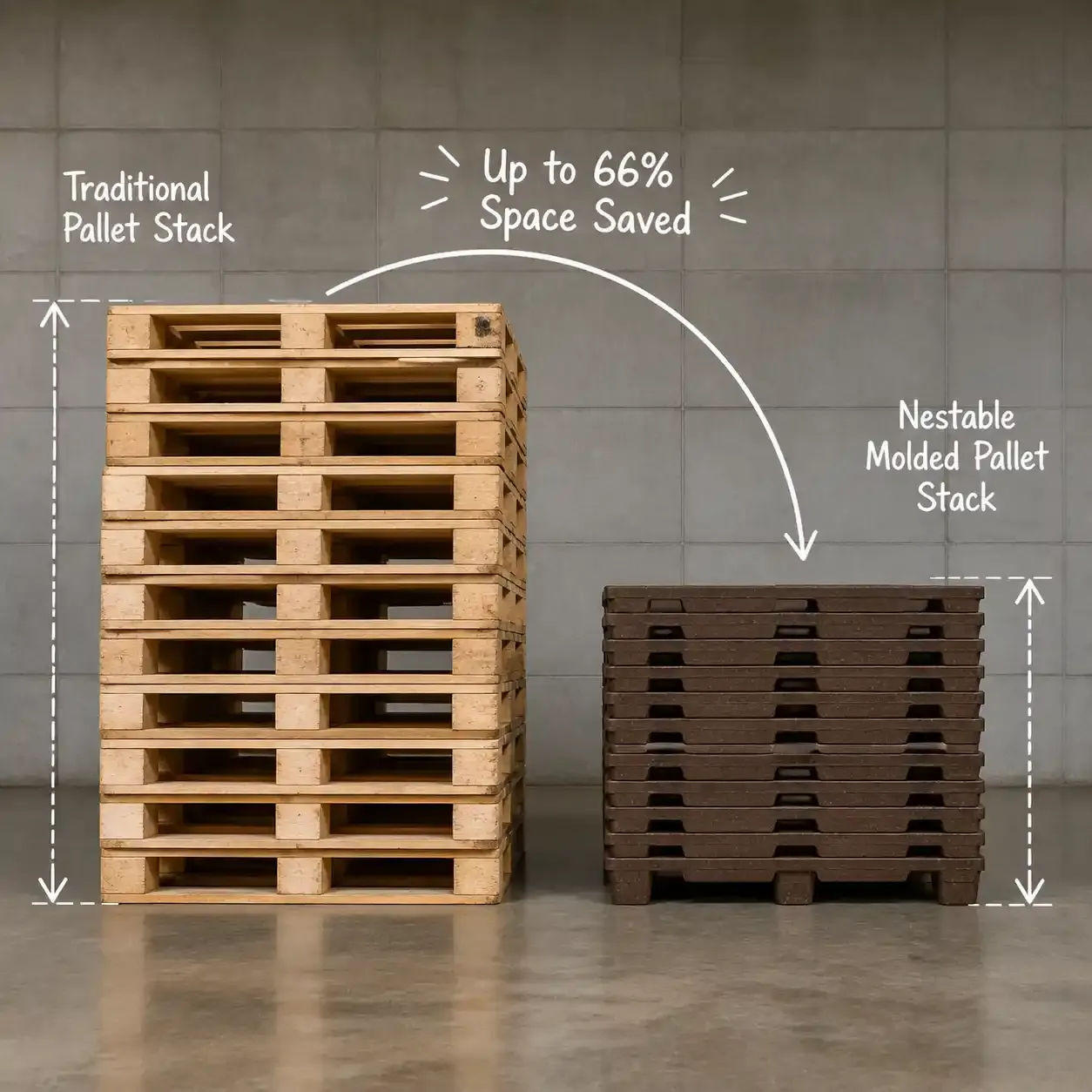
Traditional wooden pallets occupy substantial space in warehouses and shipping containers. They stack with large air gaps between them, creating unstable loads and wasting cubic volume. A stack of fifty traditional wooden pallets towers over seven meters high.
The molded pallet solves this problem through its nestable design. Empty molded pallets stack partially inside one another, achieving a nesting ratio of up to four to one . A stack of fifty molded pallets measures approximately 2.2 meters high – a reduction of nearly seventy percent in storage height compared to traditional wood .
The space savings are substantial. In warehouse storage, nesting allows up to four times as many empty molded pallets to be stored in the same floor area. In return logistics, a standard truck can carry significantly more nested molded pallets than traditional alternatives, reducing transportation costs for empty returns. Some molded pallet manufacturers report that their products save up to seventy percent of warehouse space compared to conventional pallets .
Container loading density is also dramatically improved. A standard 40-foot container can hold approximately 1,650 molded pallets, compared to just 450 traditional wooden pallets – a 3.6-fold increase in freight density . For exporters shipping large volumes of empty pallets or using pallet pooling systems, this density advantage translates directly to lower freight costs per unit.
Choosing the Right Molded Pallet Manufacturer for Your Export Operation
Selecting a reliable molded pallet manufacturer is essential to realizing the full benefits of molded pallets. Several factors should guide your decision.
First, consider the range of sizes offered. Leading molded pallet manufacturers produce pallets in standard dimensions including 1200 by 1000 millimeters (general industrial), 1200 by 800 millimeters (Euro standard), 1100 by 1100 millimeters (Asia-Pacific), 1000 by 1000 millimeters (square format), and 600 by 800 millimeters (small format for food and FBA shipments) . Custom sizes are also available from many manufacturers based on minimum order quantities.
Second, verify the manufacturer’s quality standards. Look for ISO 9001 certification, ISO 14001 environmental management, and OHSAS 18001 occupational health and safety certification. Reputable molded pallet manufacturers provide detailed load capacity documentation, material declarations, and test reports showing static, dynamic, and racking load capacities.
Third, confirm the adhesive technology. Formaldehyde-free MDI resin is the preferred binder for food and pharmaceutical exports. MDI creates strong, irreversible urethane bonds that prevent rot and moisture damage . Some manufacturers offer additional waterproofing treatments for even greater moisture resistance.
Fourth, evaluate the manufacturer’s sustainability credentials. The molded pallet is made from recycled wood waste and agricultural residues, with a material utilization rate exceeding 95 percent . Leading molded pallet manufacturers operate closed-loop production systems, turning waste into valuable shipping platforms while reducing carbon emissions. Shandong Yunwang, for example, reports reducing carbon emissions by 120,000 tons annually through molded pallet production .
Fifth, consider the manufacturer’s global logistics capabilities. Molded pallet manufacturers with established export networks can provide samples for testing, arrange FOB pricing, and ensure reliable delivery to your facility.
Conclusion: The Molded Pallet Is the Export-Ready Solution
The molded pallet represents a fundamental advancement in export logistics. Its permanent ISPM 15 exemption eliminates fumigation costs, customs delays, and compliance burdens. Its high-pressure construction delivers exceptional load capacity, durability, and moisture resistance. Its nestable design slashes warehouse space and freight costs. And its precision manufacturing ensures consistent performance in automated handling systems.
Fumigation-free molded pallets are increasingly the preferred choice for exporters of heavy machinery, food products, pharmaceuticals, and industrial goods. Leading molded pallet manufacturers continue to innovate, developing products with enhanced waterproofing, higher load-bearing capacity, and improved sustainability.
The technology is proven, the benefits are substantial, and the adoption is accelerating. For exporters seeking to simplify their supply chains, reduce logistics costs, and eliminate customs uncertainty, the molded pallet offers a clear path forward.


