


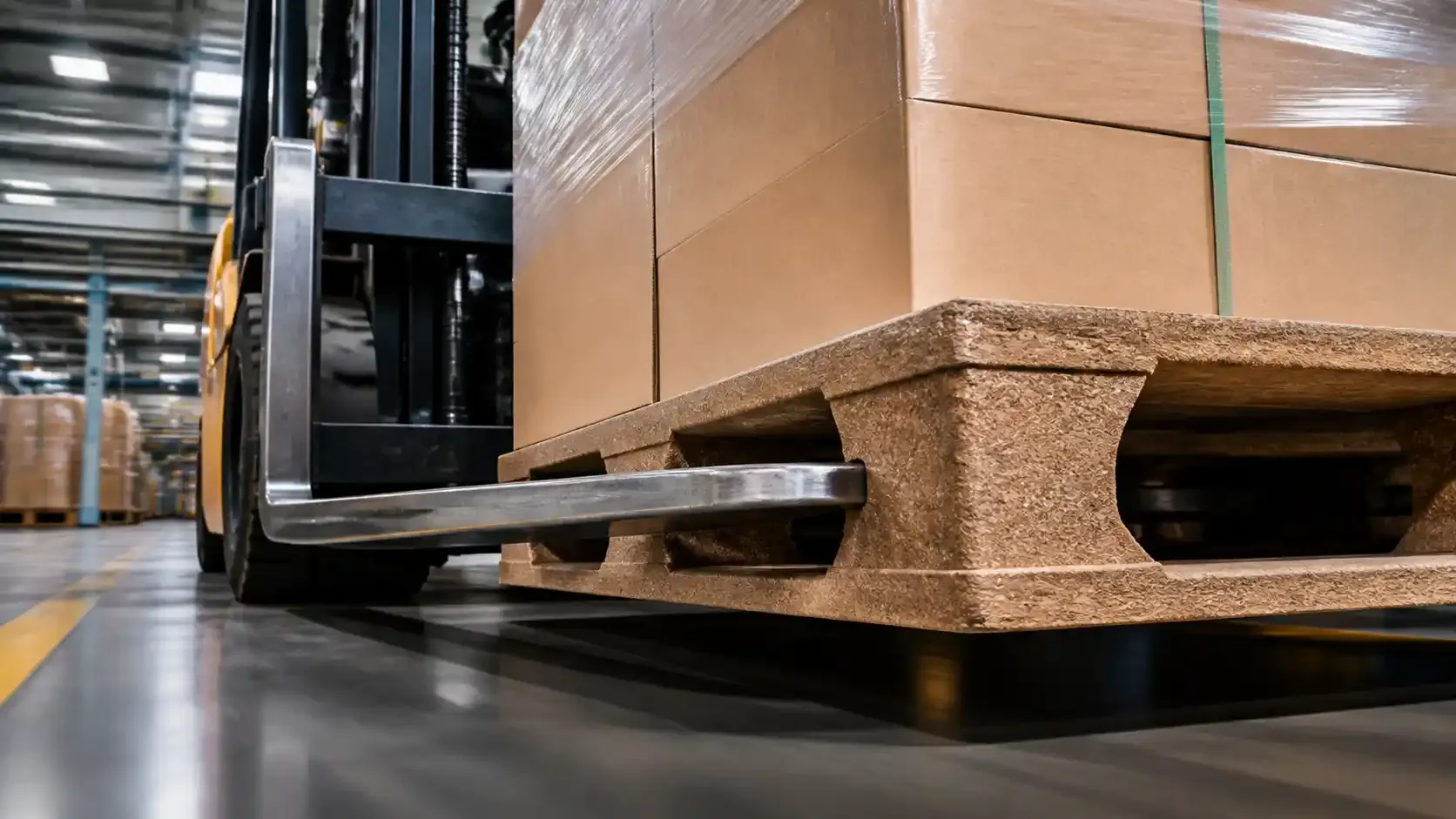
In fast-moving logistics, pallets are judged less by how they look on a warehouse floor and more by how they behave after repeated handling. Forklift contact, stacking pressure, conveyor transfer, humidity changes, and long-distance shipment all expose the pallet base to stress. For buyers comparing a molded pallet with a traditional wooden molded pallet, the key question is practical: will the platform remain stable after repeated impact loading, or will small damage turn into operational risk?
Why impact loading changes the pallet durability discussion
Static load capacity matters, but it is only one part of pallet performance. In daily distribution, a pallet may be lifted, lowered, shifted, stacked, and re-entered by forklift tines many times before it reaches the final destination. Each event may create a small shock at the deck edge, leg, rib, or entry point.
This is where the molded pallet becomes attractive to many buyers. Instead of relying on boards, nails, and assembled joints, it is commonly evaluated for its integrated construction. Pallet manufacturers pay close attention to this point because repeated impact rarely damages a pallet evenly; it usually attacks weak connections first. In a wooden molded pallet or assembled wooden design, loose fasteners, split boards, and inconsistent lumber quality can become early failure points.
A molded pressed pallet approaches the problem differently. Its one-piece form, dense compressed fiber structure, and reinforced underside ribbing are designed to spread handling stress across a broader area. That does not remove the need for proper load matching, but it can improve consistency in demanding supply chains.
How pallet manufacturers evaluate repeated impact behavior
Professional pallet manufacturers usually look beyond a single strength number. They evaluate how the pallet behaves after several types of handling stress, including drops, edge impact, forklift entry, and dynamic load movement. Industry standards such as ASTM D1185 and ISO 8611 are often referenced for pallet performance evaluation, while practical warehouse testing focuses on whether the pallet remains functional after rough handling.
Common inspection points include:
Cracking or fracture around deck edges and leg structures
Permanent deformation that affects stacking or conveyor travel
Loss of dimensional stability during repeated lifting and lowering
Surface damage that may harm cartons, bags, drums, or boxed goods
Entry-point wear caused by forklift tines and pallet jacks
For a molded pallet, the most important result is not simply whether it survives one impact. Buyers want to know whether it can maintain usable geometry after repeated events. A molded pressed pallet with a smooth, nail-free deck can also reduce the risk of product puncture or worker injury caused by exposed nails or splintered boards.
Structural reasons molded pallets handle impact differently
The manufacturing process is central to performance. Molded and compressed wood pallets are formed under high temperature and pressure from recycled wood fibers, wood residues, and suitable bonding materials. The result is a dense, uniform platform with no mechanical fasteners. This structure is different from traditional wooden pallets, which depend on separate boards and connection points.
A well-designed molded pallet typically includes several impact-oriented features:
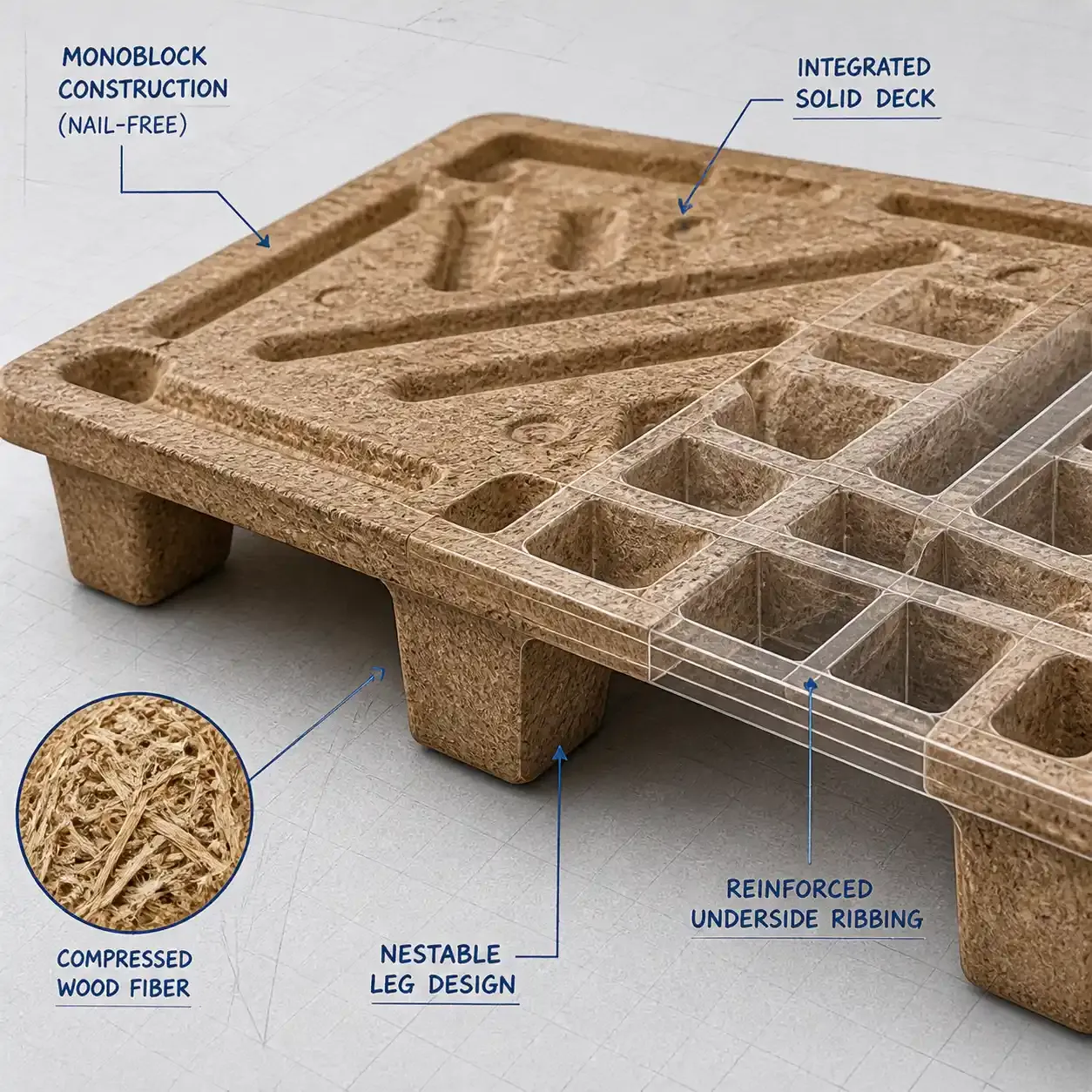
Monoblock construction that removes nails, screws, and loose joints
Integrated solid deck that provides a continuous support surface
Reinforced underside ribbing that improves resistance to forklift contact and shear stress
Four-way entry geometry that supports flexible forklift and pallet jack access
Nestable leg design that reduces empty storage space and return transport volume
These features explain why the molded pressed pallet is often considered for export logistics, carton packaging, food distribution, pharmaceutical handling, retail supply chains, and automated warehouse systems. In these environments, consistency is as valuable as strength. A pallet that keeps its shape helps protect goods and reduces interruptions in loading, stacking, and conveying.
Molded pallet and wooden molded pallet comparison
The comparison between a molded pallet and a wooden molded pallet should focus on real operating conditions rather than purchase price alone. A lower-cost pallet may become expensive if it breaks during transit, damages packaging, delays loading, or creates safety concerns in the warehouse.
| Evaluation factor | Molded pallet | Wooden molded pallet or assembled wood design |
|---|---|---|
| Impact response | Integrated structure spreads stress across the deck and ribs | Joints, boards, and fasteners may concentrate stress |
| Surface safety | Nail-free and smooth, reducing puncture risk | Nails, burrs, or splinters may appear after handling |
| Moisture behavior | Compressed fiber structure offers improved moisture resistance in normal logistics use | Ordinary wood may swell, mold, or deform in humid conditions |
| Automation fit | Uniform dimensions support conveyors, palletizers, and robotic handling | Dimensional variation can affect automated alignment |
| Empty storage | Nestable design can save warehouse and return-trip space | Conventional wooden pallets often require more stacking volume |
This comparison does not mean one material is right for every shipment. Heavy-duty, reusable, export, and automated applications often justify closer review of molded solutions, while short-distance, low-value, or temporary operations may still use conventional wood. The best choice depends on cargo value, route length, handling frequency, storage conditions, and the buyer’s tolerance for pallet-related damage.
Export and automated logistics applications
Repeated impact is especially important in cross-border logistics. Pallets may move through factories, inland warehouses, ports, customs areas, sea freight, destination terminals, and final distribution centers. Each transfer adds another chance for impact. A molded pallet designed for international movement can support export handling because molded wood pallets are typically described as suitable for international shipping without fumigation treatment, simplifying export procedures and reducing chemical treatment requirements.
For automated warehouses, dimensional consistency is even more important. Conveyors, palletizers, automated guided vehicles, and robotic picking systems require predictable pallet geometry. Even a small deformation can cause misalignment or downtime. Pallet manufacturers serving automated operations therefore evaluate not only load capacity, but also surface flatness, entry clearance, nesting behavior, and resistance to repeated forklift interaction.
A molded pressed pallet can be a practical option where four-way entry, nestable storage, smooth deck surfaces, and moisture resistance are priorities. These advantages are particularly relevant for cartonized goods, export packaging, retail distribution, food, pharmaceutical, and industrial logistics.
What buyers should request before ordering
Before selecting a molded pallet, procurement teams should ask suppliers for application-specific details rather than relying on general descriptions. Useful questions include:
What load condition is most important: floor stacking, forklift movement, racking, or container shipment?
Has the pallet design been evaluated for drop, edge impact, forklift entry, and dynamic handling?
What are the recommended cargo types, stacking methods, and storage conditions?
Does the pallet support four-way forklift or pallet jack access?
Is the empty pallet nestable for warehouse and return logistics savings?
Is the pallet suitable for export procedures where fumigation-free handling is required?
These questions help buyers compare pallet manufacturers in a way that matches actual supply chain risk. The strongest purchasing decision is not based on a single number; it is based on how the pallet performs through the full handling cycle.
Conclusion
A molded pallet can survive repeated impact loading when its structure, material density, load rating, and application match the logistics environment. Its one-piece, nail-free design gives it a clear structural advantage over many wooden molded pallet alternatives in high-frequency handling, export shipping, and automated warehousing.
For buyers, the most useful takeaway is simple: do not evaluate pallets only by static load capacity. Ask how the pallet behaves after repeated drops, forklift contact, stacking cycles, and moisture exposure. A molded pressed pallet is often worth considering when product protection, handling safety, dimensional consistency, and storage efficiency are central to the supply chain.
FAQs
Can a molded pallet withstand repeated forklift impacts?
Yes, a properly selected molded pallet is designed to handle frequent forklift interaction. Its monoblock structure and reinforced underside help distribute impact stress more evenly than many nailed wooden designs.
Is a molded pressed pallet better than a wooden molded pallet for export?
A molded pressed pallet is often preferred for export because its integrated structure, consistent dimensions, nestable shape, and fumigation-free suitability can simplify handling across long-distance logistics routes.
What do pallet manufacturers check during impact testing?
Pallet manufacturers typically check cracks, deformation, edge damage, entry-point wear, dimensional stability, and whether the pallet remains functional after repeated handling events.
Are molded pallets suitable for automated warehouses?
Yes. Their standardized dimensions, four-way entry, smooth deck surface, and stable geometry can support conveyors, palletizers, robotic handling, and other automated warehouse systems.
When should buyers choose molded pallets?
They are a strong option when shipments involve frequent handling, export movement, carton packaging, moisture-sensitive goods, automated systems, or a need to reduce pallet-related product damage.


