

E-commerce is changing the way pallets are evaluated. Faster fulfillment cycles, higher parcel volumes, cross-border shipping, and rising sustainability expectations are pushing buyers to reconsider traditional pallet choices. As a result, paper pallets, molded wood pallets, compressed wood pallets, and wood fiber pallets are receiving more attention from retailers, exporters, 3PL providers, and procurement teams looking for practical sustainable shipping solutions.
Why E-Commerce Is Accelerating Lightweight Pallet Demand
The phrase paper pallet manufacturers ramp up production reflects a broader market movement rather than a single material trend. Online retail supply chains require pallets that are lighter, easier to handle, suitable for one-way distribution, and aligned with circular packaging goals. Third-party market research shows steady growth in paper pallet adoption, driven by recyclability, lightweight construction, and demand from e-commerce, food and beverage, pharmaceutical, and logistics sectors.
For many buyers, paper pallets are attractive because they reduce unnecessary transport weight and can fit one-way shipment models. Corrugated paper pallets and honeycomb paper pallets are commonly discussed for light to medium cargo, especially where return logistics are costly or impractical. However, pallet selection is not only about weight. Export compliance, warehouse handling, surface safety, stacking efficiency, and load stability all influence the final purchasing decision.
Paper Pallets Are Part of a Wider Sustainable Packaging Shift
Paper pallets are often positioned as recyclable alternatives to conventional wooden or plastic platforms. Their appeal is strongest where cargo is relatively light, shipping routes are predictable, and moisture exposure can be controlled. In high-volume e-commerce logistics, every kilogram matters because pallet weight can affect freight cost, manual handling, and warehouse flow.
At the same time, many operations require higher strength or more robust export performance than typical paper-based platforms can provide. This is where engineered wood-based alternatives enter the conversation. Molded wood, compressed wood, and wood fiber pallets use recycled wood-based materials and engineered structures to support logistics efficiency while reducing reliance on solid timber.
Comparing Key Pallet Options for Modern Fulfillment
For international buyers, the practical question is not whether paper pallets are “better” than wood. The better question is which pallet type fits the cargo, route, storage environment, and handling system.
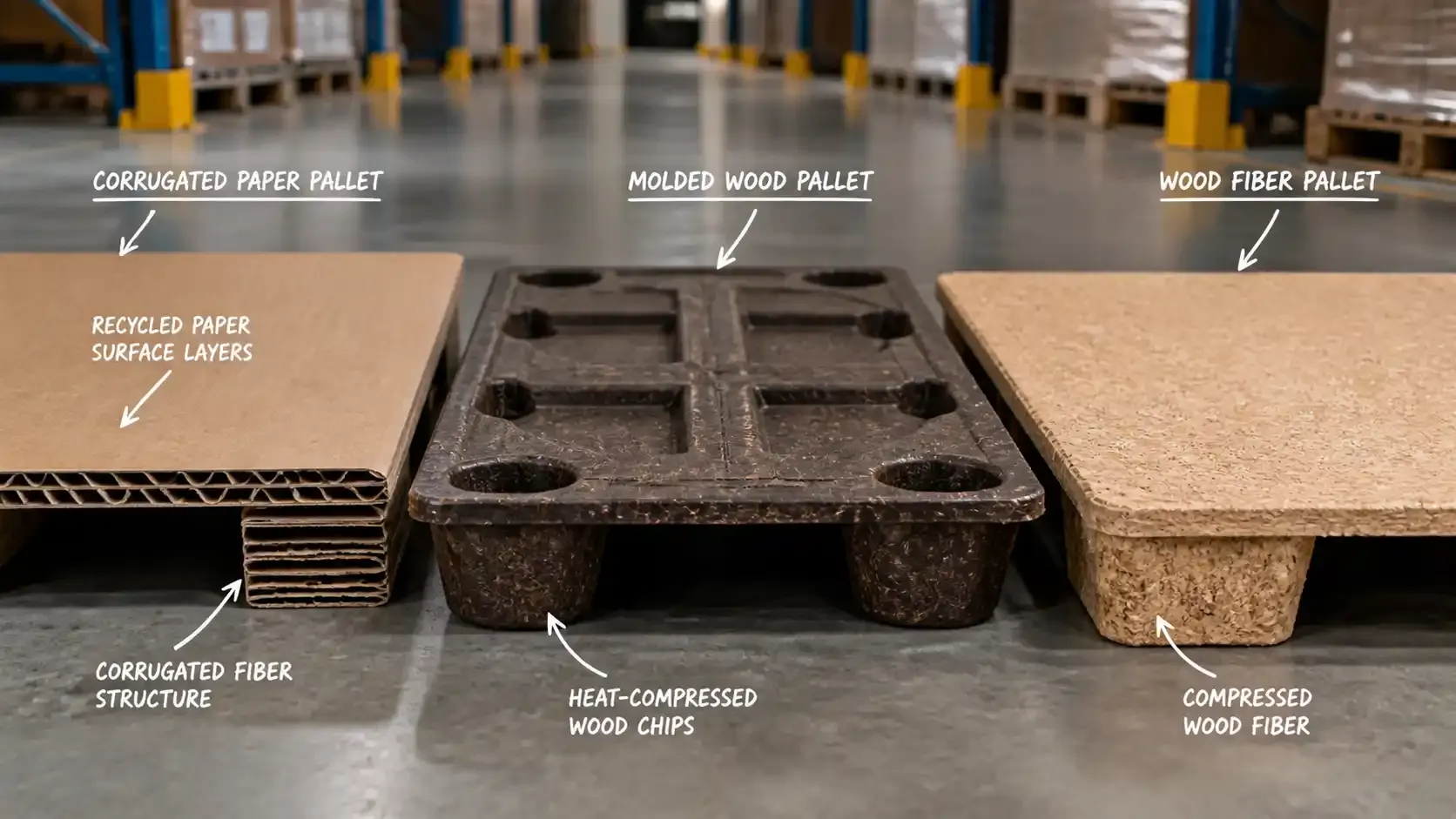
| Pallet Type | Typical Strength | Sustainability Angle | Common Use Case |
|---|---|---|---|
| Corrugated paper pallets | Light to medium loads | Recyclable paper-based structure | E-commerce parcels and one-way shipments |
| Honeycomb paper pallets | Light to medium loads | Lightweight fiber-based design | Retail distribution and export packaging |
| Molded wood pallets | Medium-duty export logistics | Made from recycled wood chips and molded under heat and pressure | Food, pharmaceuticals, retail logistics, industrial parts |
| Wood fiber pallets | Lightweight engineered wood-based solution | Made from recycled wood fibers and designed for recyclability | Cross-border retail and e-commerce shipments |
Paper pallets are useful where reduced weight and recyclability are the main priorities. In contrast, an engineered molded pallet is often evaluated when buyers need standardized export packaging, nestable storage, and stronger resistance to the demands of warehouse handling.
Molded Wood Pallets Support Export Efficiency
Molded wood pallets are produced from recycled wood chips or sawdust mixed with resin and compressed under high temperature and high pressure. This process forms a dense pallet structure while helping eliminate insects and microorganisms in the raw material. For export buyers, that manufacturing route can simplify international shipping because compressed wood pallet designs can meet ISPM 15 requirements without fumigation or quarantine treatment.
From a procurement perspective, compressed wood pallets are often considered when cost, safety, and compliance must be balanced. Compared with conventional solid timber pallets, compressed wood pallets can offer a cost advantage of approximately 30–50%. Their nail-free structure also reduces puncture risk and helps protect cartons during packing and transportation.
Wood Fiber Pallets Fill the Gap Between Weight and Strength
Wood fiber pallets are gaining interest because they combine a lightweight structure with export-friendly handling. Sentong’s wood fiber pallet information describes a design that is 50% lighter than timber, made from recycled wood-based materials, nail-free, splinter-free, and suitable for ISPM-15 compliant exporting without costly heat treatment stamps.
For high-value retail goods, electronics cartons, and cross-border e-commerce shipments, a wood fiber pallet may be a strong choice when buyers want to lower transport weight while reducing the risk of packaging punctures and tears. It also fits the broader demand for sustainable shipping solutions that do not compromise operational safety.
Warehouse Space Is Now a Cost Driver
In e-commerce fulfillment, pallet storage is more than a background detail. Empty pallet volume affects dock space, reverse logistics, labor movement, and warehouse layout. Nestable pallet designs are especially valuable because empty units stack into each other instead of occupying the same space as rigid non-nestable pallets.
Sentong’s nestable leg-type pallets are designed for e-commerce and parcel networks and can reduce storage space by up to 70% when empty. Some lightweight nestable wooden pallet designs using poplar or pine can weigh up to 40% less than traditional block pallets while supporting dynamic loads of 800–1,200 kg. For buyers operating dense fulfillment centers, this combination can reduce congestion while maintaining practical load performance.
Regional Trends Point Toward More Fiber-Based Pallets
Industry research points to continued expansion in paper pallet demand through the next decade. Allied Market Research projects the global paper pallet market to grow from $0.9 billion in 2022 to $1.3 billion by 2032. Other market reports also connect growth to e-commerce expansion, supply chain optimization, lightweight logistics, and environmental regulation.
Regionally, Europe is often associated with circular economy policy pressure, North America with demand from regulated sectors such as food and pharmaceuticals, and Asia-Pacific with manufacturing growth and cross-border trade. These trends support broader adoption of paper pallets and engineered fiber-based pallet alternatives. In parallel, the molded pulp pallet market has been projected to reach $1.87 billion in 2026, reflecting demand for recyclable and lightweight packaging materials.
How Buyers Should Choose Between Paper and Engineered Pallets
A practical pallet decision should begin with cargo and route requirements. Paper pallets are generally suitable for lightweight goods, one-way shipments, and dry distribution environments. Molded wood and wood fiber pallets become more relevant when loads are heavier, handling conditions are more demanding, or export compliance must be simplified.
Procurement teams should check five areas before ordering:
Cargo weight and load distribution: Match pallet structure to actual dynamic and static load conditions.
Export requirements: Confirm whether ISPM 15 compliance, fumigation-free shipment, or heat treatment documentation is required.
Warehouse handling: Evaluate forklift access, pallet jack movement, conveyors, robotic palletizers, and AS/RS compatibility.
Storage density: Consider nestable structures if empty pallet storage is a recurring cost.
Product protection: Choose nail-free and splinter-free surfaces for cartons, retail packaging, food, or pharmaceutical goods.
For some supply chains, the best answer is a mixed pallet strategy. Paper pallets can serve light one-way e-commerce shipments, while molded wood or wood fiber pallets can support heavier goods, export lanes, or hygiene-sensitive cargo.
The Outlook for Sustainable Shipping Solutions
The rise of paper pallets does not signal the end of wooden packaging. Instead, it shows that pallet procurement is becoming more specialized. Buyers are no longer selecting a default platform; they are choosing based on cargo weight, carbon goals, export rules, warehouse automation, and total logistics cost.
Engineered wooden pallets, molded wood pallets, and wood fiber pallets will continue to work alongside paper pallets as e-commerce networks expand. For international buyers, the strongest strategy is to compare materials by application rather than by category alone. The right pallet should reduce waste, protect goods, simplify shipping, and support smoother fulfillment from warehouse to final destination.
FAQs
What are paper pallets mainly used for?
Paper pallets are commonly used for lightweight goods, one-way shipments, retail distribution, and e-commerce logistics where recyclability and reduced pallet weight are important.
Are paper pallets suitable for heavy cargo?
Paper pallets are generally associated with light to medium cargo. For heavier or more demanding logistics applications, molded wood pallets, compressed wood pallets, or wood fiber pallets may be more suitable.
Why are molded wood pallets considered export-friendly?
Molded wood pallets are manufactured under high temperature and pressure, which helps eliminate insects and microorganisms in raw materials. Compressed wood pallet designs can meet ISPM 15 requirements without fumigation or quarantine treatment.
How do lightweight shipping pallets reduce logistics costs?
Lightweight shipping pallets can reduce freight weight, improve payload efficiency, support easier manual handling, and reduce storage pressure when nestable designs are used.
What should e-commerce buyers compare before choosing a pallet?
Buyers should compare cargo weight, route conditions, moisture exposure, export compliance, warehouse handling equipment, storage density, and product protection requirements.


