

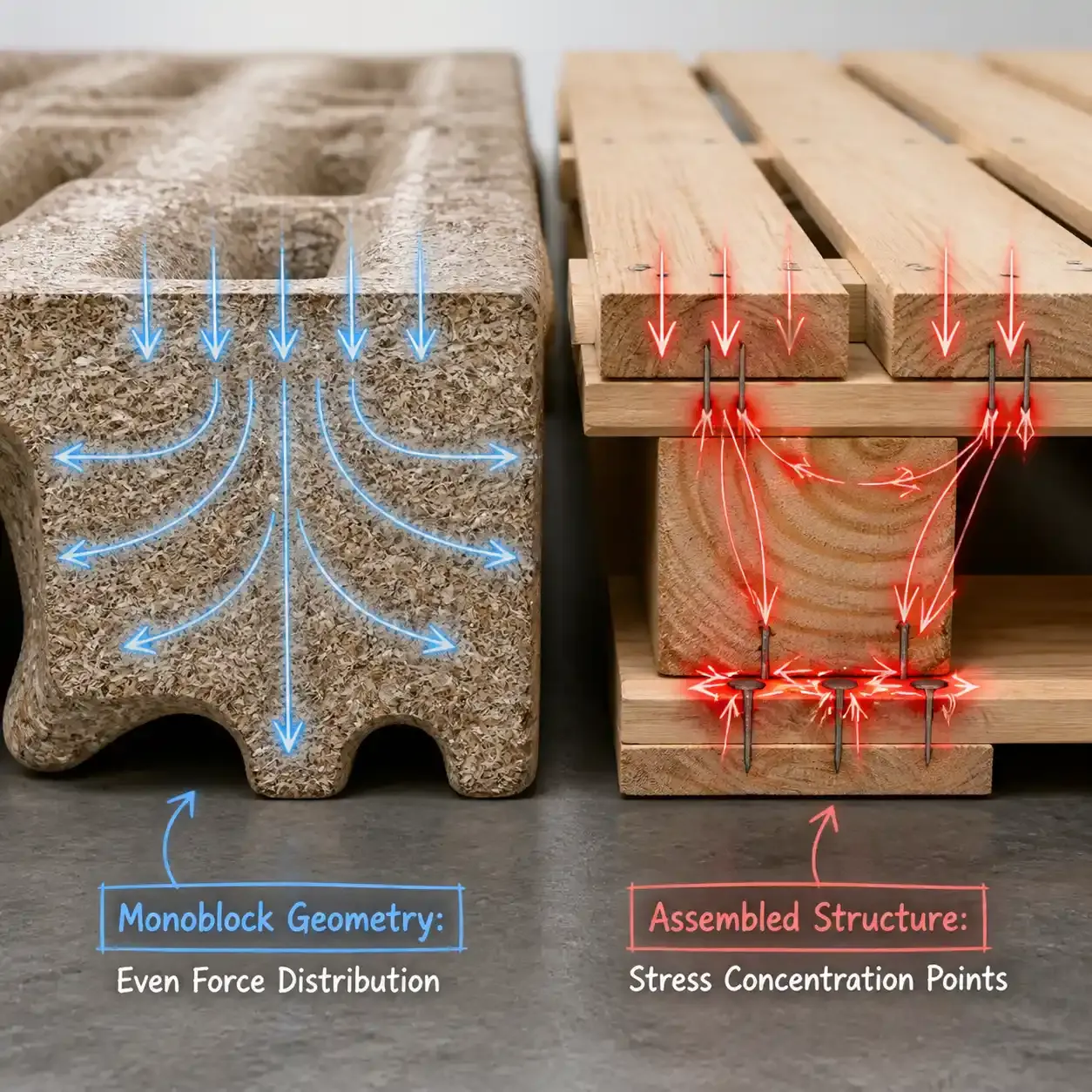
Export pallets fail in ways that are easy to misdiagnose. A deck bows upward after a few weeks in a container. Fork entry openings tighten until the tines no longer fit. A stack of loaded pallets leans to one side because the bottom unit has twisted. These symptoms are often attributed to load weight, poor handling, or manufacturing defects. In reality, a large share of molded pallet deformation traces back to one variable: moisture content.
A wood molded pallet is a fiber-resin composite. Wood fiber is hygroscopic—it absorbs and releases moisture as ambient conditions change. If the pallet leaves the factory with moisture content outside the specified range, or if the MDI bond does not fully encapsulate the fiber, the pallet will move dimensionally after it is packed. This article examines five dimensions of moisture content control and why they determine whether an export pallet arrives flat and dimensionally stable or warped and unusable.
The Physics: How Moisture Drives Dimensional Change
The first step to controlling deformation is understanding why moisture moves the pallet. Wood fibers swell as they absorb water and shrink as they dry. In a molded wood pallet, the fibers are bonded with resin, but they are not fully sealed—moisture can still migrate through the fiber matrix if the moisture content and resin distribution are not controlled.
The critical concept is equilibrium moisture content. Every wood-fiber product seeks equilibrium with the relative humidity of its surroundings. A pallet manufactured and packaged at 20°C and 50% relative humidity reaches equilibrium at roughly 8% to 9% moisture content. If that same pallet is loaded into a container that later reaches 85% relative humidity, the fiber will absorb moisture until it reaches a new equilibrium—potentially 14% to 16% moisture content. The swelling that accompanies this absorption creates internal stress. The deck bows, the legs distort, and the pallet loses dimensional accuracy.
Deformation is therefore not a sudden event. It is a slow re-equilibration process that occurs over the weeks the export pallet spends in transit. The only way to prevent it is to control moisture content at the factory and to package the pallet so that it does not absorb moisture before it is used.
Manufacturing Moisture Specifications: Why 6% to 8% Is the Target
The second dimension is the manufacturing specification. Leading molded pallet manufacturers dry the wood fiber before molding and control the moisture content of the finished pallet to a defined range, typically 6% to 8%.
This range is not arbitrary. Below 6%, the fiber becomes brittle and the resin may not cure evenly, reducing impact strength. Above 8%, the pallet carries excess moisture that will be released or absorbed during transit, increasing the risk of dimensional change. A molded wood pallet held at 6% to 8% has enough moisture to maintain fiber flexibility but not enough to drive significant swelling or shrinkage when ambient humidity changes.
The manufacturing process makes this control possible. The high-temperature pressing cycle drives residual moisture down, and the MDI adhesive reacts with the moisture present in the fiber to form a cross-linked structure. A molded pallet manufacturer that specifies and verifies the finished moisture content, rather than relying on incoming fiber moisture alone, produces a pallet with predictable dimensional behavior. Fumigation-free molded pallets that meet this specification are less likely to deform during export.
MDI Bonding and Moisture Encapsulation: The Chemistry That Resists Swelling
The third dimension is adhesive chemistry. The binder determines how much of the fiber surface is encapsulated and how resistant the finished pallet is to moisture uptake.
MDI (methylene diphenyl diisocyanate) resin reacts with hydroxyl groups on the wood fiber and with water present in the fiber to form a polyurea cross-linked network. This reaction consumes moisture as it cures and creates a hydrophobic barrier around the fiber bundles. The result is a molded wood pallet with strong water resistance and low moisture absorption. Under humid conditions, an MDI-bonded pallet absorbs far less water than a pallet bonded with urea-formaldehyde resin.
Urea-formaldehyde resin is cheaper, but it is hydrolytically unstable. It absorbs water, swells, and can lose significant strength when exposed to humidity. A molded pallet manufacturer that uses UF resin to reduce cost creates a pallet that may deform and weaken during ocean transit. For an export pallet exposed to container condensation, MDI is the appropriate chemistry. The difference is measurable in both moisture uptake and dimensional stability.
Testing and Quality Control: Verifying Moisture Content Before Shipment
The fourth dimension is verification. A moisture specification means nothing unless it is measured and recorded for every production batch.
Molded pallet manufacturers should test finished pallets using a calibrated moisture meter, sampling from multiple points on the deck and legs to confirm uniformity. The test results should be recorded and linked to the batch, so that if a deformation complaint arises, the manufacturer can trace it back to production conditions. Some manufacturers also conduct accelerated humidity testing, placing samples in a controlled chamber at high relative humidity and measuring dimensional change over time. This reveals whether the pallet will deform in the conditions it will actually encounter during export.
The quality control process should also monitor the molding parameters that affect moisture. Press temperature, dwell time, and cooling rate all influence the final moisture content. A molded pallet manufacturer that controls these parameters consistently produces pallets that leave the factory at the specified moisture level. A manufacturer that adjusts settings to increase output without monitoring moisture will produce pallets with variable dimensional behavior.
Packaging, Storage, and Loading: Protecting the Pallet Until It Is Used
The fifth dimension is protection after production. A fumigation-free molded pallet that leaves the factory at 7% moisture content can still absorb moisture during storage and transport if it is not packaged properly.
Molded pallet manufacturers typically wrap pallets in stretch film or moisture-barrier packaging before shipment. The packaging should cover the deck and edges, and it should be sealed so that humid air does not circulate through the stack. For export shipments, the pallet should be stored in a dry warehouse and loaded into the container as close to departure as possible. If the pallet sits on a humid dock for days before loading, it will absorb moisture regardless of its original condition.
The container environment also matters. A molded wood pallet loaded into a container that contains wet cargo or unventilated moisture sources will absorb humidity. Exporters should ensure that the container is dry before loading, that cargo is properly protected, and that the molded pallet is not exposed to direct water contact. The export pallet is a moisture-managed component, and its performance depends on protecting it through the entire supply chain.
Conclusion: Moisture Control Is the Foundation of Dimensional Stability
Molded pallet deformation is not inevitable. It is the predictable result of moisture content that is not controlled, measured, and protected. A molded pallet manufacturer that dries fiber to specification, uses MDI chemistry, verifies finished moisture content, and packages the pallet for humidity protection delivers a molded wood pallet that remains flat and dimensionally accurate through export transit.
For exporters, the lesson is to treat moisture content as a specification, not a background variable. Ask the molded pallet manufacturer for finished moisture test data, confirm the adhesive chemistry, and require moisture-barrier packaging. Fumigation-free molded pallets that meet these requirements avoid the warping, bowing, and twisting that turn a compliant export pallet into a rejected shipment. The technology is available, the specification is clear, and the deformation problem is preventable.


