

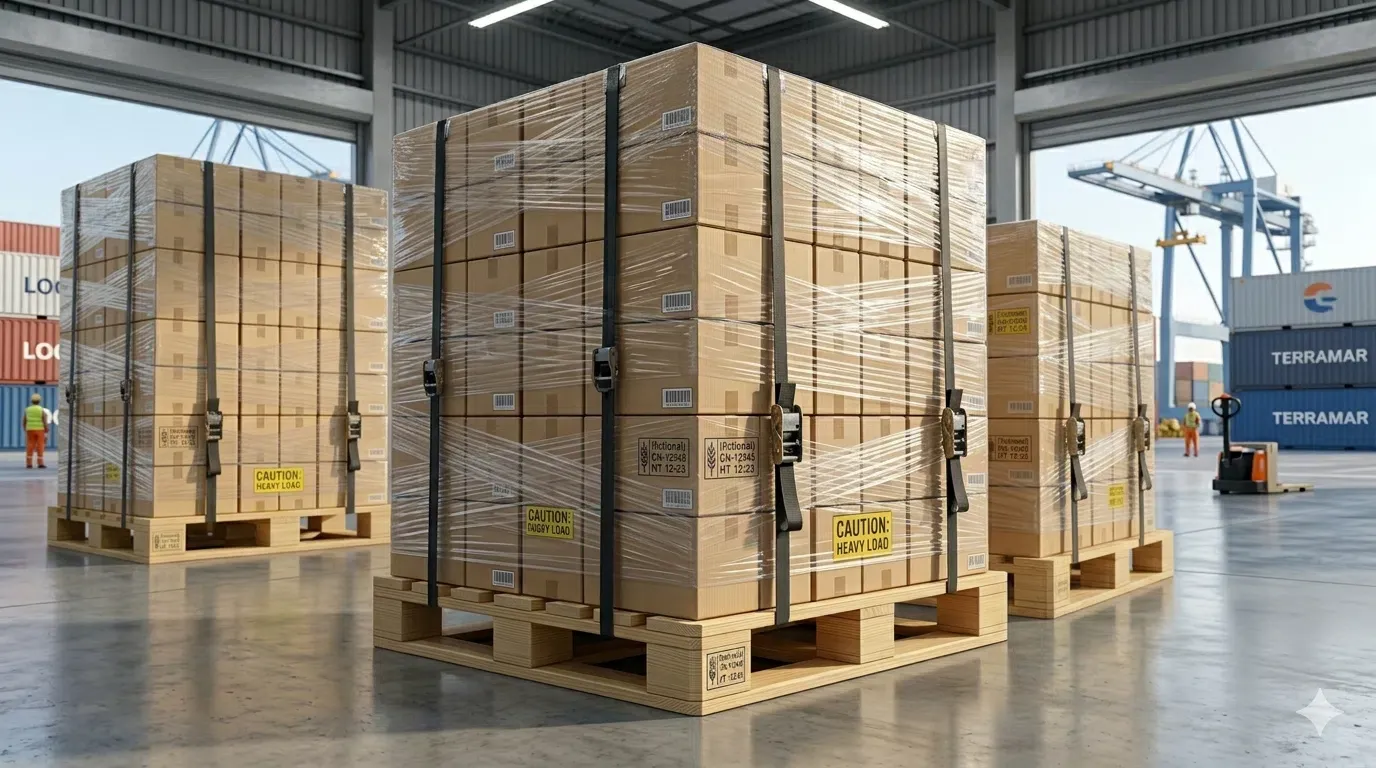
Forklift efficiency is rarely attributed to the pallet. Operators blame traffic, aisle width, or load weight. Yet the molded pallet’s foot design—whether it uses continuous stringer patterns or discrete block patterns—determines how quickly a forklift can approach, align, enter, lift, and exit. In high-volume export operations, those seconds compound into hours of lost throughput and avoidable damage.
A molded pallet is formed as a one-piece platform, but its underside geometry is engineered for specific handling profiles. Leading molded pallet manufacturers now offer both stringer-style and block-style foot patterns, and the choice affects forklift cycle time, load stability, and compatibility with automated equipment. This article examines five ways foot design influences export pallet forklift efficiency and how buyers should match the pattern to their handling environment.
Stringer and Block Foot Patterns: The Structural Difference That Shapes Handling
The first consideration is the structural distinction between the two patterns. A stringer-style molded wood pallet uses continuous longitudinal ribs running the length of the pallet, similar to the stringers on a conventional wooden pallet. These ribs create two-way entry: the forklift can approach from either end, but not from the sides. The continuous rib distributes load along its full length and provides a smooth, guided entry path for the forks.
A block-style molded pallet uses discrete feet positioned at the corners and midpoints, creating a nine-leg or similar configuration. This pattern typically allows four-way entry, so the forklift can approach from any side. The block feet concentrate load at specific points and create open space between them, which changes how the pallet sits on the floor, how it stacks, and how a forklift operator judges alignment.
For an export pallet moving through crowded loading docks, the entry pattern is not a minor detail. It determines whether a forklift must turn the vehicle, whether the operator can approach from the nearest side, and how much maneuvering space is required. A molded pallet manufacturer that offers both patterns allows the exporter to match the pallet to the dock layout rather than forcing the dock to adapt to the pallet.
Fork Entry Geometry and Alignment Time: Where Seconds Become Hours
The second efficiency factor is alignment time. Every forklift lift begins with an approach: the operator must position the forks at the correct height, width, and angle before entering the pallet. Poorly designed entry geometry extends this approach, and in a busy export warehouse, those extra seconds multiply across thousands of lifts.
Stringer patterns offer a natural advantage in guided entry. The continuous rib acts as a funnel, and the fork entry opening is bounded by a long, straight surface that helps the operator align the forks. Block patterns require more precise positioning because the entry is defined by discrete feet rather than a continuous guide. However, block patterns compensate with four-way entry, which can reduce alignment time by allowing the operator to approach from the closest side without repositioning the forklift.
The design details matter as much as the pattern. Leading molded pallet manufacturers chamfer the entry edges, radius the foot corners, and control entry height and width to tolerances that accommodate standard forklift tines. A molded pallet with sharp entry edges or inconsistent opening dimensions forces the operator to slow down and re-approach. A fumigation-free molded pallet designed for export handling should specify entry dimensions that match the forklift fleet, not merely meet a generic standard.
Load Distribution, Stability, and Stacking: How Foot Pattern Affects Safe Lifting
The third factor is load distribution. A stringer pattern spreads load along continuous ribs, which is advantageous for heavy, uniformly distributed cargo. The continuous support reduces point loading on the deck and provides a stable base for stacked loads. A block pattern concentrates load at the feet, which can be beneficial for cargo with concentrated weight, but it requires the deck to be stiff enough to bridge between support points.
For forklift efficiency, stability translates directly into speed. A pallet that shifts or flexes during lifting forces the operator to slow down, re-level the load, or abort the lift. A stable pallet allows a smooth, confident lift and a faster exit from the rack or container. Molded wood pallets are inherently stiff because they are formed as a single piece under high pressure, and both stringer and block patterns benefit from this stiffness. The difference is how the pattern interacts with the load: stringer patterns favor long, heavy loads, while block patterns favor modular loads and four-way access.
Stacking stability is also pattern-dependent. Block-style molded pallets often stack more predictably because the feet align with the pallet above, creating a columnar load path. Stringer-style pallets stack along the ribs, which is stable but may require more precise alignment. For export pallet operations that stack loaded pallets in warehouses or containers, the pattern should be selected with the stacking method in mind. A molded pallet manufacturer can provide load charts and stacking recommendations for each pattern.
Automated Forklifts and AGV Compatibility: Foot Design for Sensor-Driven Handling
The fourth factor is automation. Automated guided vehicles and robotic forklifts rely on sensors, cameras, and predefined entry points. They cannot compensate for misalignment the way a human operator can. Foot design therefore becomes a machine-vision and tolerance issue.
Block patterns are often preferred for automated handling because four-way entry gives the AGV more approach options and simplifies path planning. The discrete feet also create clear visual reference points for sensor systems. Stringer patterns can work well in automated systems, but the two-way entry constraint must be built into the AGV routing, and the continuous rib must present a consistent surface for the sensor to detect.
Tolerance control is critical in both cases. An automated system expects the entry opening to be within a defined range every time. A molded pallet manufacturer serving automated export pallet lines must hold dimensional tolerances tightly and verify them through inline inspection. Fumigation-free molded pallets that meet these tolerances allow automated forklifts to operate at full speed without sensor errors or failed engagements.
Container Loading, Warehouse Space, and Maintenance: The Hidden Efficiency Factors
The fifth factor extends beyond the forklift itself. Foot pattern affects how efficiently pallets load into containers, how much warehouse space they consume when empty, and how easily they are maintained.
Stringer patterns often nest more compactly because the continuous ribs align and stack with minimal gap. Block patterns can also nest, but the feet may create slightly more stack height depending on the design. For export pallet shipments where empty pallets are returned or stored, the nesting ratio directly affects freight and storage costs. A molded pallet manufacturer should specify the nesting ratio for each pattern so the exporter can calculate container utilization.
Maintenance is another consideration. Block patterns with open space between feet are easier to inspect and clean, which matters for food and pharmaceutical exports. Stringer patterns provide continuous support but may trap debris between ribs. Both patterns benefit from the molded pallet’s nail-free, moisture-resistant construction, but the cleaning routine differs.
Conclusion: Match the Foot Pattern to the Handling Reality
Molded pallet foot design is not a cosmetic choice. Stringer patterns guide entry and support long, heavy loads. Block patterns enable four-way access and suit modular loads and automated handling. The right choice depends on the forklift fleet, dock layout, stacking method, automation level, and maintenance requirements.
For exporters, the practical step is to evaluate foot pattern alongside load capacity and ISPM 15 exemption when selecting a molded pallet manufacturer. Request entry dimensions, nesting ratios, and load charts for each pattern, and pilot the pallet in the actual handling environment before committing to volume. A molded wood pallet that matches the forklift workflow delivers faster cycles, fewer damaged loads, and lower total handling cost. The export pallet is only as efficient as the interface between its feet and the forks that lift it.


