

Automotive logistics is one of the most demanding sectors in global shipping. Engine blocks, transmission housings, brake assemblies, and stamped steel components routinely weigh between 500 and 2,000 kilograms per unit load. These parts are often precision-machined, surface-critical, and destined for assembly lines where a single damaged component can halt production. The pallet beneath these loads must deliver uncompromising strength, dimensional stability, and regulatory compliance.
The molded pallet – also known as a presswood pallet or molded wood pallet – has emerged as the preferred export pallet for automotive component shipping. Engineered from recycled wood fibers bonded under extreme heat and pressure, a molded pallet offers load capacity, vibration dampening, and ISPM 15 exemption that traditional wooden pallets cannot match. Leading molded pallet manufacturers have refined this technology specifically for heavy-duty automotive applications, delivering fumigation-free molded pallets that keep assembly lines running worldwide.

Load Capacity and Structural Integrity for Heavy Components
The first requirement in automotive logistics is raw load capacity. A molded pallet is manufactured under 1,000 to 1,600 tons of pressing force, creating a dense, homogeneous structure with no nails, staples, or weak joints. This one-piece construction distributes weight evenly across the entire platform, eliminating the stress concentrations that cause traditional wooden pallets to fail under heavy point loads.
Standard molded wood pallets offer dynamic load capacities of 1,500 to 2,500 kilograms and static loads of 5,000 to 8,000 kilograms. Heavy-duty configurations achieve even higher ratings. Independent testing has confirmed that molded pallets are approximately twice as stiff as new hardwood pallets, providing the dimensional stability required for precision automotive components. A molded pallet manufacturer serving the automotive sector can supply export pallet configurations tailored to specific component weights and handling requirements. Fumigation-free molded pallets eliminate the risk of nail pops that can scratch machined surfaces or puncture protective packaging.
Vibration Dampening and Protection for Precision Parts
Automotive components are sensitive to vibration. During ocean transit, continuous low-frequency vibration can loosen fasteners, abrade surface finishes, and fatigue delicate electronic assemblies. The pallet’s ability to dampen rather than transmit vibration directly affects the condition of delivered parts.
A molded pallet excels at vibration dampening. The wood-fiber composite structure possesses inherent viscoelastic properties, converting vibrational energy into low-grade heat through internal friction. The MDI resin matrix adds a secondary damping mechanism. Unlike metal pallets that transmit vibration directly to cargo, a molded wood pallet absorbs energy and reduces transmissibility. This is particularly valuable for automotive electronics, sensors, and calibrated assemblies. A molded pallet manufacturer can provide test data demonstrating vibration dampening performance, giving automotive logistics engineers confidence that their export pallet will protect sensitive cargo. Fumigation-free molded pallets deliver this protection without the compliance delays of traditional wood.
ISPM 15 Compliance and Customs Efficiency for Global Automotive Supply Chains
Automotive supply chains are global, with components crossing multiple borders before final assembly. Every international shipment of solid wood packaging must comply with ISPM 15, requiring heat treatment or fumigation. This adds cost, delay, and customs risk. A single faded IPPC stamp can hold a container of engine parts for days, costing thousands in demurrage fees.
Fumigation-free molded pallets are permanently exempt from ISPM 15. The high-temperature manufacturing process sterilizes the material, classifying the molded pallet as processed wood. Customs clearance requires only a Material Declaration. Inspection rates are below one percent, and processing times are measured in minutes. For automotive exporters shipping to multiple continents, this compliance simplicity is transformative. A molded pallet manufacturer can supply destination-specific documentation, ensuring that the export pallet clears customs without surprises. Fumigation-free molded pallets keep assembly lines supplied without interruption.
Space Efficiency and Warehouse Optimization in Automotive Logistics
Automotive logistics operations face constant pressure on warehouse space. Components arrive in high volumes, and empty pallets accumulate quickly. Traditional wooden pallets are non-nestable, consuming vast cubic volume. A stack of 50 wooden pallets towers over 7 meters high, creating unstable loads and wasting valuable floor space.
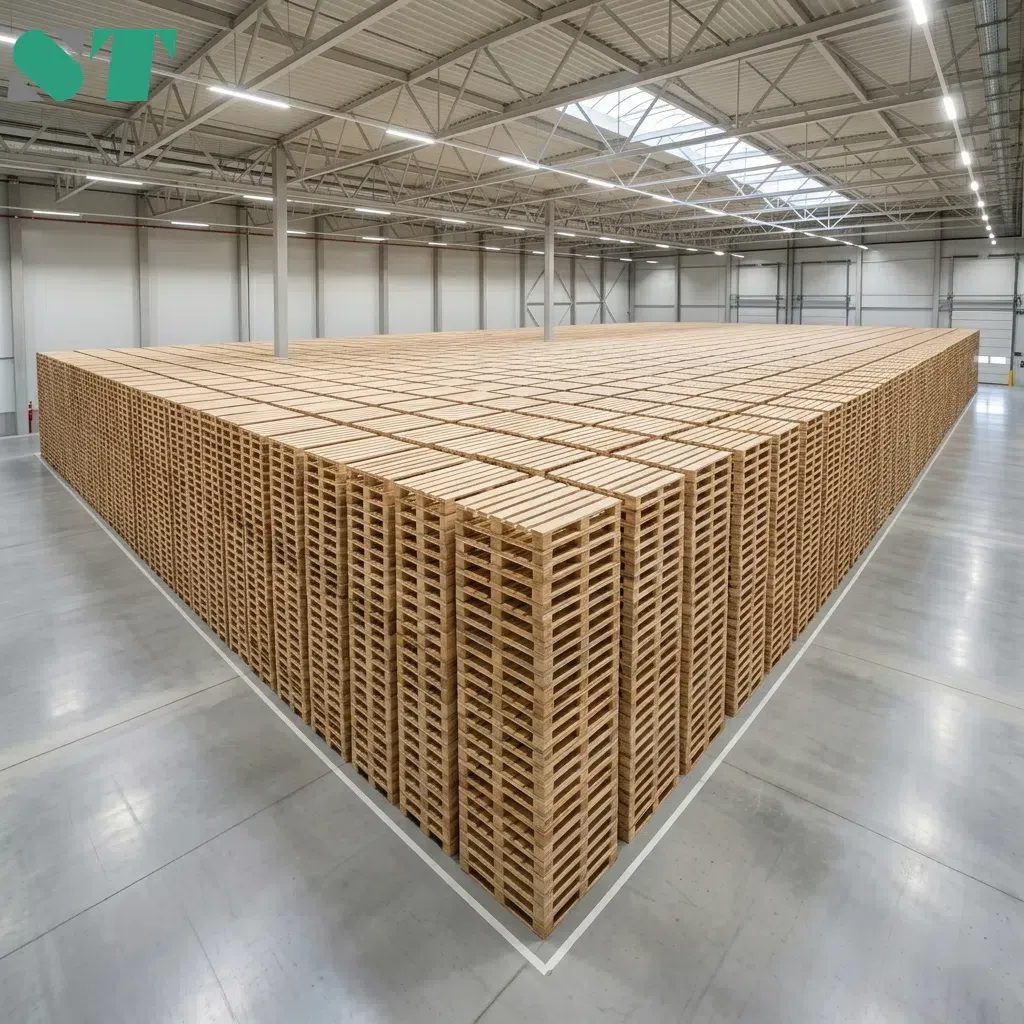
A molded wood pallet features a nestable design that achieves a four-to-one stacking ratio. Fifty molded pallets stack to approximately 2.2 meters, saving up to 70 percent in storage height. A standard 40-foot container holds approximately 1,650 molded pallets compared to 450 traditional wooden pallets, dramatically increasing freight density. For automotive logistics managers, this means more components per shipment, lower warehouse overhead, and faster container turnaround. A molded pallet manufacturer can supply export pallet solutions optimized for automated racking and conveyor systems. Fumigation-free molded pallets reduce storage footprint without compromising load capacity.
Cost Savings and Total Cost of Ownership for Automotive Exporters
The financial case for molded pallets in automotive logistics is compelling. Traditional wooden pallets require recurring fumigation fees of $5 to $25 per pallet per shipment. They break at rates of 20 to 30 percent, generating replacement costs and product damage claims. Their non-nestable design inflates freight and storage expenses.
A molded pallet eliminates these costs. Fumigation-free molded pallets remove treatment fees entirely. Their breakage rate is below five percent, reducing replacements. Their nestable design slashes freight and warehouse costs. Their nail-free surface prevents damage to precision components. A molded pallet manufacturer can provide a total cost of ownership analysis showing savings that typically exceed the initial price difference. For automotive exporters shipping thousands of pallets annually, the molded wood pallet delivers a measurable return on investment within months. The export pallet becomes a strategic asset rather than a disposable expense.
Conclusion: The Molded Pallet Is the Automotive Export Standard
Automotive logistics demands the highest levels of strength, protection, compliance, and efficiency. The molded pallet delivers on every dimension. Its high-pressure construction supports the heaviest components. Its vibration dampening protects precision parts. Its ISPM 15 exemption eliminates customs delays. Its nestable design optimizes warehouse and freight density. And its total cost of ownership outperforms traditional alternatives. Leading molded pallet manufacturers continue to innovate, developing fumigation-free molded pallets specifically engineered for automotive supply chains. For exporters shipping heavy components across borders, the molded pallet is not just an option—it is the standard. The technology is proven, the savings are documented, and the time to switch is now.


