


For exporters shipping goods across international borders, the sticker price of a pallet is deceptive. A two-dollar saving on a traditional wood pallet often costs thousands in punctured packaging, leaked product, and rejected shipments at customs. The real cost of a pallet is not what you pay upfront—it is what you pay over its entire lifecycle, from procurement to disposal, including fumigation, freight, storage, damage, and replacement.
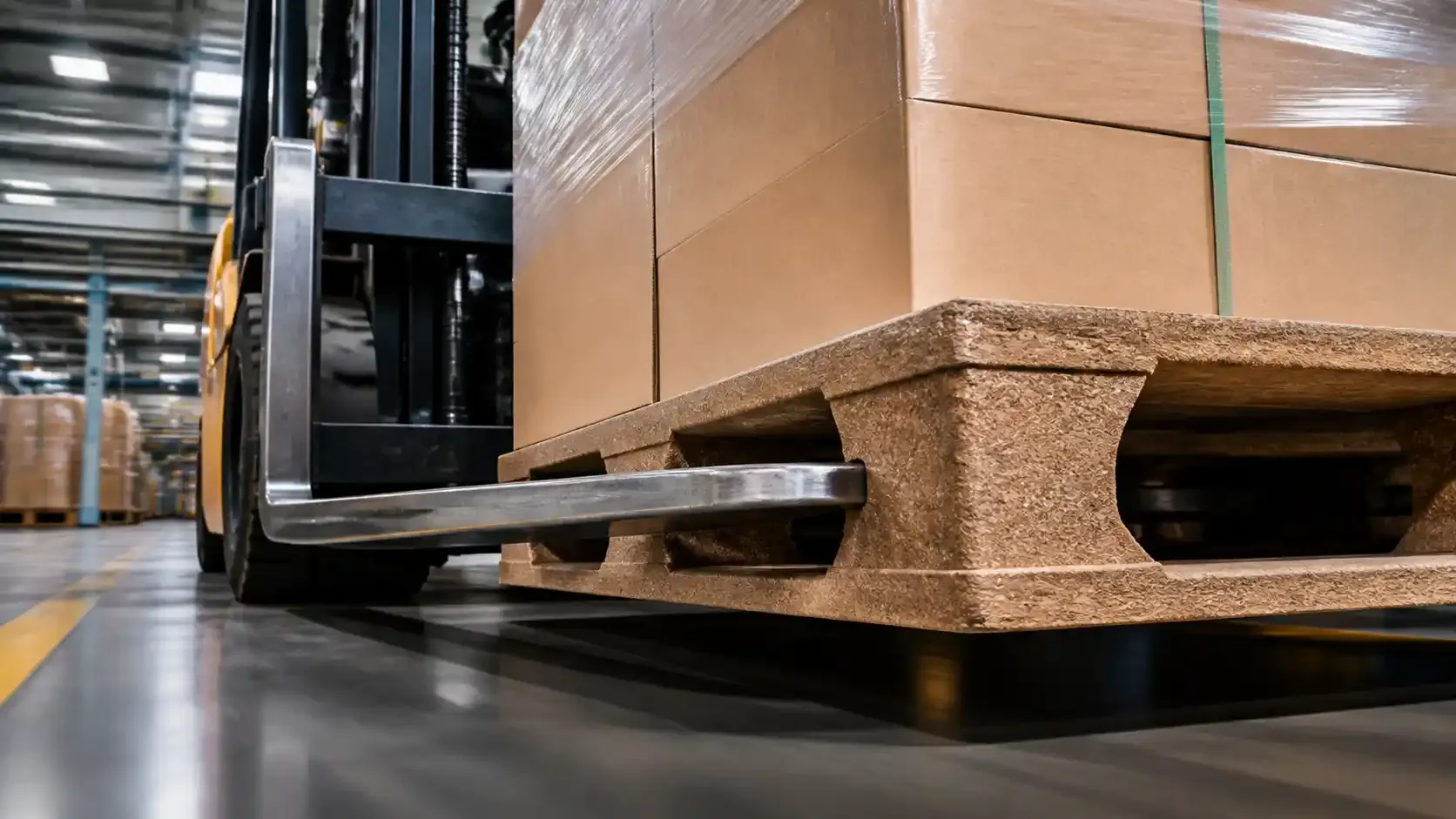
The molded pallet—also known as a presswood pallet or molded wood pallet—has emerged as the most cost-effective solution for export logistics. Engineered from recycled wood fibers under high heat and pressure, the molded pallet is permanently exempt from ISPM 15 fumigation requirements. It is lighter than solid wood, nestable for space efficiency, and free from nails that damage cargo. This article examines five key cost advantages that make fumigation-free molded pallets the superior choice for export pallet logistics.
Eliminating Recurring Fumigation Costs
The most immediate cost advantage of a molded pallet is the elimination of ISPM 15 fumigation fees. Traditional solid wood pallets require heat treatment or chemical fumigation for every international shipment—a recurring, non-negotiable expense that accumulates rapidly.
The numbers are compelling. Fumigation costs typically range from $10 to $25 per pallet, depending on location and volume. At around $5 per pallet, fumigating 1,000 pallets costs $5,000. For an exporter shipping 5,000 pallets annually, that means spending $25,000 each year just on fumigation fees. When factoring in compensation for delays and expedited freight charges, the true losses can exceed $30,000 annually.
The molded pallet eliminates this entire cost category. Manufactured at temperatures of 180 to 220 degrees Celsius, the molded pallet is classified as processed wood and permanently outside the scope of ISPM 15. It requires no fumigation, no heat treatment certificate, and no IPPC stamp. Customs clearance requires only a Material Declaration. That $25,000 annual fumigation bill? Instantly saved.
Beyond the direct fees, fumigation adds significant time costs. Treatment adds one to two days per shipment, and during peak season, queues can extend to a week. For time-sensitive export orders, these delays can jeopardize contracts and incur expedited shipping charges. The molded pallet eliminates fumigation delays entirely—load and go immediately.
Lightweight Design and Freight Cost Reduction
Weight is money in export logistics. Every kilogram of pallet weight adds to shipping costs, reducing the cargo weight you can carry within container limits.
The molded pallet delivers substantial weight savings. A molded pallet typically weighs between 6 and 32 kilograms depending on size, while a comparable solid wood pallet weighs approximately 27 kilograms. This weight reduction of 40 to 60 percent lowers gross cargo weight and directly reduces freight costs.
The freight savings compound across large volumes. Global shippers adopting molded wood pallet systems achieve 38 percent higher container load rates. IKEA’s implementation after switching to molded pallets reduced costs by $47 per shipment, with damage claims dropping by 73 percent, saving $2.1 million. The molded pallet’s lightweight engineering—16 kilograms versus 27 kilograms for traditional wood—contributed to these substantial savings.
For air freight, where charges are based on weight, the savings are even more pronounced. Every kilogram saved on pallet weight translates directly to lower freight bills and the ability to ship more product within the same weight allowance.
Nestable Design and Storage/Freight Density Savings
Traditional wooden pallets are space hogs. A stack of 50 solid wood pallets towers over 7 meters high—unstable and inefficient. They cannot nest, consuming vast warehouse space and reducing container loading density.
The molded pallet transforms this equation through its nestable design. Empty molded pallets stack partially inside one another, achieving a nesting ratio of up to 4 to 1. Fifty-five molded pallets can be stacked to approximately 2.2 meters, whereas the same number of traditional wooden pallets would reach about 7 meters. This saves up to 70 percent in storage space.
The freight density benefits are equally dramatic. A standard 40-foot container can hold over 1,500 empty molded pallets, compared to roughly 400 standard wooden pallets. This slashes per-unit transport costs by nearly 60 percent. For exporters shipping one-way pallets or managing return logistics, this density advantage translates directly to lower freight costs per unit.
Some molded pallet manufacturers report that their nestable designs save up to 70 percent of warehouse space compared to conventional pallets. In one documented case, a company using stackable molded wood pallets optimized warehouse space while maximizing cost per shipment, saving money on pallets while managing fewer product damage incidents and customer complaints.
Lower Breakage Rates and Reduced Replacement Costs
Traditional wooden pallets have a breakage rate of 20 to 30 percent, while molded pallets have a breakage rate below 5 percent. This difference has a profound impact on replacement costs and supply chain reliability.
The molded pallet’s durability stems from its one-piece, monoblock design manufactured using high-pressure hydraulic presses—often 1,600 tons of pressing force. This creates a dense, uniform structure with no nails, no boards, and no weak spots. The molded wood pallet deck is approximately 50 percent more resistant to impacts and damage by forklifts than standard wooden pallets.
Independent testing has confirmed that molded pallets are twice as stiff as traditional GMA pallet designs. This stiffness matters for pallet and unit load performance, reducing product damage during transit. For exporters shipping bagged goods like PVC resin or fertilizers, switching to a smooth-surface pallet reduces packaging damage rates by approximately 18 percent.
The lower breakage rate means fewer replacements, less downtime, and lower procurement costs over time. Traditional wooden pallets require frequent ad-hoc repairs—nail replacement, board swaps, and fumigation for export. Molded pallets need minimal onsite repair and can be cycled back to a central refurbisher, delivering a lower cost per trip.
ISPM 15 Compliance and Administrative Cost Savings
Beyond the direct fumigation fees, traditional wooden pallets impose significant administrative costs. Exporters must manage treatment certificates, coordinate with fumigation facilities, fill out forms, and track IPPC stamps. Any delay or error in the paperwork can lead to further checks at customs, grinding efficiency to a halt.
The molded pallet eliminates this administrative burden entirely. Because it is permanently exempt from ISPM 15, there are no treatment certificates to manage, no fumigation records to retain, and no IPPC stamps to inspect for fading or damage. Customs clearance requires only a Material Declaration.
The time savings are equally valuable. Fumigation delays of two to three days per shipment are eliminated entirely. For exporters handling time-sensitive orders, this means faster response times, shorter lead times, and a significant competitive advantage. One machinery exporter who switched to pressed wood pallets recently had a rush order that needed to be at the port in three days—he got it done in two, earning high praise from his client for his efficiency.
The molded pallet’s compliance advantage is recognized globally. Molded pallets are accepted at customs in the European Union, United States, Australia, Canada, Japan, South Korea, and most major importing countries without fumigation documentation. This global acceptance eliminates the risk of customs holds over faded stamps or missing documentation—a risk that can cost thousands in demurrage fees.
Conclusion: The Molded Pallet Delivers Superior Value
The cost advantage of fumigation-free molded pallets in export pallet logistics is clear and measurable across multiple dimensions. They eliminate recurring fumigation fees of $5 to $25 per pallet, saving exporters thousands annually. Their lightweight design reduces freight costs by 40 to 60 percent per pallet. Their nestable design saves up to 70 percent in warehouse space and increases container density by nearly 60 percent. Their lower breakage rate—below 5 percent versus 20 to 30 percent for traditional wood—dramatically reduces replacement costs. And their permanent ISPM 15 exemption eliminates administrative overhead and customs delay risks.
Leading molded pallet manufacturers continue to innovate, developing products with enhanced durability, lighter weight, and improved sustainability. For exporters seeking to reduce total cost of ownership, improve supply chain reliability, and eliminate the headaches of fumigation compliance, the molded pallet offers a proven, cost-effective solution.
The technology is mature, the savings are substantial, and the business case is compelling. The question is no longer whether molded pallets are cost-effective—they are. The question is how quickly your operation can start capturing these cost advantages.


