
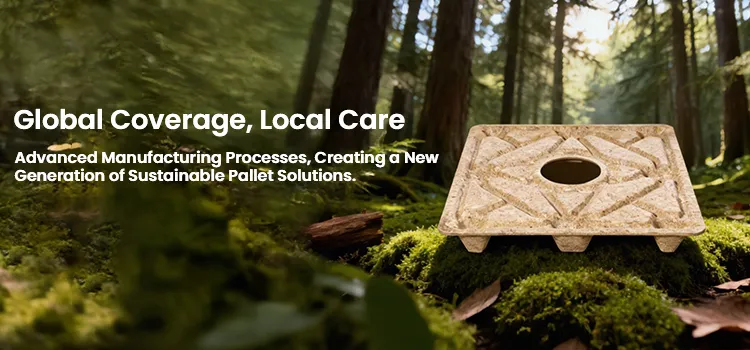

The wood molded pallet has evolved far beyond its origins as a simple alternative to nailed lumber. What began as a lightweight, fumigation-free export pallet has become a platform for innovation, with leading molded pallet manufacturers investing heavily in materials science, automation, and circular economy models. The next decade will redefine what a molded pallet can do—from self-monitoring load integrity to carbon-negative production. This article explores five innovation frontiers shaping the future of the molded wood pallet and what they mean for exporters, warehouse operators, and supply chain strategists.
Next-Generation Materials and Bio-Based Adhesives
The first frontier is material science. Traditional molded pallet manufacturing relies on MDI resin, a formaldehyde-free adhesive that creates waterproof bonds. Leading molded pallet manufacturers are now developing bio-based alternatives derived from plant starches, lignin, and agricultural byproducts. These adhesives reduce reliance on petrochemicals while maintaining the moisture resistance and structural integrity that exporters demand.
Innovation is also occurring in fiber sourcing. Beyond recycled wood waste, manufacturers are incorporating bamboo, rice husks, and coconut fibers into molded wood pallet production. These alternative fibers offer comparable strength with lower density, reducing pallet weight and freight costs. For the export pallet market, lighter pallets mean lower fuel consumption and higher container loading efficiency. Fumigation-free molded pallets made from these advanced materials maintain permanent ISPM 15 exemption while improving sustainability profiles. A forward-looking molded pallet manufacturer now offers material declarations that document biobased content and carbon footprint, enabling exporters to meet tightening environmental regulations in Europe and North America.
Smart Manufacturing and Industry 4.0 Integration
The second frontier is production technology. The next generation of molded pallet manufacturing lines incorporates AI-driven quality control, real-time sensor monitoring, and predictive maintenance. Presses now reach 3,000 tons of force, producing denser, stronger pallets with tighter dimensional tolerances. Automated inspection systems detect density variations, surface defects, and dimensional deviations at production speed, ensuring that every molded pallet meets specification before leaving the factory.
For the molded pallet manufacturer, this means higher yields and lower waste. For the buyer, it means consistent load capacity and reliable performance. Leading manufacturers are also adopting digital twins—virtual replicas of production lines that simulate changes before implementation. This reduces downtime and accelerates the development of new molded wood pallet designs. In the export pallet sector, traceability is becoming standard. QR codes and batch numbers allow buyers to verify the production date, material composition, and test results of every fumigation-free molded pallet shipment. This level of transparency builds trust and simplifies quality audits.
Design Innovations for Automation and Digital Integration
The third frontier is design. As warehouses adopt automated storage and retrieval systems, conveyor networks, and autonomous mobile robots, the molded pallet must function as an interface, not just a platform. Leading molded pallet manufacturers are embedding RFID tags, NFC chips, and low-power sensors directly into the molded wood pallet structure. These smart pallets transmit location, load weight, and environmental data to warehouse management systems.
The benefits for the export pallet are significant. A smart molded pallet can alert operators to load shifts during ocean transit, monitor humidity exposure, and confirm chain of custody at each handoff. Fumigation-free molded pallets equipped with sensors can provide customs authorities with real-time compliance data, further reducing inspection risk. Design innovation also extends to structural features. Manufacturers are developing pallets with reinforced corners for automated grippers, anti-slip surfaces for robotic arms, and nesting geometries that optimize stack stability. The molded pallet is becoming an active participant in the digital supply chain, not a passive carrier.
Sustainability and Circular Economy Breakthroughs
The fourth frontier is sustainability. The molded pallet is already a circular product—manufactured from recycled wood waste and fully recyclable at end of life. But leading molded pallet manufacturers are pushing further. Closed-loop take-back programs now collect used fumigation-free molded pallets from customers, regrind them, and reintroduce the material into new production runs. Some manufacturers achieve recycling rates above ninety-five percent, with zero landfill waste.
Carbon accounting is also advancing. Life cycle assessments show that a molded wood pallet generates approximately six kilograms of CO₂ equivalent, compared to eighteen kilograms for a traditional wooden pallet. Manufacturers are now offering carbon-neutral molded pallets by investing in reforestation or carbon capture projects. For exporters facing carbon border adjustment mechanisms in the European Union, this documentation is becoming essential. The export pallet is no longer just a logistical tool—it is a sustainability credential. A molded pallet manufacturer that provides transparent environmental data helps its customers meet ESG goals and avoid carbon tariffs.
Customization and Performance Optimization
The fifth frontier is customization. Exporters ship diverse cargo—from heavy machinery components to temperature-sensitive pharmaceuticals. No single molded pallet design fits all applications. Leading molded pallet manufacturers now offer modular mold systems that allow rapid changeover between sizes and configurations. Custom load ratings, entry options, and surface textures are available without the cost of dedicated tooling.
Performance optimization is also advancing through hybrid designs. Some molded wood pallets combine a high-density molded core with reinforced edge rails or steel inserts for extreme racking loads. Others feature conductive additives for electronics export or antimicrobial treatments for food and medical shipments. Fumigation-free molded pallets can be engineered to meet specific vibration dampening profiles, protecting sensitive equipment during ocean transit. For the export pallet buyer, this means a molded pallet can be tailored to the exact requirements of the cargo, the container, and the destination market. The molded pallet manufacturer becomes a solutions partner, not just a supplier.
Conclusion: The Future Is Molded, Smart, and Sustainable
The wood molded pallet is entering a new era. Bio-based materials, smart manufacturing, digital integration, circular economy models, and customized performance are transforming what a molded pallet can deliver. Leading molded pallet manufacturers are investing in these innovations to meet the demands of global exporters who need reliable, compliant, and sustainable shipping platforms.
The fumigation-free molded pallet will remain the core offering, but its capabilities will expand. It will carry sensors. It will document its own carbon footprint. It will adapt to automated warehouses. It will be customized for the cargo it protects. And it will continue to eliminate ISPM 15 fumigation, saving time and money for exporters worldwide.
For supply chain professionals, the message is clear. The export pallet of the future is not a commodity—it is a strategic asset. Partnering with an innovative molded pallet manufacturer is no longer just a procurement decision; it is a competitive advantage. The technology is advancing, the benefits are compounding, and the future of the molded wood pallet has already begun.


