

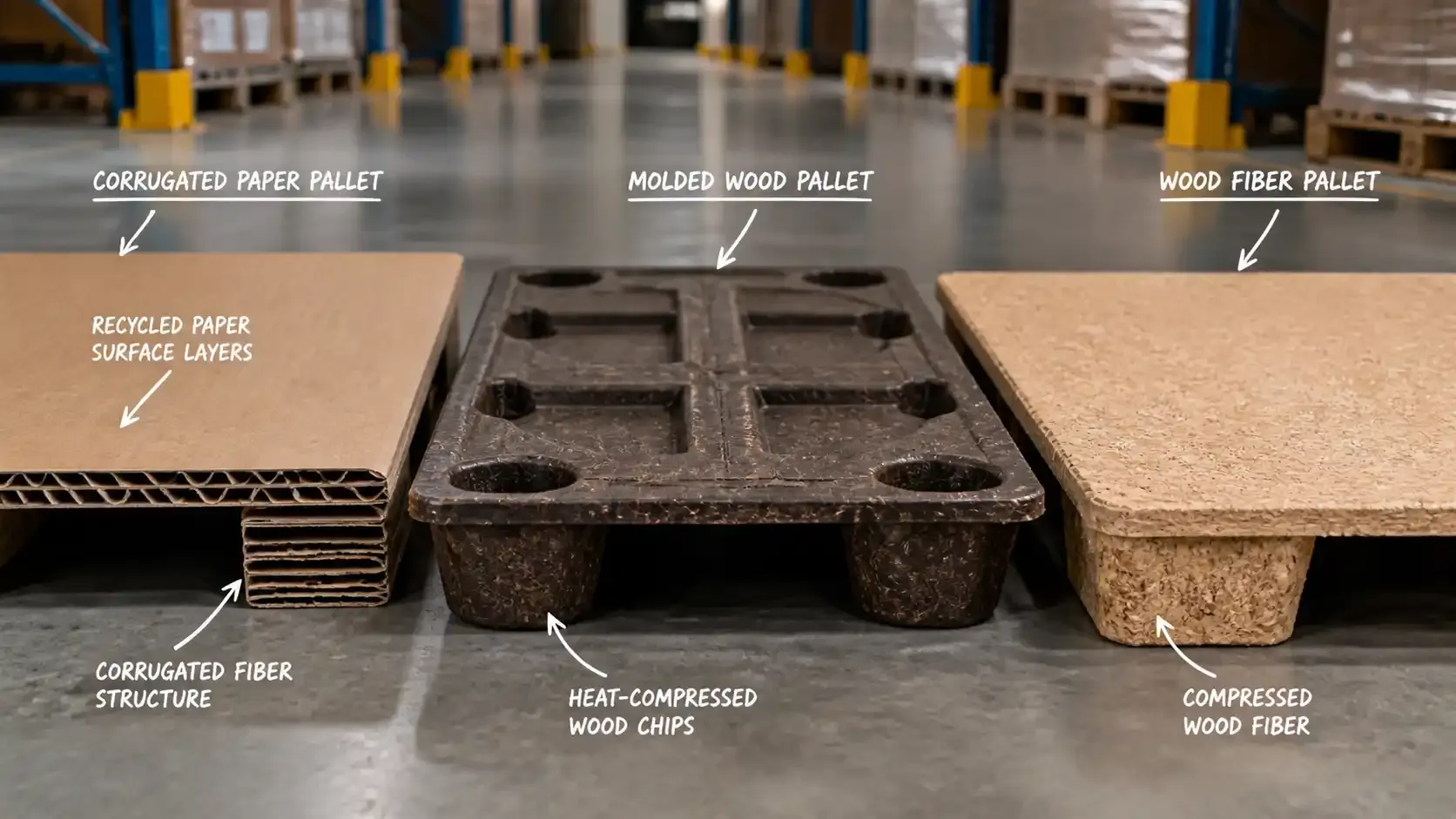
Every kilogram shipped across an ocean costs money. Freight rates for sea and air cargo are calculated partly on weight, and a pallet that is heavier than necessary reduces the payload available for revenue-generating goods. For exporters shipping high-volume, low-density products—consumer goods, packaged foods, electronics, and e-commerce parcels—the pallet’s tare weight can represent a meaningful share of total shipment weight. Reducing that weight without sacrificing strength is one of the most direct ways to lower landed cost.
The molded pallet has become the leading solution to this challenge. Manufactured from wood fiber and resin under high pressure, a molded wood pallet can weigh 40% to 60% less than a comparable hardwood pallet while maintaining the load capacity that export cargo demands. The key to this combination is high-density fiber engineering: the ability to compress fiber into a thin, dense structure that delivers stiffness and impact resistance without bulk. Leading molded pallet manufacturers have refined this technology to the point where a lightweight export pallet no longer means a weak one. This article examines five dimensions of high-density fiber solutions and why they are reshaping export pallet selection.
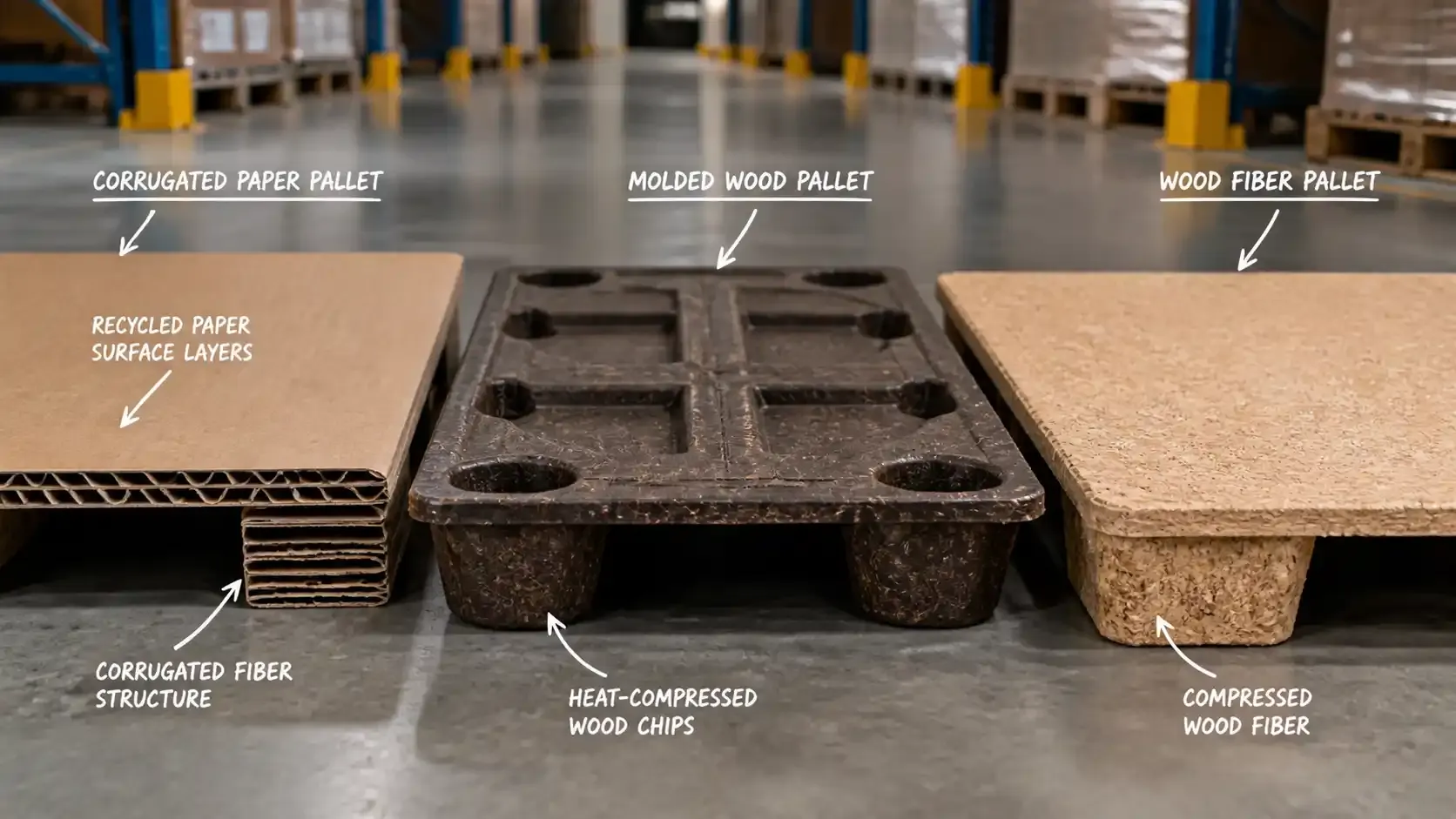
The Weight Problem: Why Traditional Pallets Carry Excess Mass
The first step to understanding lightweight solutions is recognizing where traditional pallet weight comes from. A standard hardwood pallet weighs roughly 20 to 25 kilograms, and heavier-duty configurations can exceed 30 kilograms. That weight is largely structural redundancy: thick boards, multiple stringers, and metal fasteners are used to compensate for the natural variability and lower strength-to-weight ratio of solid timber.
For export logistics, this weight is dead load. It consumes container payload, increases fuel consumption, and raises handling effort. In air freight, where chargeable weight is the primary cost driver, the penalty is even more pronounced. A pallet that weighs 25 kilograms instead of 12 kilograms adds 13 kilograms of chargeable weight per unit—multiplied across a shipment, this becomes a significant cost.
Traditional wooden pallets also absorb moisture, which adds further weight during humid transit. A pallet that gains several percent moisture content during an ocean voyage becomes heavier as the journey progresses, compounding the freight penalty. A lightweight molded pallet avoids this weight gain because its MDI-bonded structure resists water absorption.
High-Density Fiber Engineering: How Lightweight Strength Is Achieved
The second dimension is the engineering that makes lightweight strength possible. A molded pallet is not simply a thinner version of a wooden pallet. It is a different material system, and its performance comes from how the fiber is processed and bonded.
High-density fiber molding compresses wood particles and resin under pressures of up to 1,600 tons and temperatures of 180°C to 220°C. The result is a homogeneous structure with a density that can exceed 900 kilograms per cubic meter, significantly higher than the bulk density of assembled lumber. This density provides stiffness and impact resistance in a thin profile, allowing the pallet to achieve load ratings comparable to heavier wooden pallets while using far less material.
The geometry of the pallet also contributes to weight efficiency. Molded pallets use rib structures and optimized leg patterns that place material only where it is needed for load transfer and handling. A wooden pallet, by contrast, uses uniform board thickness across the entire deck, including areas that carry little stress. The molded design removes unnecessary mass while preserving the structural pathways that carry the load.
For exporters, the practical result is a molded wood pallet that weighs 6 to 15 kilograms depending on size and configuration, yet supports dynamic loads of 1,500 to 2,500 kilograms and static loads of 5,000 to 8,000 kilograms. This strength-to-weight ratio is what makes the lightweight export pallet viable for demanding cargo.
The Freight Economics: How Lighter Pallets Reduce Landed Cost
The third dimension is the financial impact. Lightweight pallets reduce cost through three mechanisms: lower freight charges, higher payload utilization, and reduced handling effort.
Freight charges fall because the pallet’s tare weight is lower. For sea freight, where weight and volume both influence cost, the reduction in tare weight allows more cargo within the same container weight limit. For air freight, where chargeable weight dominates, the savings are more direct: a molded pallet that weighs 10 kilograms less than a wooden alternative reduces chargeable weight by 10 kilograms per pallet.
Payload utilization improves because the weight saved on pallets can be redirected to revenue-generating goods. In a container with a fixed maximum gross weight, every kilogram of pallet weight is a kilogram of product that cannot be shipped. A lighter pallet shifts that balance in the exporter’s favor.
Handling effort declines because lighter pallets are easier to move manually and place less strain on forklifts and conveyors. This reduces operator fatigue, lowers injury risk, and can improve throughput in manual handling environments. A molded pallet manufacturer that designs for lightweight handling delivers operational benefits that extend beyond the freight invoice.
The nestable design of many molded pallets amplifies these savings. Empty pallets stack at a four-to-one ratio, reducing the volume of return shipments and the number of containers required for pallet repositioning. The combination of lower tare weight and higher nesting density makes the fumigation-free molded pallet one of the most freight-efficient export pallet options available.
Durability and Load Performance: Why Lightweight Does Not Mean Fragile
The fourth dimension addresses the most common concern about lightweight pallets: durability. Exporters who have experience with thin wooden pallets that crack under load may assume that a lighter molded pallet will perform similarly. The evidence does not support that assumption.
Molded pallets are engineered for stiffness and impact resistance. Independent testing has shown that molded wood pallets are approximately twice as stiff as new hardwood pallets, and their one-piece construction eliminates the joints and fasteners where wooden pallets fail. The high-density fiber structure distributes load across the entire deck, reducing point stress and extending service life.
Breakage rates for molded pallets are typically below 5%, compared to 20% to 30% for traditional nailed wood pallets. The MDI bond resists moisture, so the pallet does not weaken or delaminate in humid conditions. And because the pallet is molded as a single piece, there are no nails to protrude, no boards to split, and no fasteners to work loose.
The load capacity of a lightweight molded pallet is sufficient for most export cargo. Standard configurations handle dynamic loads of 1,500 to 2,500 kilograms and static loads of 5,000 to 8,000 kilograms. Heavy-duty versions extend these ratings further. For exporters shipping dense or heavy goods, a molded pallet manufacturer can specify a reinforced design that maintains the weight advantage while meeting the load requirement.
Supplier Selection: What to Verify in a High-Density Fiber Molded Pallet
The fifth dimension is supplier qualification. Not every molded pallet marketed as lightweight delivers the strength-to-weight performance that export cargo requires. Buyers should verify several characteristics before committing to a volume order.
The first is density and press capacity. A molded pallet manufacturer operating high-tonnage presses can achieve higher density and better fiber consolidation, which translates into stiffness and durability. The buyer should ask for the press capacity and the target density of the finished pallet.
The second is load test data. The supplier should provide ISO 8611 or ASTM D1185 test reports covering static, dynamic, and racking performance for the specific pallet specification. A lightweight pallet without verified load ratings is a risk, not a solution.
The third is moisture content and adhesive chemistry. MDI-bonded pallets resist moisture uptake and maintain their weight and dimensions in humid transit. The buyer should confirm the finished moisture content and the adhesive system, and request test data showing dimensional stability under high humidity.
The fourth is dimensional consistency. Automated handling systems require pallets that fit within tight tolerances. A molded pallet manufacturer that controls tolerances to within a millimeter or two delivers a lightweight export pallet that performs reliably in conveyor and racking systems.
The fifth is the ISPM 15 documentation package. A fumigation-free molded pallet should come with a Material Declaration and exemption statement as standard export files. Lightweight design should not come at the cost of compliance clarity.
Conclusion: Lightweight Is a Design Outcome, Not a Compromise
The lightweight export pallet is not a thinner, weaker version of a traditional pallet. It is the result of high-density fiber engineering that places material only where it is needed, bonds it into a homogeneous structure, and delivers stiffness and impact resistance at a fraction of the weight. Leading molded pallet manufacturers have turned this engineering into a practical advantage for exporters: lower freight costs, higher payload utilization, easier handling, and durable performance across repeated shipments.
For exporters evaluating pallet options, the message is to look past the weight figure to the evidence behind it. A molded wood pallet with verified load ratings, controlled moisture content, and tight dimensional tolerances delivers the lightweight advantage without the fragility that lightweight products often imply. The fumigation-free molded pallet combines this weight efficiency with permanent ISPM 15 exemption, making it a compelling choice for export logistics where every kilogram and every compliance detail matters.


