
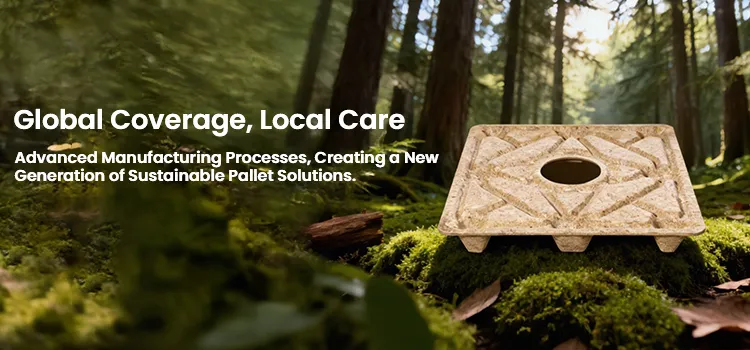

Pallets are the invisible backbone of global logistics. More than five billion pallets are in circulation worldwide, and 70 to 85 percent of them are traditional wooden pallets. Pallet production consumes up to 43 percent of all U.S. hardwood production and about 15 percent of softwood production. The carbon footprint of a single conventional wooden pallet during production is approximately 5.0 kg CO₂ equivalent. Multiply that by the billions of pallets manufactured and discarded each year, and the environmental impact becomes staggering.
Molded pallet manufacturers have recognized that the resin binder—not the wood fiber—is the primary carbon hotspot in molded pallet production. Traditional molded pallets rely on petrochemical adhesives, which contribute significantly to embodied carbon. By replacing these with bio-based resins derived from plants, agricultural byproducts, and industrial waste streams, manufacturers are achieving dramatic carbon reductions without compromising load capacity or moisture resistance. This article examines five ways leading molded pallet manufacturers are reducing carbon footprint through bio-based resin innovation.
Bio-Based PDI: The World‘s First Certified Bio-Based Adhesive Molded Pallet
The most significant breakthrough in bio-based resin technology comes from Suzhou Adson Low Carbon Technology, which developed the world’s first bio-based PDI adhesive molded pallet. Unlike conventional MDI (methylene diphenyl diisocyanate) binders derived from petrochemical feedstocks, PDI (pentamethylene diisocyanate) is derived from plant-based starch and other renewable materials.
The carbon footprint of Adson‘s bio-based molded pallet was verified at 1.8859 kg CO₂eq per unit—dramatically lower than traditional wooden, plastic, or metal pallets. The assessment followed the “cradle to grave” principle under ISO 14067, covering the entire product life cycle from raw material acquisition through manufacturing, transport, and end-of-life disposal. Despite PDI costing nearly double the price of conventional MDI, Adson chose the more eco-friendly option to reduce its carbon footprint.
The pallet is composed of more than 95 percent bio-based material by mass, using waste wood, small-diameter timber, and agricultural and forestry residues. Adson supplies downstream clients including China Merchants Group, Foxconn, Sinochem, Wanhua Chemical, and LG Chem. This certification demonstrates that the molded pallet industry can deliver verifiable, third-party-validated carbon reductions through bio-based resin innovation. For any exporter shipping to markets that prioritize traceable, low-carbon certified logistics carriers, this certified molded wood pallet offers a significant competitive advantage.
MDI with Bio-Based Feedstocks: Scaling Carbon Reduction at Industrial Volume
While PDI represents the cutting edge of bio-based chemistry, the broader adoption of MDI-based molded pallets with enhanced bio-content is delivering carbon reductions at industrial scale. Wanhua Chemical‘s MDI molded pallet solution utilizes waste wood, plant fibers, and agricultural and forestry residues as raw materials, achieving a wood resource utilization rate exceeding 95 percent and reducing carbon emissions by 50 to 80 percent compared to traditional pallets.
The MDI binder reacts with moisture in the wood fibers to form a polyurea cross-linked structure, creating a dense, gap-free internal matrix that delivers superior load capacity and dimensional stability. Dynamic fork lift load exceeds 2,000 kilograms, and pallet deck deformation is reduced by 30 percent compared to plywood pallets. The chemical structure remains stable from minus 40°C to 100°C, making the molded pallet suitable for cold chain applications.
The production process itself contributes to carbon reduction. MDI molded pallets tolerate a wider range of raw material moisture content, significantly reducing drying energy consumption. Hot pressing time is shortened by 50 percent, saving substantial steam and electricity. Each 40-foot container can carry 1,650 pallets—260 more than traditional pallets—improving transportation efficiency and reducing per-unit freight emissions. Wanhua‘s molded pallet solution has received the industry’s first ISO 14067 product carbon footprint verification statement, providing exporters with verified data for carbon reporting and CBAM compliance.
Lignin-Based Adhesives: A 100 Percent Bio-Based Alternative
The third frontier in bio-based resin innovation is lignin, a natural polymer that is the second most abundant organic material on Earth after cellulose. Lignin is a byproduct of the pulp and paper industry and is traditionally burned for energy. Leading molded pallet manufacturers are now using lignin as a complete replacement for petrochemical adhesives in molded wood pallet production.
Logistics Arts Production GmbH (LAP) has successfully completed test series confirming the use of bio-based lignin adhesive in combination with recovered wood for pallet manufacturing. The lignin adhesive is 100 percent bio-based, replacing conventional melamine, phenol, and formaldehyde resins that dominate presswood pallet production. The advantages are compelling. Lignin is a natural resource that requires no additional land use. The adhesive eliminates fossil-based binders entirely. The carbon stored in the wood remains permanently bound in the product—a principle known as cascade utilization. And at end of life, the lignin-bound molded pallet can be energetically recovered, completing the circular cycle.
LAP management emphasizes that sustainability is not a compromise but a competitive advantage. With prices for wood, plastics, and other pallet materials rising continuously, bio-based raw materials could create a decisive competitive edge in the coming years. For molded pallet manufacturers, lignin represents a pathway to completely fossil-free production.
Life Cycle Assessment: Quantifying the Carbon Advantage
The carbon benefits of bio-based resins are validated through rigorous Life Cycle Assessment. Presswood pallets manufactured with natural binders such as starch and lignin have a production carbon footprint of approximately 1.7 to 2.5 kg CO₂ equivalent per pallet, compared to approximately 5.0 kg CO₂ equivalent for wooden EPAL pallets. Transport emissions per 100 kilometers are also significantly lower: approximately 0.02 to 0.03 kg CO₂ equivalent for presswood pallets versus 0.12 kg CO₂ equivalent for wooden pallets.
For a molded pallet manufacturer, these numbers translate directly into competitive advantage. The global molded wood pallets market is projected to reach USD 4.1 billion by 2036, growing at a compound annual growth rate of 6.1 percent. Buyers increasingly evaluate load strength, material consistency, and compliance documentation—including carbon footprint data—before approving repeat purchases. A molded pallet manufacturer that can provide ISO 14067 carbon footprint verification and document bio-based content is positioned to win contracts from sustainability-conscious exporters.
The carbon advantage extends across the entire logistics chain. A molded wood pallet that weighs 5 to 7 kilograms, compared to 15 to 20 kilograms for a standard wooden pallet, reduces transport emissions by 60 to 75 percent per 100 kilometers. Combined with a 4-to-1 nesting ratio that allows 1,650 molded pallets per 40-foot container versus 450 wooden pallets, the freight efficiency gains compound the resin-level carbon reductions. For the export pallet market, the molded pallet delivers carbon savings at every stage—production, transport, and end of life.
Circular Economy Integration: Closing the Carbon Loop
Bio-based resins do more than reduce carbon at production—they enable circular economy models that keep carbon locked in productive use. Molded pallets made with bio-based PDI, MDI, or lignin adhesives can be crushed and recycled into new molded pallets at end of life. Wanhua Chemical reports that recycling molded pallets cuts chemical resin usage by 80 percent and advances green circular processes. The carbon stored in the wood fiber remains sequestered through multiple product cycles.
The take-back programs operated by leading molded pallet manufacturers ensure that used fumigation-free molded pallets are collected, reground, and reintroduced into production. Some manufacturers achieve recycling rates above 95 percent, with zero landfill waste. This closed-loop approach means the carbon invested in the original bio-based resin is not released as emissions but remains bound in new products.
For exporters facing the European Union’s Carbon Border Adjustment Mechanism, this circularity provides a direct compliance advantage. CBAM cost analysis shows that old-style molded pallets without MDI carry a carbon cost of approximately $4.80 per pallet, while future-ready low-carbon molded pallets with certified bio-based resin have a baseline carbon footprint of just 5.967 kg CO₂ equivalent. As carbon pricing expands and reporting requirements tighten, the bio-based molded pallet transforms from a sustainability preference into a financial necessity. A molded pallet manufacturer that offers certified bio-based resins helps its customers avoid carbon tariffs while meeting their own ESG commitments.
Conclusion: Bio-Based Resins Are the Future of Molded Pallets
Molded pallet manufacturers are demonstrating that carbon footprint reduction and commercial performance are not competing objectives. Bio-based PDI derived from plant starch delivers a certified carbon footprint of 1.8859 kg CO₂ equivalent per pallet. MDI with enhanced bio-content achieves 50 to 80 percent carbon reduction at industrial scale. Lignin-based adhesives offer a completely fossil-free pathway. Life cycle assessments confirm that bio-based molded wood pallets generate a fraction of the carbon emissions of conventional alternatives. And circular recycling programs keep that carbon locked in productive use across multiple product generations.
Leading molded pallet manufacturers—Adson with bio-based PDI, Wanhua Chemical with MDI and agricultural residues, and LAP with lignin adhesives—are proving that the technology is mature, the carbon data is verified, and the commercial case is compelling. For exporters and warehouse operators seeking a fumigation-free molded pallet that meets tightening carbon regulations, the bio-based resin molded wood pallet is not just an option—it is the export pallet of the future. The technology is proven, the carbon savings are documented, and the time to adopt is now.


