
An export pallet that arrives a week late is not a pallet—it is a missed container booking, a demurrage charge, or a delayed production line. For European exporters, the arithmetic of pallet procurement has shifted decisively. Sourcing molded pallets from distant manufacturing hubs may offer a competitive unit price, but the logistics burden of ocean freight, customs clearance, and unpredictable lead times often erodes those savings. Local sourcing from European molded pallet manufacturers is emerging as the strategic answer, compressing delivery timelines and building resilience into supply chains that cannot afford interruption.
Europe is the world‘s largest regional market for molded fiber pallets, accounting for roughly 39% of global share, and the continent’s molded pallet manufacturers are responding by positioning production close to the customers they serve. This article examines five ways local sourcing from European molded pallet manufacturers accelerates export pallet delivery—and why the molded wood pallet is the platform best suited to this localized model.
Geographic Proximity and the 600-Kilometer Delivery Radius
The most direct driver of faster delivery is geographic proximity between production and consumption. European molded pallet manufacturers have deliberately distributed their production footprints to shorten the last mile, and the results are measurable in days rather than weeks.
The local-production model is well established in European pallet logistics. Q-Pall, for example, operates factories in Denmark, Germany, France, and Spain with a stated objective of never being more than 600 kilometers from its customers, noting that transporting pallets from a single central point across Europe is expensive because trucks largely transport air over long distances. This geographic discipline reduces transport costs and, critically, compresses the delivery window from weeks to days.
For molded pallet buyers, this proximity translates into a different procurement rhythm. Instead of planning around a 45-to-75-day cycle that includes ocean freight and port congestion, European buyers can operate on replenishment cycles measured in days. A molded wood pallet manufactured in the Netherlands or Germany can reach most Western European destinations within a working week, allowing exporters to respond to order surges without holding large buffer inventories. The molded pallet manufacturer that invests in regional capacity is, in effect, selling time as much as product.
Regional Manufacturing Footprints That Shorten Lead Times
Beyond individual factory locations, the depth of a molded pallet manufacturer’s European footprint determines how quickly orders can be fulfilled and how flexibly capacity can be redirected.
INKA Paletten illustrates the model. The German company, which introduced its first presswood pallet in 1971 and gave its name to the “Inka pallet” category, now has production handled by its partner Presswood in Ermelo, the Netherlands, while INKA focuses on sales and distribution throughout Europe through a comprehensive dealer network. INKA one-way presswood pallets are available in all standard sizes from quarter pallets to the CP3 format, and the production process guarantees pest-free status and ISPM 15 compliance without additional treatment or marking. For an exporter, this means a fumigation-free molded pallet can be ordered through a local distributor and delivered without the phytosanitary documentation delay that accompanies solid wood.
The multi-site model extends further. Presswood International operates production locations in Ermelo and Berlin, supported by a worldwide reseller network that includes seven partners in the Netherlands alone. Binderholz positions its pressboard pallets, made from sawdust and recycled wood chips, with explicitly short delivery times as a commercial feature. Engelvin Bois Moulé in Mende, France, is the country‘s only manufacturer of standard-sized molded wood pallets and has built its business on valorizing local sawmill by-products, giving French exporters a domestic source for PEFC-certified molded pallets. Each of these manufacturers shortens the physical and administrative distance between pallet production and export dispatch.
Inventory Localization: Fast-Movers in Stock, Molds Near the Customer
Delivery speed is not only a function of factory location—it depends on whether the right pallet is already in stock when the order arrives. European molded pallet manufacturers have refined inventory strategies that make rapid fulfillment possible without requiring customers to carry large safety stocks.
The Q-Pall model again provides a clear example. The company ensures that best-selling “fast mover” pallets are held in stock at every factory, enabling quick and efficient delivery. For customer-specific and project-related pallets, the strategy is even more distinctive: rather than keeping production centralized, Q-Pall moves the mold to the factory closest to the end customer. This approach gives the buyer the delivery speed of a local supplier without sacrificing product customization.
For exporters sourcing a molded wood pallet, this combination—standard sizes available ex-stock, custom molds deployable to a nearby plant—removes the trade-off between speed and specification. The molded pallet manufacturer effectively becomes a responsive extension of the exporter’s operations rather than a distant supplier whose lead times must be planned around. In markets where order patterns are volatile, this inventory posture is a competitive differentiator.
Supply Chain Resilience and Second-Source Availability
Faster delivery in normal conditions is valuable; guaranteed delivery during disruption is essential. Local sourcing from European molded pallet manufacturers builds resilience that import-dependent supply chains cannot replicate.
Multiple production locations create redundancy. Q-Pall explicitly markets its multi-site European footprint as a second-source guarantee: if a production problem occurs at the facility where a particular pallet type is made, or in the worst case a factory is lost, another location can take over production using a copy mold, ensuring customer production continues without interruption. For an exporter whose entire outbound schedule depends on pallet availability, this redundancy is a form of operational insurance.
The resilience argument extends beyond factory redundancy. Sourcing within Europe eliminates exposure to ocean freight disruptions, port congestion, and the customs variability that accompanies imported pallets. As European pallet buyers increasingly evaluate supply chain resilience alongside unit price, the local molded pallet manufacturer’s ability to promise continuity becomes a decisive advantage. The export pallet is no longer a commodity purchased on price alone—it is a supply-critical component whose availability must be assured.
Compliance Proximity and the Regulatory Advantage of European-Made Molded Pallets
Local sourcing also accelerates delivery indirectly by reducing compliance friction. A fumigation-free molded pallet from a European manufacturer arrives with the documentation and regulatory alignment already in place for European export operations.
INKA, for instance, states that its presswood pallets are guaranteed pest-free from the production process and already comply with ISPM 15, so no additional treatment or marking is required—making them suited as universal load carriers for worldwide export, including demanding markets such as the USA, China, and Australia. The company provides personalized export certificates as standard documentation. Engelvin’s molded wood pallets carry PEFC certification and NIMP 15 thermal treatment certification, with a declared global warming potential of −7.66 kg CO₂ equivalent per unit for its urea-formaldehyde configuration—a carbon-negative profile that supports European sustainability reporting.
Binderholz classifies its pressboard pallets as “processed wood” under ISPM 15, suitable for global export, with an interlocking design that saves storage and transport space compared to standard Euro pallets. For an exporter shipping within or from Europe, a European-made molded pallet means the compliance work is already done by a manufacturer operating under the same regulatory framework—no surprises at the border, no re-documentation, no delay. The molded pallet manufacturer becomes a compliance partner, not just a product supplier.
Conclusion: Local Sourcing Turns Pallet Procurement into a Speed Advantage
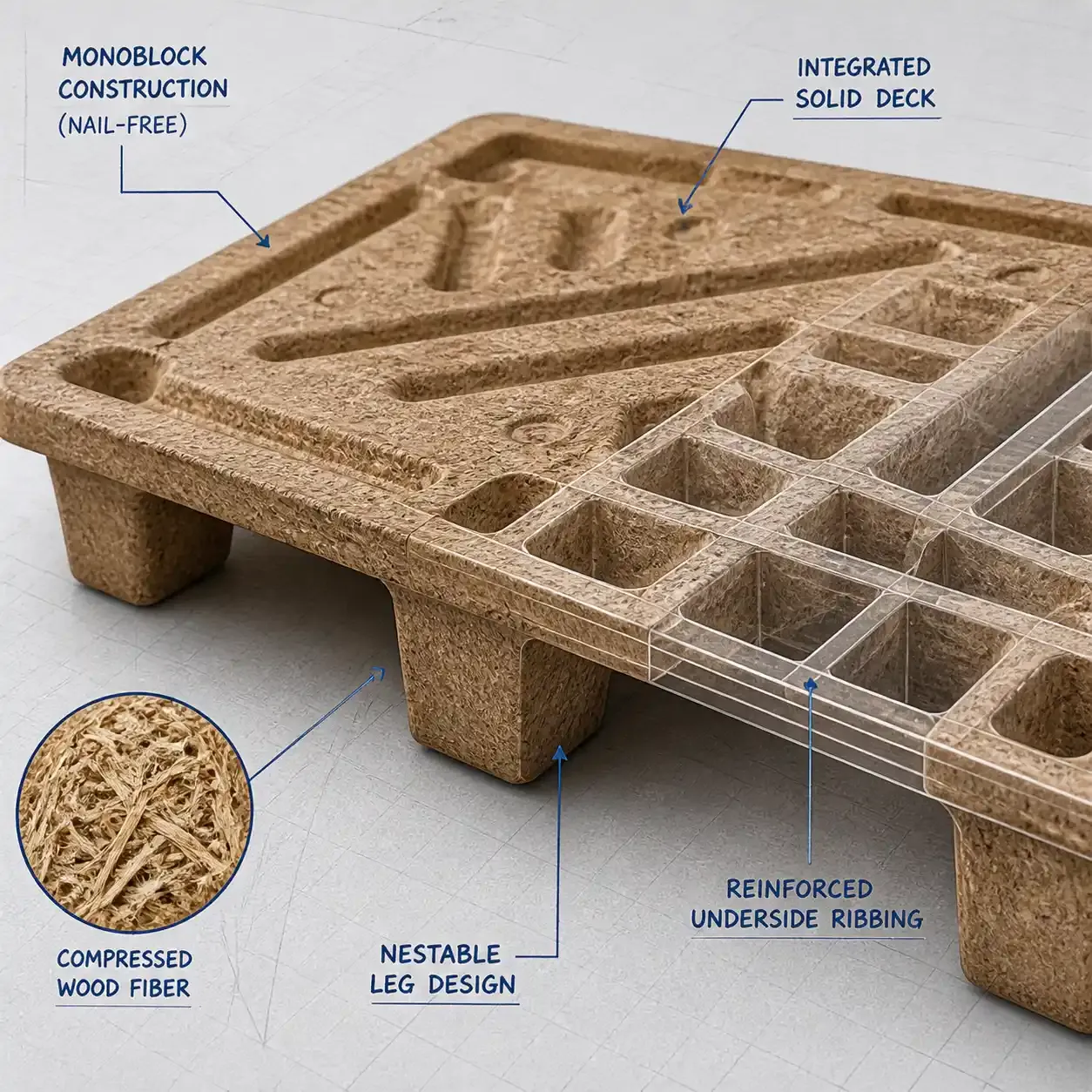
For European exporters, the choice of molded pallet supplier is ultimately a choice about time. Local sourcing from European molded pallet manufacturers compresses delivery from weeks to days, localizes inventory so the right pallet is available when needed, builds redundancy that protects against disruption, and eliminates the compliance friction of cross-border pallet imports. The molded pallet itself—fumigation-free, nestable, lightweight, and durable—is the ideal platform for this localized model, and Europe’s manufacturers have built the production footprint and distribution networks to deliver it reliably.
The exporters who gain the most are those who treat pallet sourcing as a supply chain design decision rather than a purchasing transaction. A molded wood pallet from a nearby European manufacturer is not merely a compliant export platform—it is a faster, more resilient, and more predictable way to keep goods moving. For operations where every delivery window matters, that proximity is the advantage that compounds.


