

For exporters seeking alternatives to traditional solid wood pallets, the engineered wood category offers multiple options. Two of the most frequently compared are the molded pallet – also known as a presswood pallet or molded wood pallet – and the particleboard pallet. Both are manufactured from wood particles and resin, both are exempt from ISPM 15 fumigation requirements, and both offer advantages over conventional nailed lumber pallets.
Yet despite their similarities, these two pallet types are fundamentally different products with distinct performance characteristics, cost structures, and application fit. The molded pallet is formed under extreme heat and pressure into a one-piece, integrated structure. Particleboard pallets, by contrast, are typically assembled from flat particleboard panels cut and fastened together – often with nails or staples – in a traditional pallet configuration.
This article compares these two export pallet options across six critical dimensions – manufacturing process, load capacity and structural integrity, moisture resistance and durability, ISPM 15 compliance, space and freight efficiency, and total cost of ownership – to help you determine which engineered wood pallet delivers better value for your export operation.
Manufacturing Process: One-Piece Molding vs. Panel Assembly
The manufacturing process is where the molded pallet and particleboard pallet diverge most fundamentally.
A molded pallet is manufactured through a high-pressure compression molding process. Wood fibers, chips, shavings, and other wood by-products are mixed with resin – typically MDI (methylene diphenyl diisocyanate) – and placed into a precision steel mold. The mold is subjected to extreme heat – typically 180°C to 220°C – and immense pressure, often 1,000 to 1,600 tons of pressing force. The result is a single, one-piece structure with the top deck and support legs formed in a single molding step. Every molded pallet produced from the same mold is geometrically identical, with tight dimensional tolerances.
Particleboard pallets are made from flat particleboard panels – manufactured in the same way as particleboard used in furniture and construction. Wood particles are mixed with resin, formed into sheets, and pressed flat. These panels are then cut to size and assembled – typically with nails, staples, or brackets – into a pallet configuration. Unlike the molded pallet, a particleboard pallet is an assembled product with multiple components and potential failure points at the joints.
The difference is critical. A molded pallet has no nails, no staples, and no joints – it is a single, integrated platform. A particleboard pallet, while using engineered wood panels, still relies on mechanical fasteners that can loosen, protrude, or fail over time.
Load Capacity and Structural Integrity: Strength Under Pressure
For exporters shipping heavy loads, load capacity is non-negotiable. The molded pallet delivers exceptional performance across static, dynamic, and racking load conditions.
A standard 1200 by 1000 millimeter molded pallet offers a dynamic load capacity of 2,000 kilograms and a static load capacity of 8,000 kilograms. The 1200 by 800 millimeter Euro format provides 1,500 kilograms dynamic and 5,000 kilograms static. Heavy-duty molded pallet configurations achieve dynamic loads of up to 2,500 pounds and static loads exceeding 17,000 pounds in independent testing. Some molded pallet manufacturers report static loads reaching 7 to 8 tons.
Independent testing conducted by Virginia Tech compared Litco's Inca molded wood pallet to new and repaired GMA-style wood pallets. The molded pallet demonstrated static strength of 12,432 to 17,259 pounds – exceeding the static strength of new GMA-style pallets. The molded pallet deck was found to be approximately twice as stiff as conventional pallet designs. This stiffness provides more stable movement on forklifts, reduces compression damage to packaged product, and makes product more resistant to load shift during transportation.
Particleboard pallets have significantly lower load capacities. Lightweight particleboard pallets typically carry 300 to 500 kilograms of goods. Particleboard pallets are generally recommended for lighter loads and single-use applications. While reinforced particleboard pallets may achieve higher capacities, they cannot match the one-piece structural integrity of a molded pallet.
The molded pallet's high-density, one-piece construction creates a platform that distributes weight evenly across the entire surface. The molded pallet's superior load capacity makes it the clear choice for heavy machinery parts, industrial components, and dense raw materials.
Moisture Resistance and Durability: Surviving Ocean Transit
Export shipments face harsh conditions – humidity, temperature swings, salt air, and the "container rain" phenomenon common in ocean shipping. Moisture resistance is critical.
The molded pallet excels in moisture resistance. MDI resin creates a polyurethane molecular chain that is chemically stable and waterproof. The hydrophobic bond formed during the MDI curing process prevents rot and massive weight fluctuation seen in natural timber. Molded pallets maintain their structural integrity even in high-humidity shipping lanes. The high-density structure – achieving 900 kilograms per cubic meter perimeter density – grants severe resistance against forklift tine impacts and moisture intrusion.
The manufacturing process itself enhances durability. The molded pallet is formed under temperatures of 220°C, with the products receiving internal temperatures exceeding 133°F (56°C) for more than 30 minutes. This high-temperature sterilization destroys all contaminants including listeria, resident pests, molds, and fungi. The finished product has a moisture content of not more than 9 percent.
Particleboard pallets face significant moisture vulnerability. Traditional particleboard pallets often use urea-formaldehyde (UF) adhesives, which break down under high humidity and temperature fluctuations. While phenol-formaldehyde and melamine-formaldehyde resins provide better moisture resistance, they require substantially longer cure times. Urea-formaldehyde resins have sufficient moisture durability only for uses involving minimal exposure to moisture. For ocean transit, this limitation is a serious concern.
For exporters shipping through tropical climates or on long ocean voyages, the molded pallet's superior moisture resistance provides reliable performance that particleboard pallets cannot match.
ISPM 15 Compliance: Both Exempt, But One Is Simpler
Both the molded pallet and particleboard pallet are exempt from ISPM 15 fumigation requirements. The molded pallet is classified as "processed wood" and is permanently outside the scope of ISPM 15. Particleboard is also exempt as a processed wood product.
However, the compliance experience differs. A molded pallet requires no fumigation, no heat treatment certificate, and no IPPC stamp. Customs clearance requires only a Material Declaration. The high-heat manufacturing process – 220°C – kills all pests and larvae instantly.
Particleboard pallets, while also exempt, must be manufactured entirely from processed wood material created using glue, heat, or pressure. Lower-quality particleboard containing bark or voids can potentially trigger customs inspections. For exporters seeking the simplest compliance path, the molded pallet offers the most straightforward solution.
Space and Freight Efficiency: Nesting vs. Flat Stacking
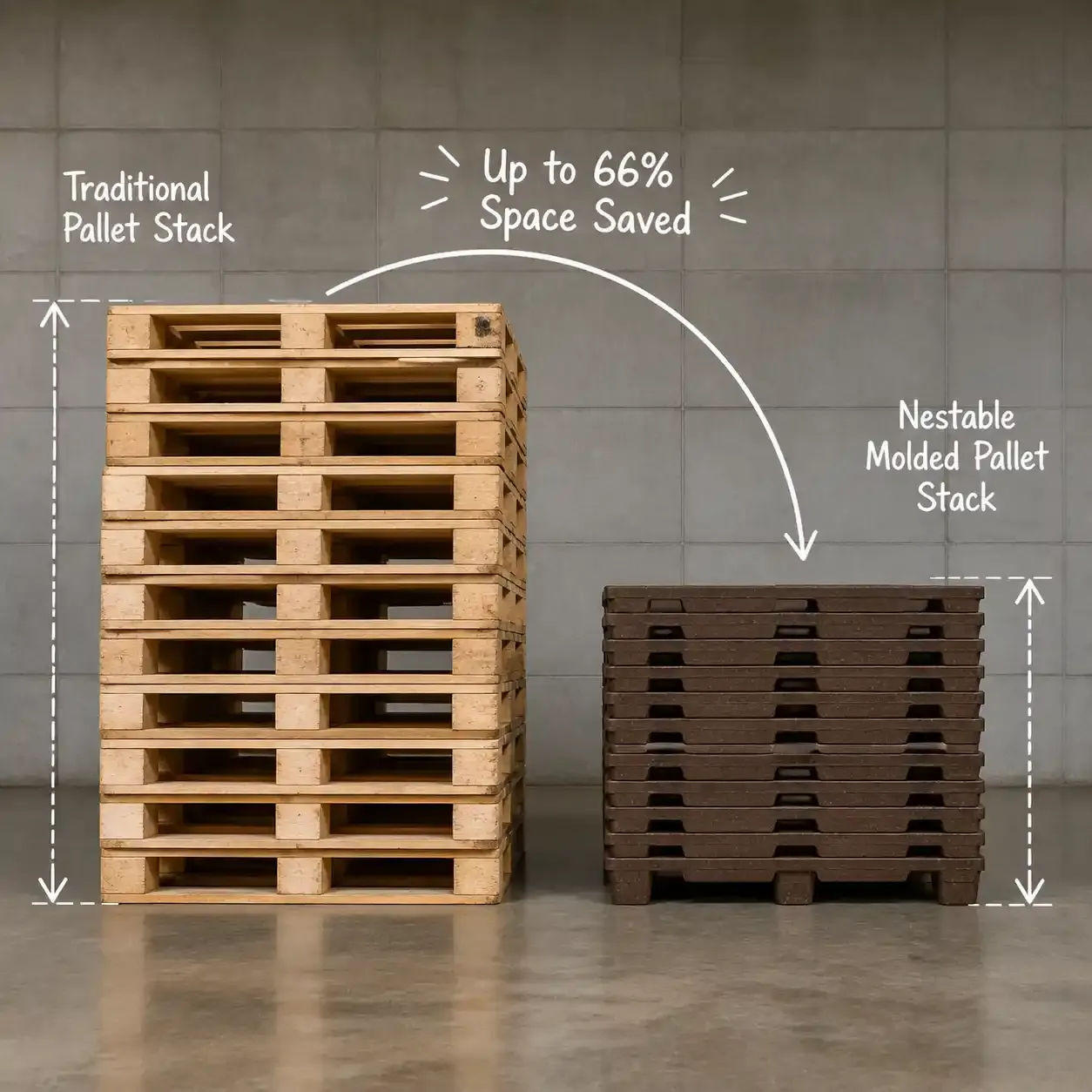
Space efficiency directly impacts freight costs. The molded pallet's nestable design achieves a 4-to-1 space-saving ratio. A stack of 50 molded pallets measures approximately 1.7 meters high, compared to over 7 meters for the same number of traditional wooden pallets. This saves up to 70 percent in storage space.
Container loading density is equally impressive. A standard 40-foot container can hold approximately 1,650 molded pallets, delivering a 260 percent increase in transport efficiency.
Particleboard pallets are generally non-nestable. They consume warehouse space and reduce container loading density. For exporters shipping large volumes, this space inefficiency translates directly to higher freight costs per unit.
Total Cost of Ownership: Which Pallet Delivers Better Value?
Total cost of ownership – not just upfront price – determines real value. The molded pallet delivers substantial savings across multiple dimensions.
The molded pallet eliminates fumigation fees of $5 to $25 per pallet per shipment. Its nestable design reduces warehouse space requirements by 70 percent. Its lower breakage rate – below 5 percent compared to 20 to 30 percent for traditional pallets – dramatically reduces replacement costs. Its MDI resin construction prevents moisture damage that would destroy particleboard pallets. Long-term use of molded pallets can reduce logistics costs by over 15 percent.
Particleboard pallets carry hidden costs. Their UF adhesive breaks down in humid conditions. Their assembled construction with nails creates product damage risks. Their non-nestable design wastes warehouse space. For one-way export shipments where pallets are not returned, the molded pallet offers superior value.
Leading molded pallet manufacturers – such as Litco International, Shandong Yunwang, and Anhui Lituo – have refined the technology to deliver exceptional performance at competitive prices. As one molded pallet manufacturer notes, molded pallets are "durable enough to be reused and inexpensive enough to be expendable, making them ideal for return and reuse programs where pallet loss is difficult to manage".
Conclusion: The Molded Pallet Is the Superior Export Choice
The evidence is clear. While both the molded pallet and particleboard pallet are engineered wood alternatives to traditional lumber pallets, the molded pallet delivers superior performance across every critical dimension for export shipping.
The molded pallet offers higher load capacity – up to 8 tons static and 2.5 tons dynamic. It provides exceptional moisture resistance through MDI resin technology. Its one-piece construction eliminates nails and failure points. Its nestable design saves 70 percent in warehouse space and increases container density by 260 percent. Its permanent ISPM 15 exemption ensures simple customs clearance. And its lower total cost of ownership delivers substantial long-term savings.
Particleboard pallets, while lower in upfront cost for some applications, cannot match the molded pallet's strength, durability, moisture resistance, or space efficiency. For exporters shipping heavy loads through demanding ocean environments, the molded pallet is the engineered wood pallet that delivers.
The technology is proven, the data is clear, and the savings are substantial. For exporters seeking a reliable, cost-effective, and export-ready pallet solution, the molded pallet is the superior choice.


