
Humidity is the silent destroyer of export logistics. A container crossing the equator can experience internal temperatures exceeding 60°C and relative humidity near saturation. The “container rain” phenomenon—condensation dripping from container ceilings onto cargo—is a well-documented cause of damaged goods, mold outbreaks, and rejected shipments. For exporters shipping through Southeast Asia, the Gulf of Mexico, or tropical sea routes, the pallet beneath the cargo must survive weeks of relentless moisture exposure without losing structural integrity.
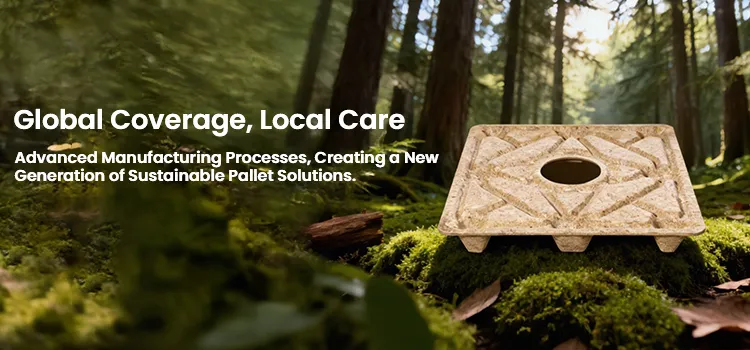
Two pallet types dominate the moisture-resistant category: fumigation-free molded pallets and plastic pallets. The molded pallet is manufactured from recycled wood fibers bonded with MDI resin under extreme heat and pressure. Plastic pallets are injection-molded from HDPE or PP. Both are ISPM 15 exempt. Both resist water. But their long-term performance in humid conditions diverges sharply. This article compares them across five critical dimensions to determine which truly lasts longer when moisture is the enemy.
The Moisture Absorption Mechanism: Low Baseline vs. Zero Absorption
The starting point for any humidity comparison is how each material interacts with water at the molecular level.
A molded pallet begins with a significant advantage: its moisture content after manufacturing is exceptionally low. The high-temperature pressing process—typically 180°C to 220°C—drives residual moisture down to 6 to 8 percent, compared to 12 to 18 percent for traditional wood pallets. This low baseline means the pallet starts dry and stays dry longer. More importantly, the MDI adhesive used in premium molded pallets reacts chemically with the wood fibers to form an irreversible polyurethane molecular chain. This cross-linked structure creates what manufacturers describe as a triple waterproof barrier. In controlled submersion testing, presswood pallets absorbed only 5 to 7 percent additional moisture after 24 hours in water, compared to 20 to 30 percent for untreated wooden pallets.
Plastic pallets, made from HDPE or PP, are inherently hydrophobic. Water molecules cannot penetrate the polymer matrix. On paper, this gives plastic a theoretical edge: zero absorption. However, this advantage is undermined by a critical weakness. Plastic pallets do not absorb water—but they can trap it. A hollow or ribbed plastic pallet design can accumulate condensation inside structural cavities, creating persistent damp pockets that promote mold growth on the cargo above, even if the pallet itself remains intact. Solid, one-piece plastic pallets avoid this trap but command significantly higher prices.
For the molded pallet, the low moisture content and MDI bonding create a self-sealing surface that resists both absorption and surface wetting. For the plastic pallet, moisture resistance is absolute but comes with design caveats.
Structural Stability Under Humidity: Rigidity vs. Flex
The ability to maintain dimensional stability under humid conditions is where the molded pallet pulls decisively ahead.
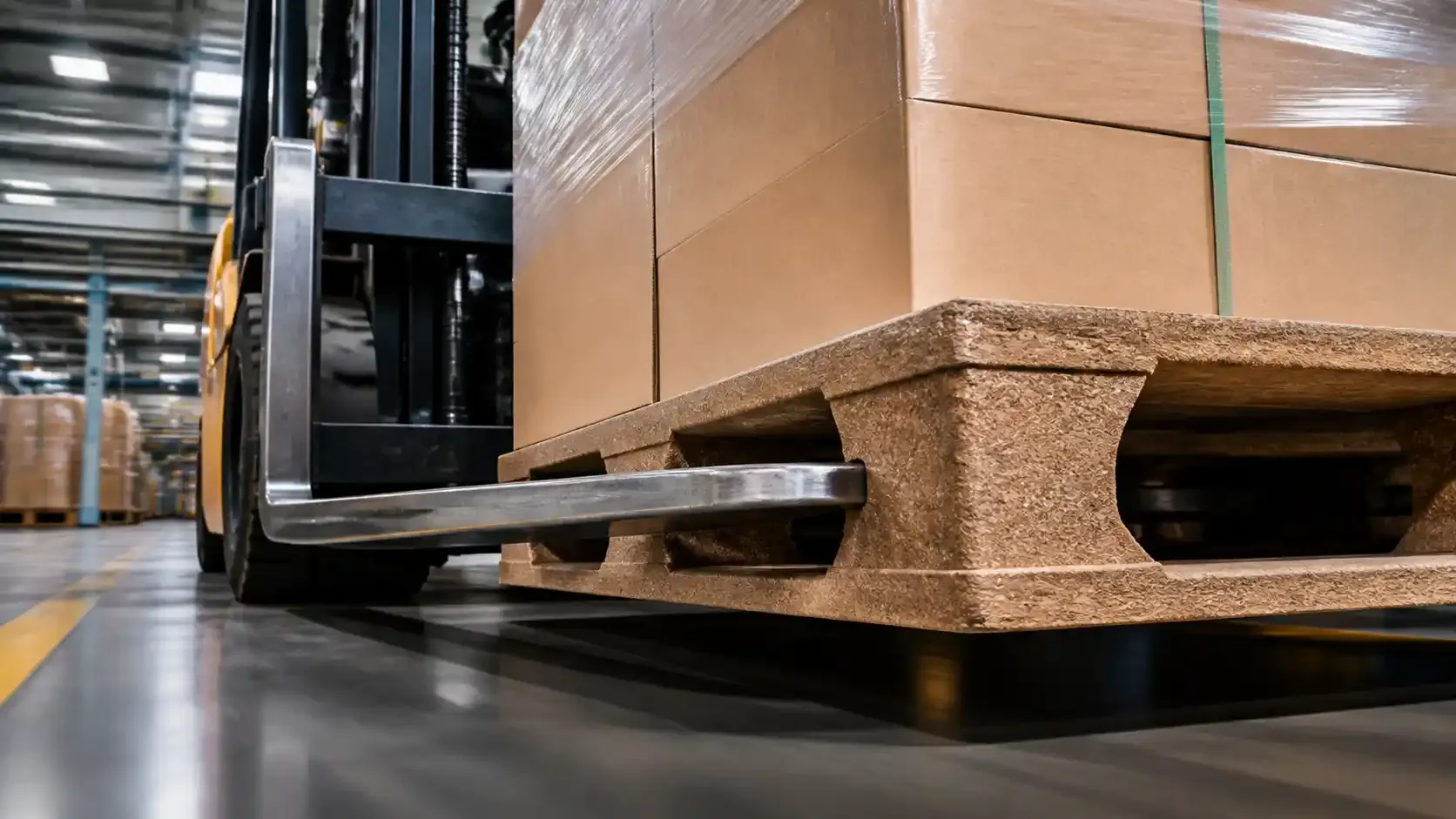
MDI-bonded molded pallets are notably stiffer than plastic alternatives of comparable load ratings. Independent testing has confirmed that presswood pallets are approximately twice as stiff as new and repaired GMA-style wood pallets, and industry sources consistently report that molded pallets are stiffer than nestable plastic pallets. This rigidity is not merely a comfort feature—it is a functional requirement for humid environments. A pallet that flexes under load in a damp container can shift cargo, stress packaging, and increase the risk of load collapse during forklift handling.
Plastic pallets, particularly those made from recycled material or with hollow structural designs, can exhibit greater flex under load, especially as temperatures rise. In high-humidity conditions accompanied by temperature fluctuations, the polymer chains in some plastic pallets can begin to relax, reducing rigidity. This effect is more pronounced in lower-grade plastics and less so in premium virgin HDPE designs.
The molded pallet’s one-piece, high-density construction—achieving densities up to 1.3 g/cm³—maintains its shape and load-bearing geometry regardless of ambient humidity. A plastic pallet may match this stiffness when new and solid-molded, but its performance is more sensitive to material grade and design quality.
Long-Term Aging: Water-Induced Degradation vs. Dimensional Stability
The critical question for “lasting longer” is not performance on day one, but performance after months or years of humid exposure. Here, the molded pallet demonstrates a fundamental advantage rooted in its material chemistry.
Molded pallets are thermoset composites. The MDI resin cures into an irreversible cross-linked network that does not soften, swell, or degrade when exposed to moisture. The wood fibers are encapsulated and bonded, preventing the fiber swelling that destroys traditional wood pallets. Field data from manufacturers shipping to high-humidity regions such as Southeast Asia and South America reports zero structural failure across extended periods. The expected service life of a quality molded pallet in humid warehouse or export conditions is three to five years.
Plastic pallets face a different long-term challenge: water-induced aging. While the polymer does not absorb water, prolonged exposure to humidity combined with temperature fluctuations and trace UV radiation can accelerate molecular chain scission. The surface loses gloss, becomes brittle, and impact resistance declines. Micro-cracks that develop from handling impacts become pathways for moisture ingress, further accelerating crack propagation. This “water-induced aging” phenomenon is especially pronounced in plastic pallets made from recycled feedstock, which may contain contaminants that act as weak points. Some lower-grade plastic pallets can embrittle within two to three years in demanding humid environments, even though the material itself never absorbs water.
The molded pallet’s thermoset structure is immune to this degradation pathway. Its failure mode, if any, is mechanical wear or impact fracture—not humidity-induced chemical breakdown.
Mold and Biological Resistance: Dry Baseline vs. Surface Condensation
For exporters shipping food, pharmaceuticals, or agricultural products, mold growth on the pallet is a compliance and quality disaster. Mold requires moisture and organic nutrients. The molded pallet addresses both.
Its moisture content of 6 to 8 percent is below the threshold required for mold spore germination, which typically needs sustained moisture levels above 15 to 20 percent. The MDI-bonded surface is non-porous and hydrophobic, preventing the formation of the damp microenvironments where mold thrives. Even under 90 percent relative humidity, molded pallets resist fungal growth because there is simply no accessible moisture within the material to support it.
Plastic pallets do not support mold growth on their own surface—plastic is not a nutrient source. However, the design of many plastic pallets creates a different problem. Grid-deck or ribbed plastic pallets have open surfaces that allow condensation to pool in recesses. If that condensation contacts organic debris—dust, wood particles, or spilled product—mold can colonize the pallet surface. In sealed containers where airflow is minimal, this surface mold can spread to packaging and compromise cargo. Solid-deck plastic pallets reduce this risk but at a higher cost.
For hygiene-critical exports, the molded pallet’s low-moisture, non-nutrient surface offers more reliable mold prevention than most plastic pallet designs.
Total Cost and Practical Lifespan in Humid Export Operations
The final comparison is economic: which pallet delivers more usable life per dollar in humid conditions?
A molded pallet typically costs 60 to 70 percent less than a comparable plastic pallet. For one-way export shipments—the dominant use case in humid trade lanes—this cost differential is decisive. A molded pallet that survives one or two humid voyages and then is recycled or disposed of economically still delivers lower total cost than a plastic pallet that must be recovered and returned to justify its price.
For closed-loop operations where pallets are reused hundreds of times, plastic pallets can achieve a lower cost per trip—if they are premium virgin-material designs maintained in controlled conditions. But in humid export environments, where pallets are often not recovered, the molded pallet’s combination of low upfront cost, moisture resistance, and sufficient durability for multiple trips makes it the more practical economic choice.
Some manufacturers position molded pallets as “engineered to perform like plastic—smooth, water-resistant, consistent—but priced as a consumable.” This captures the essential value proposition: the molded pallet delivers the moisture resistance and dimensional stability that exporters need, without the capital cost and recovery logistics burden of plastic.
Conclusion: The Molded Pallet Outlasts Plastic in Humid Export Conditions
For exporters shipping through humid climates and long ocean routes, the fumigation-free molded pallet offers superior long-term performance. Its MDI-bonded structure resists moisture absorption at the molecular level, maintaining structural integrity where plastic pallets may embrittle over time. Its low moisture content prevents mold growth. Its exceptional stiffness ensures load stability even in damp, temperature-fluctuating containers. And its low cost makes it economically viable for one-way export shipments where plastic pallets would be too expensive to discard.
Plastic pallets remain a viable choice for closed-loop systems in controlled environments, particularly where extreme hygiene standards demand a non-porous, non-organic surface. But for the majority of humid export applications, the molded pallet delivers a better balance of moisture resistance, durability, and cost.
The technology is proven. The material science is sound. For exporters facing humidity as a constant adversary, the molded pallet is the pallet that lasts.


