
For exporters, ISPM 15 fumigation is a stubborn and expensive reality. Every solid wood pallet crossing an international border must be heat-treated or chemically fumigated to eliminate pests. This requirement adds days to every shipment, costs money for treatment and certificates, and creates customs risk when stamps fade or paperwork goes missing. The molded pallet offers a permanent escape from this cycle. Because it is manufactured from recycled wood fibers under extreme heat and pressure, the molded pallet is classified as processed wood and falls outside the scope of ISPM 15. Leading molded pallet manufacturers have refined this technology to deliver fumigation-free molded pallets that clear customs without treatment, certificates, or delays. This article explains how the molded wood pallet eliminates ISPM 15 fumigation and why that saves both time and money.
The Manufacturing Process That Sterilizes the Pallet
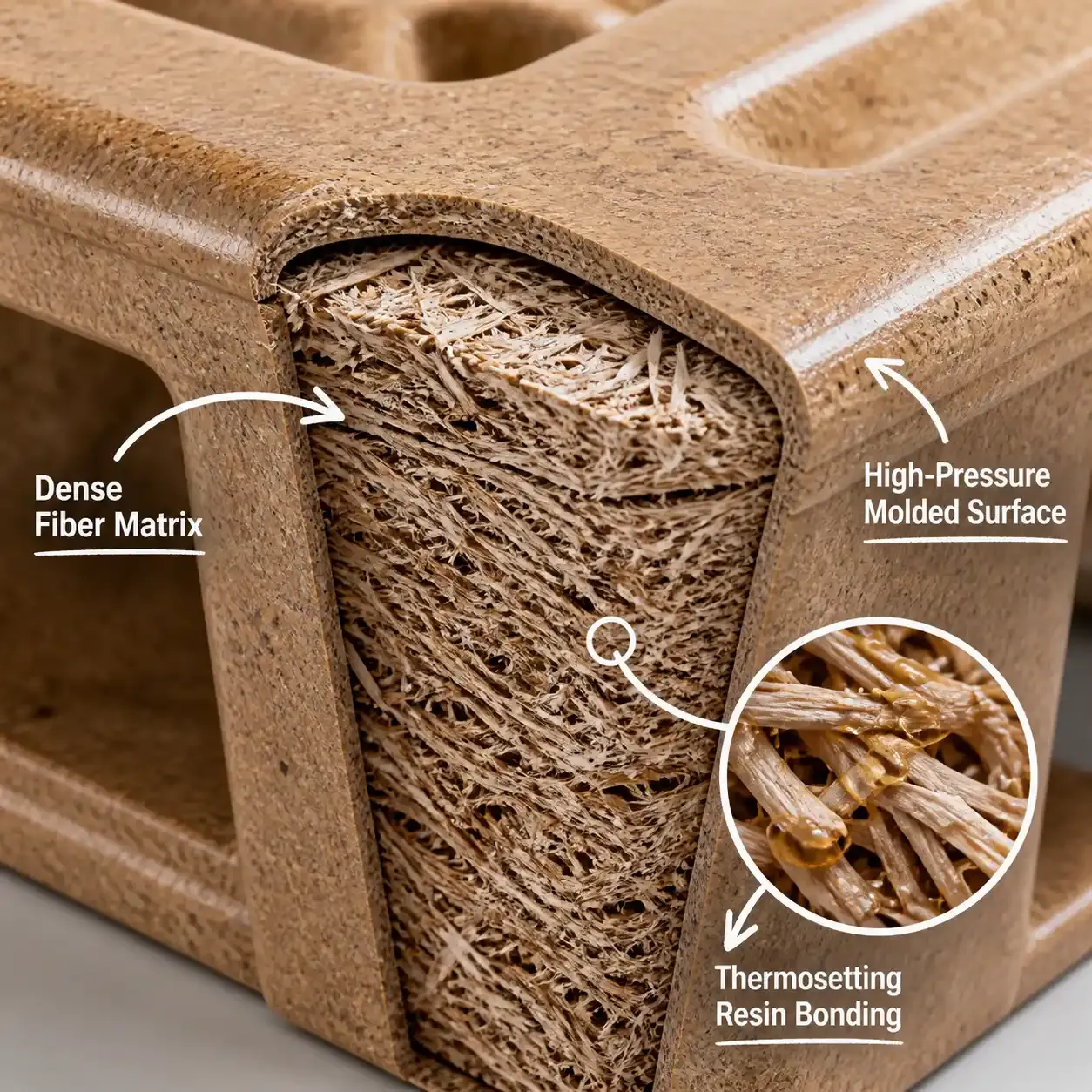
The foundation of ISPM 15 exemption is the manufacturing process itself. A molded pallet is produced by mixing wood fibers, sawdust, and agricultural residues with a resin binder, then pressing the mixture into a precision mold. The process applies temperatures of 180°C to 220°C and pressure of 1,000 to 1,600 tons. This extreme heat and pressure do more than shape the pallet—they sterilize it completely. Insects, larvae, eggs, fungi, and pathogens are destroyed during the molding cycle. Unlike traditional wood pallets that harbor pests in bark, knots, and voids, the molded wood pallet is homogenous and biologically inert. A molded pallet manufacturer that controls temperature and pressure consistently produces a platform that is permanently free of pest risk. This is why fumigation-free molded pallets are not merely treated—they are inherently exempt.
The Legal Basis for Permanent ISPM 15 Exemption
The International Plant Protection Convention defines ISPM 15 as applying to solid wood packaging material. Processed wood—material that has been glued, heated, pressurized, or otherwise transformed—is explicitly excluded. Because the molded pallet is manufactured under heat and pressure with resin, it meets this definition of processed wood. It is not raw lumber. It is an engineered composite. Customs authorities in the European Union, United States, Canada, Australia, Japan, South Korea, and most other major markets recognize this classification. A molded pallet requires no fumigation, no heat treatment, and no IPPC stamp. For an export pallet, this means the compliance burden disappears entirely. The molded pallet manufacturer provides a Material Declaration, and the shipment clears customs as processed wood. There is no certificate to expire, no stamp to fade, and no treatment record to track.
Saving Time: Faster Clearance and Zero Treatment Delays
Time is money in export logistics. Traditional fumigation adds one to three days to every shipment, and during peak season the delay can stretch to a week. Treatment scheduling, transport to and from the fumigation facility, and waiting for certificates all consume hours that could be spent moving cargo. Fumigation-free molded pallets eliminate these delays. Because the molded pallet is exempt, there is no treatment step. No waiting for fumigation. No certificate to collect. No inspection hold over a missing stamp. Pressed wood pallet shipments achieve clearance rates above 99 percent with processing times measured in minutes, compared to days for traditional wood pallets. For urgent export orders, this speed advantage can be the difference between meeting a deadline and losing a contract. A reliable molded pallet manufacturer ships the pallets ready to load, and the export pallet moves directly from factory to container without interruption.
Saving Money: Eliminating Fumigation Fees and Hidden Costs
The direct cost of fumigation is substantial. Treatment fees range from $5 to $25 per pallet per shipment, and for an exporter shipping 5,000 pallets annually, that adds up to $25,000 or more every year. But the hidden costs are often larger. Demurrage fees from customs delays can exceed $1,000 per day. Administrative overhead for managing treatment certificates adds labor hours. Product damage from protruding nails on traditional pallets generates claims and replacements. The molded wood pallet eliminates all these costs. Fumigation fees disappear. Customs delay costs vanish. Certificate management becomes unnecessary. The one-piece, nail-free construction of the molded pallet prevents cargo damage, reducing claims. A molded pallet manufacturer can provide a total cost of ownership analysis showing savings that typically exceed the initial price difference. For exporters, the molded pallet is not just a compliant choice—it is the lower-cost choice.
Global Acceptance and Supply Chain Reliability
Uncertainty is the enemy of reliable export logistics. A pallet that clears customs in one country may face questions in another. Traditional wooden pallets are subject to inspection rates of approximately 22 percent, and clearance can be delayed by a single faded stamp. Fumigation-free molded pallets are accepted globally as processed wood. Inspection rates are below one percent, and customs processing is routine. The molded pallet manufacturer can supply documentation tailored to each destination, including Material Declarations and, where required, non-wood packaging declarations. This global consistency makes the molded pallet the preferred export pallet for supply chains that cannot tolerate surprises. Whether shipping to Hamburg, Tokyo, Sydney, or Los Angeles, the molded pallet clears customs without fumigation and without delay.
Conclusion: The Permanent Solution to ISPM 15
The molded pallet eliminates ISPM 15 fumigation not by treating wood, but by transforming it. The high-temperature, high-pressure manufacturing process sterilizes the material, and the resulting processed wood classification provides permanent exemption. Fumigation-free molded pallets save time by removing treatment delays, and they save money by eliminating fees, demurrage, and administrative overhead. They clear customs globally with minimal inspection and maximum reliability. For exporters seeking an export pallet that simplifies compliance and reduces costs, the molded wood pallet from a qualified molded pallet manufacturer is the permanent solution. The technology is proven, the savings are documented, and the time to switch is now.


