

Urgent export orders leave no margin for procurement delays. A customer confirms a purchase order, a container is booked, and the loading date is fixed. If the pallets are not on the dock when the truck arrives, the container sails empty or the shipment is postponed. In either case, the cost is immediate: demurrage, missed delivery windows, and damaged customer relationships.
Traditional wooden pallets are poorly suited to this scenario. Every order requires ISPM 15 heat treatment or fumigation, and treatment schedules add days that urgent shipments cannot spare. The molded pallet changes this equation. A fumigation-free molded pallet is ready to load as soon as it is produced, and leading molded pallet manufacturers maintain stock in regional warehouses to serve urgent export orders. This article examines five practical dimensions of stock availability and fast delivery for molded pallets, from regional warehousing and compliance simplicity to logistics coordination and supplier selection.
The Treatment Bottleneck That Stops Urgent Shipments
The first reason molded pallets are suited to urgent export orders is that they eliminate the treatment bottleneck. Traditional solid wood pallets must be heat-treated or fumigated before they can cross an international border. This treatment is not instantaneous. Scheduling, transport to and from the treatment facility, and waiting for the certificate add two to three days to every order, and during peak season the queue can stretch to a week.
A molded wood pallet requires no treatment. The manufacturing process subjects the fiber to temperatures of 180°C to 220°C, sterilizing the material and classifying the pallet as processed wood under ISPM 15. The fumigation-free molded pallets are ready to load directly from the factory or warehouse. For an urgent export order, this removes the single most unpredictable step in the pallet supply chain. A molded pallet manufacturer that holds stock of standard sizes can dispatch pallets the same day, allowing the exporter to meet a container booking that would otherwise have to be postponed.
Stock Availability from Regional Warehouses
The second dimension is stock availability. A molded pallet manufacturer that produces only to order cannot serve urgent demand, regardless of how fast its production line runs. The solution is regional warehousing: holding inventory of fast-moving sizes close to the customers who need them.
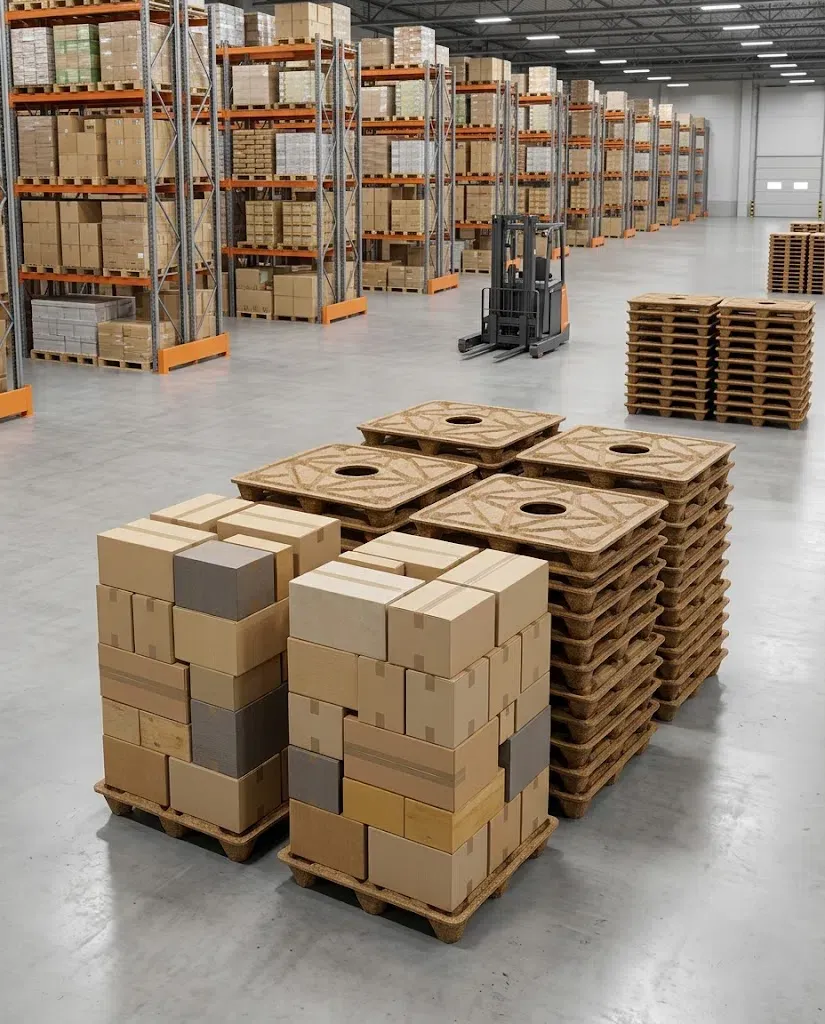
Leading molded pallet manufacturers maintain stock of standard dimensions—Euro format, GMA standard, Asia-Pacific square, and industrial 1200 by 1000 millimeter—in warehouses positioned near major export hubs. When an urgent order arrives, the pallets are picked from stock and delivered within days rather than weeks. This model is particularly valuable for SMEs and exporters who cannot forecast demand precisely enough to place forward orders.
The stock availability advantage extends beyond the pallet itself. A molded pallet manufacturer that holds inventory can also supply the export documentation package—Material Declaration and exemption statement—as standard files, so the buyer is not waiting for paperwork while the container is already at the dock. For the urgent export pallet order, the combination of physical stock and ready documentation is what makes fast delivery possible.
Fumigation-Free Compliance Eliminates Waiting
The third dimension is the compliance path. Fumigation-free molded pallets do not require a treatment certificate, an IPPC stamp, or a phytosanitary inspection before shipment. The exemption is based on the material classification—processed wood—and the supporting documentation is a Material Declaration and an exemption statement.
This simplicity has a direct effect on delivery speed. There is no treatment facility to schedule, no certificate to wait for, and no stamp to verify. The molded pallet is ready to ship as soon as it is packed. For an urgent export order, this removes the compliance step that most often causes delay. The export pallet clears customs as processed wood, and the shipment moves without the inspection holds that can affect solid wood packaging. A molded pallet manufacturer that understands this documentation path can supply the right files with the pallets, so the buyer is not assembling paperwork at the last minute.
Fast Logistics and Order Fulfillment
The fourth dimension is logistics coordination. Stock availability and compliance simplicity are necessary but not sufficient. The pallets must physically reach the exporter’s dock in time for loading.
Molded pallet manufacturers serving urgent orders have adapted their logistics in three ways. First, they offer expedited dispatch from regional stock, with delivery in days rather than weeks. Second, they support mixed orders, allowing the buyer to combine several pallet sizes or configurations in one shipment without waiting for a full production run of each. Third, they provide shipment tracking and proactive communication, so the exporter knows when the pallets will arrive and can plan container loading accordingly.
The nestable design of the molded wood pallet also helps. Empty pallets stack compactly, so a large urgent order can be delivered in fewer trucks and stored in less space at the exporter’s facility. When the container is ready, the pallets are already on site, nested and accessible. For an urgent export order, this physical efficiency reduces the risk of a last-minute shortage or handling delay.
Customization Without the Tooling Delay
The fifth dimension is customization. Urgent orders sometimes require a non-standard pallet size or configuration, and traditional tooling timelines can make this impossible. A new mold can take weeks to design, machine, and validate.
Molded pallet manufacturers have addressed this through modular tooling and existing mold libraries. Many standard regional sizes are available from existing molds without tooling time. For limited modifications—deck texture, entry configuration, fork opening dimensions, or branding—modular mold systems allow changes without building a new mold. When a genuinely custom size is required, some manufacturers offer shared mold arrangements that reduce the tooling lead time and cost.
For the urgent export pallet buyer, the practical rule is to prioritize standard sizes from stock whenever possible, and to reserve custom dimensions for orders with sufficient lead time. A molded pallet manufacturer that is transparent about tooling timelines helps the buyer make this trade-off realistically rather than promising a delivery date that cannot be met. The fumigation-free molded pallet remains the faster option in almost every scenario, but customization should be planned rather than rushed.
Conclusion: Urgent Orders Need Stock, Not Promises
Urgent export orders are won or lost on availability. A pallet that is compliant but not in stock cannot load a container. A molded pallet that is in stock but undocumented cannot clear customs. The molded pallet manufacturers that serve urgent demand combine three capabilities: regional stock of standard sizes, a simple fumigation-free compliance path with ready documentation, and logistics that deliver on short notice.
For exporters, the practical checklist is straightforward. Confirm which sizes the molded pallet manufacturer holds in regional stock. Ask for the standard export documentation package and verify that it covers the specific product. Check lead times for delivery from stock versus production. Inquire about mixed orders and expedited dispatch. And confirm that the supplier can support customization without extending the timeline beyond the container booking.
The molded wood pallet is already the preferred export pallet for its ISPM 15 exemption, nestable design, and durability. When combined with stock availability and fast delivery, it becomes the pallet that keeps urgent export orders on schedule. The technology is proven, the logistics are established, and the suppliers are ready. For exporters facing tight deadlines, fumigation-free molded pallets are not just a compliant choice—they are the choice that arrives on time.


