

Export cargo rarely fails because of a single dramatic event. It fails quietly, over weeks, as humidity cycles inside a container push a pallet past the limit of what its material can tolerate. Condensation drips from container ceilings, loading docks transfer moisture into the pallet deck, and refrigerated transit subjects the platform to repeated freeze-thaw cycles. When the pallet loses stiffness, the unit load sags, packaging compresses, and the shipment arrives rejected or damaged.
Two lightweight export platforms are often compared for moisture performance: the molded pallet, manufactured from wood fiber and resin under heat and pressure, and the honeycomb pallet, built from a paper honeycomb core laminated between paper facings. Both are ISPM 15 exempt, both reduce freight weight, and both are marketed as alternatives to solid wood. But their behavior in humid conditions is fundamentally different. This comparison examines five dimensions of moisture performance to determine which platform protects export cargo more reliably.
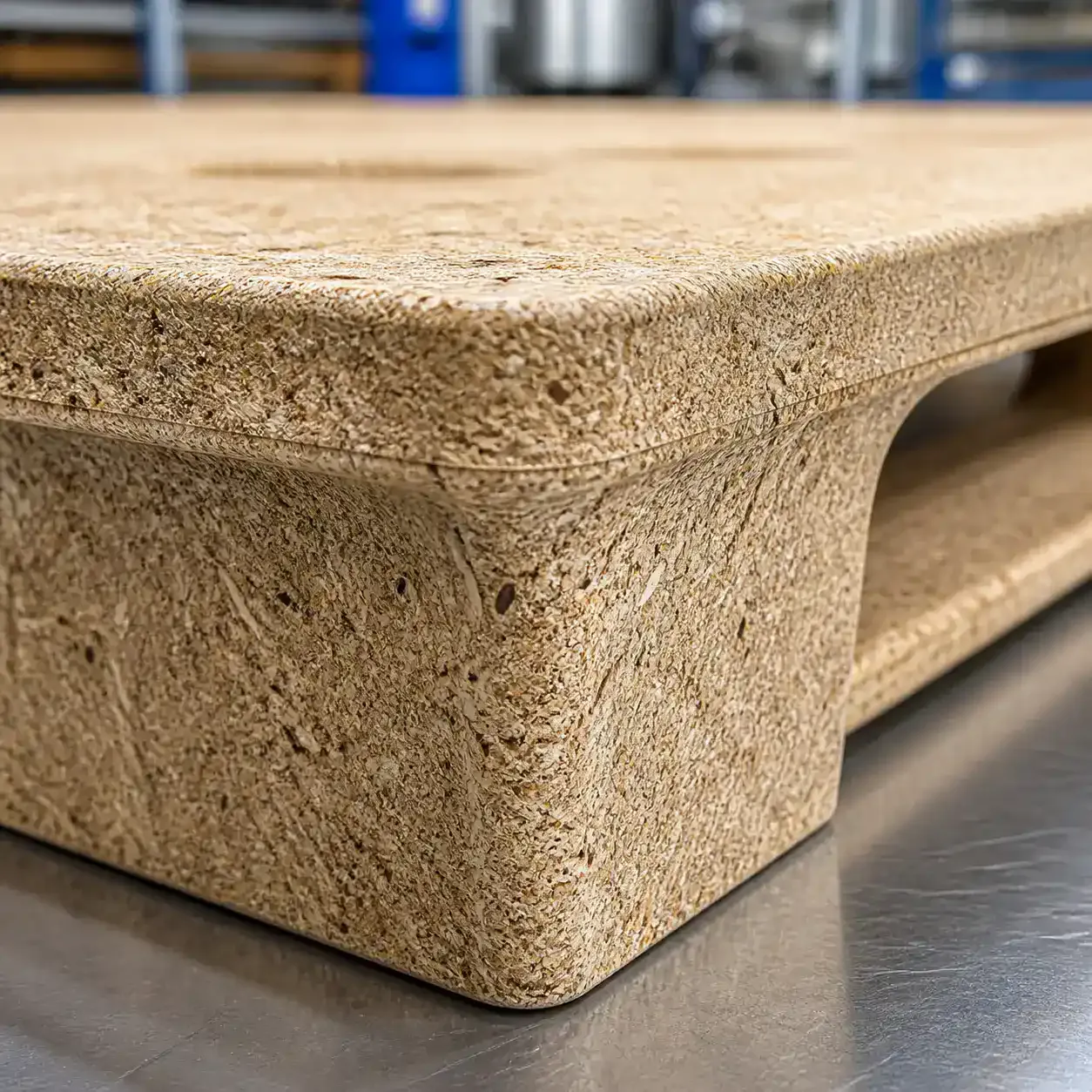
Material Structure and Moisture Absorption Mechanism
The moisture performance of any pallet begins with its material architecture. A molded wood pallet is a dense, one-piece composite. Wood fibers are bonded with MDI resin under temperatures of 180°C to 220°C and pressures up to 1,600 tons, producing a homogeneous deck with no laminations or open cells. The manufacturing process drives residual moisture down to a guaranteed 6% to 8%, compared with up to 22% for dried wooden pallets. More importantly, MDI reacts with the wood fiber to form a polyurea cross-linked structure with strong water resistance, giving the molded pallet what manufacturers describe as excellent waterproof and moisture-proof performance.
A honeycomb paper pallet is an assembly, not a monolith. A kraft paper honeycomb core is laminated between paper sheets to form the deck, with paper or fiber legs underneath. Its primary material is cellulose, and cellulose is hydrophilic by nature. The hydroxyl groups in paper fibers readily form hydrogen bonds with atmospheric water molecules, causing the fibers to swell and the bonds between them to weaken. Some honeycomb grades add moisture-resistant coatings for chilled or humid conditions, but these coatings are a surface treatment, not a structural property of the core.
The structural difference matters because it determines how each pallet responds to humidity. The molded pallet resists water penetration through its cross-linked chemistry. The honeycomb pallet absorbs water into its core, and once moisture enters the honeycomb cells, it is difficult to remove.
Moisture Content and Dimensional Stability Under Humidity
The second dimension is dimensional stability—whether the pallet maintains its geometry as ambient humidity rises. This is critical for automated handling, rack alignment, and stable stacking.
The molded pallet starts dry and stays dimensionally consistent. Its low initial moisture content means it does not release moisture into packaged goods, and its MDI-bonded structure resists warping even in high-humidity environments above 90% relative humidity. Cold-chain testing confirms that molded pallets maintain structural integrity through condensation cycles and do not support mold growth. The dense, closed structure does not swell appreciably when exposed to humid air, so the pallet’s footprint and fork-entry dimensions remain within tolerance.
Honeycomb paper pallets face a different reality. When relative humidity rises, paper fibers swell and the core softens. In an environment with relative humidity greater than 80%, honeycomb paperboard easily absorbs moisture, and its mechanical properties deteriorate rapidly. Field data from humid export conditions shows that when ambient relative humidity exceeds 75%, uncoated honeycomb cores can absorb 12% to 15% moisture within 48 hours, causing the core layer to soften and support capacity to plummet. This swelling does not merely reduce strength—it changes the pallet’s dimensions, creating misalignment in automated systems and instability in stacked loads.
Load-Bearing Capacity and Strength Loss in High Humidity
The third and most consequential dimension is what happens to load capacity when humidity rises. A pallet that carries two tons in a dry warehouse may carry far less inside a humid container.
The molded pallet retains its load-bearing performance in humid conditions. MDI-bonded molded wood pallets maintain static load capacity even in high-humidity environments above 90% relative humidity, and they are described by suppliers as fully waterproof under humidity, cold-chain, and fumigation conditions. The cross-linked polyurethane structure does not soften when wet, unlike urea-formaldehyde-bonded pallets that lose strength with moisture exposure. For heavy export cargo, this stability is the difference between a safe unit load and a collapsed stack.
Honeycomb paper pallets experience severe strength loss as humidity rises. When paper moisture content increases from 6% to 12%, compressive strength can drop by more than 30%; in high-humidity environments near 90% relative humidity, strength loss can exceed 50%. Uncoated fiber loses roughly 45% of its compression strength at 85% relative humidity—a condition that is routine inside an ocean container and in humid warehouses during summer. At 80% relative humidity, strength begins to decline sharply, and at 95% relative humidity combined with elevated temperature, compressive strength can fall by more than 60%, causing honeycomb pallets to collapse. These are not marginal reductions. They are failure-level losses that make honeycomb pallets unsuitable for heavy or high-stack export loads in humid conditions unless heavily coated and carefully protected.
Cold Chain and Condensation Tolerance
The fourth dimension is cold chain performance. Refrigerated and frozen logistics subject pallets to repeated condensation: moisture condenses on cold surfaces when the pallet moves from a freezer to a humid dock, and the cycle repeats at every handoff.
The molded pallet is designed for this environment. Its low moisture content and hydrophobic chemistry mean condensation forms on the surface but does not penetrate the structure. Molded pallets maintain their structural integrity through condensation cycles and are fully waterproof under cold-chain conditions. They do not warp, swell, or support bacterial growth when exposed to the moisture that accumulates in refrigerated warehouses. The stable molecular structure remains functional from minus 50°C to 100°C, so the pallet does not become brittle or deform across the temperature range of cold chain logistics.
Honeycomb paper pallets are poorly suited to cold chain use. Condensation wets the paper surface, and the moisture migrates into the honeycomb core. Once the core is wet, freeze-thaw cycles can cause delamination and structural breakdown. The pallet may dry out between shipments, but repeated wetting and drying degrades the fiber bonds and reduces service life. For exporters shipping temperature-sensitive goods through humid or cold chain routes, this is a reliability risk that no amount of surface coating fully eliminates.
Long-Term Moisture Exposure and Export Compliance Reliability
The fifth dimension is the practical question of how each pallet performs across an export cycle that includes open-air staging, humid port warehouses, and long ocean transit. Moisture exposure is not a brief event—it is a cumulative condition.
The molded pallet tolerates brief wetness and handles the humidity of covered transit without special precautions. Its permanent ISPM 15 exemption as processed wood removes the phytosanitary treatment burden, and its moisture resistance means the pallet does not become a source of mold or contamination that could trigger a customs or quality rejection. For exporters shipping to the European Union, North America, and other regulated markets, this combination of moisture durability and compliance certainty makes the molded wood pallet a reliable platform across repeated shipments.
Honeycomb paper pallets require dry storage and covered transit unless they are specifically coated for moisture resistance. Untreated honeycomb pallets dislike standing water and are vulnerable to prolonged humidity, which limits their use in open-air staging and in tropical or humid export lanes. Coated grades improve performance, but the coating adds cost and does not change the underlying hydrophilicity of the cellulose core. For one-way shipments in controlled dry conditions, honeycomb pallets can be economical. For moisture-exposed export routes, they are a higher-risk choice.
Conclusion: The Molded Pallet Handles Moisture Better
The comparison points to a clear conclusion. The molded pallet, particularly when manufactured with MDI resin, handles moisture more reliably than the honeycomb pallet across every critical dimension. Its cross-linked chemistry resists water penetration rather than absorbing it. Its low initial moisture content and dimensional stability prevent warping and swelling. Its load capacity remains stable at high humidity, while honeycomb paper loses 30% to 60% of its strength under the same conditions. Its cold-chain performance is proven through condensation cycles. And its moisture durability supports repeated export use without the dry-storage restrictions that constrain honeycomb pallets.
Honeycomb pallets retain a role in lightweight, dry, one-way airfreight and e-commerce lanes where every kilogram counts. But for export cargo exposed to humid ports, ocean containers, and cold chain transitions, the molded wood pallet from a qualified molded pallet manufacturer offers the moisture performance that protects both the cargo and the compliance status of the shipment. Moisture is unforgiving, and the pallet that resists it is the one that arrives intact.


